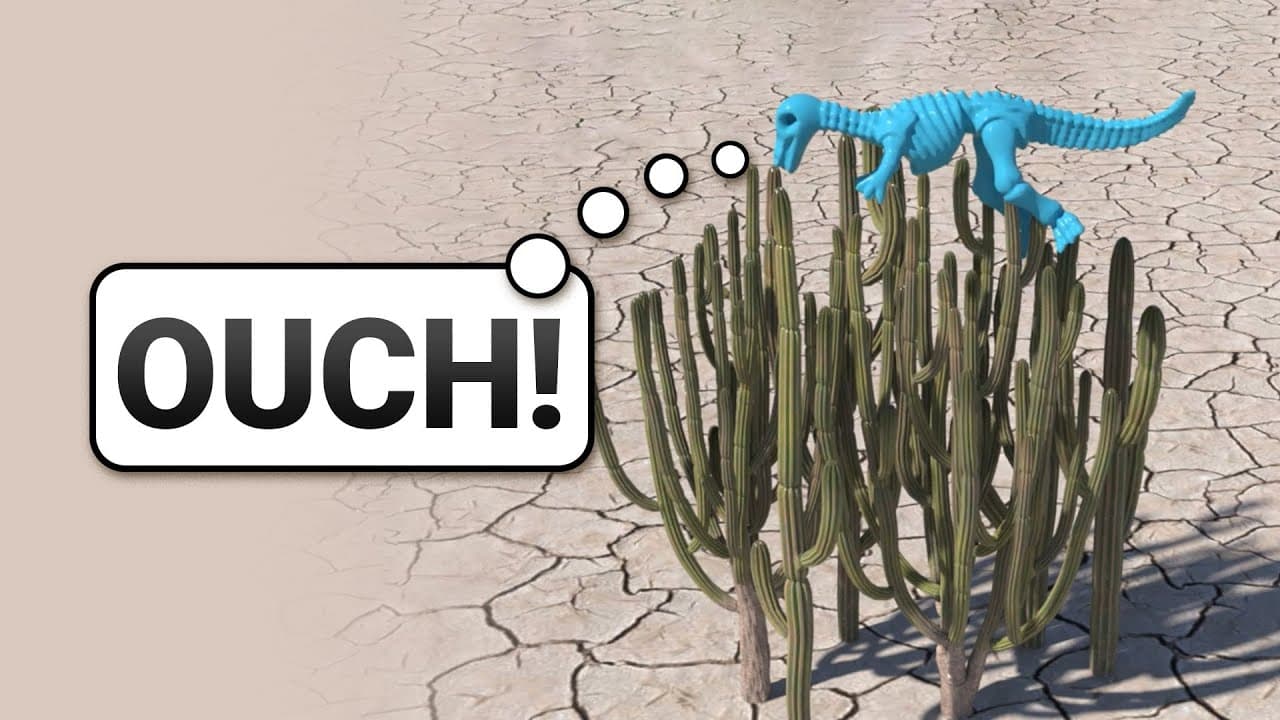
How Can a Virtual Dinosaur Fall Into a Cactus Over 100 Times Faster? 🦖🌵
TL;DR
A new reduced-simulation technique makes elastic-interaction simulations stable and close to the reference while computing them in larger time steps. In a particularly suitable scene, it runs 110 times quicker and reaches seconds per frame; even the furball worst-case scenario is at least 10 to 15 times faster. Read on to see how it prevents instability and penetrations without requiring an all-night computation.
Transcript
Dear Fellow Scholars, this is Two Minute Papers with Dr. Károly Zsolnai-Fehér. Today we are going to do this and this and this on a budget. Today, through the power of computer graphics research works, we can simulate all these amazing elastic interactions. If we are very patient that is, because they take forever to compute. But, if we wish to run... Read More
Key Insights
- 🏑 Simulations of elastic interactions can be computationally expensive but are essential in various fields, including computer graphics.
- 🥺 Increasing the time step size in simulations can lead to instability and inaccurate results.
- 👻 The new technique allows for reduced simulations while maintaining stability and accuracy.
- 👶 The reduced simulations computed with the new technique are difficult to distinguish from the reference simulations.
- 💨 The technique offers a significant speedup of over 100 times faster computations compared to the reference simulations.
- 💨 Complex scenarios, such as furballs, can still benefit from a 10 to 15 times faster computation using the technique.
- 🤗 The new technique opens up possibilities for better simulations in various applications.
Install to Summarize YouTube Videos and Get Transcripts
Explore YouTube Video Summarizer or Get YouTube Transcript Extractor
Questions & Answers
Q: How does the new technique make elastic simulations faster?
It computes a reduced simulation and advances time in larger steps, so the calculation finishes more quickly. In the demonstrated scene, the result was 110 times quicker than the reference simulation.
Q: Why do larger time steps usually reduce simulation accuracy?
Larger time steps advance the simulation in bigger chunks. This can miss important interactions between steps, producing more instability and penetration.
Q: What problems occurred with the previous simulation method?
The previous method had two visible issues: objects remained in motion when they should have come to rest, and elements penetrated one another. Increasing the time-step size made both problems worse.
Q: How does the new method handle instability and penetration?
In the difficult ship-and-rods scene, the new method allowed objects to come to rest and showed no penetrations. It remained stable even after the time-step size was increased.
Q: How close is the reduced simulation to the reference simulation?
The reduced and reference simulations did not look identical, but they appeared close to equivalent. The presenter said he was unsure whether he could distinguish which was the reference and which was the cheaper reduced simulation.
Q: Is the new simulation technique real time?
No, the demonstrated technique is still not real time. However, it operates in the seconds-per-frame range, turning what could require an all-nighter into roughly a coffee-break-length computation for the showcased scene.
Q: Are all scenes more than 100 times faster with the new method?
No, the showcased scene was particularly well suited to the technique and ran 110 times quicker. Other scenes are not typically 100 times faster.
Q: How much faster is the technique in a difficult furball scene?
The furball scenario is described as the worst case for the technique. Even there, the computation is at least 10 to 15 times faster, potentially reducing an all-night simulation to the length of a quick nap.
Summary & Key Takeaways
-
The power of computer graphics research allows for simulating elastic interactions, but these simulations take a long time to compute.
-
Increasing the time step size usually results in simulations that are less accurate and unstable.
-
The new technique presented in the video overcomes these issues, providing stable simulations that are over 100 times faster than the reference simulations.
Read in Other Languages (beta)
Share This Summary 📚
Summarize YouTube Videos and Get Video Transcripts with 1-Click
Try YouTube Summary with ChatGPT & Claude or YouTube Transcript Generator
Explore More Summaries from Two Minute Papers 📚




Summarize YouTube Videos and Get Video Transcripts with 1-Click
Try YouTube Summary with ChatGPT & Claude or YouTube Transcript Generator