E1 Reaction Mechanism With Alcohol Dehydration & Ring Expansion Problems
TL;DR
The video explains the E1 reaction mechanism through example problems, demonstrating how alkyl halides can be converted into alkenes.
Transcript
in this video we're going to focus on the e1 reaction mechanism now let's start with this example problem let's say we have tert butyl bromide and we wish to react it with water and we're going to heat the solution heat in the solution favors the e1 reaction so how can we draw the e1 product for this reaction elimination reactions they produce alke... Read More
Key Insights
- 💁 The E1 reaction mechanism involves the leaving group leaving, carbocation formation, and proton abstraction by a base to form alkenes.
- ❓ Internal alkenes and tetra-substituted alkenes are more stable than terminal and less substituted alkenes, respectively.
- 😋 Rearrangements and ring expansions can occur in E1 reactions to form more stable carbocations and rings.
- 💁 The major E1 product is typically the most stable alkene formed in the reaction.
- 💦 Water can act as a base in the E1 mechanism to abstract a proton and form the alkene.
- ⚾ Concentrated sulfuric acid is commonly used in E1 dehydration reactions as a source of protons or as a weak base.
- 👥 Protonation of alcohol is necessary to convert the hydroxyl group into a good leaving group in E1 reactions.
Install to Summarize YouTube Videos and Get Transcripts
Explore YouTube Video Summarizer or Get YouTube Transcript Extractor
Questions & Answers
Q: How does the E1 reaction mechanism convert alkyl halides into alkenes?
The E1 reaction involves the leaving group leaving, forming a carbocation. Water is then used as a base to abstract a proton, which helps form the pi bond in the alkene.
Q: Why is the trans alkene the major product in the reaction between two bromobutane and water?
Internal alkenes, like trans-2-butene, are more stable than terminal alkenes. In addition, tetra-substituted alkenes are more stable than tri-substituted or disubstituted alkenes, determining the major product.
Q: How is the major E1 product determined in the reaction of a secondary alcohol with sulfuric acid?
The major E1 product is typically the most stable alkene, known as the Zaitsev product. It has the highest number of R groups attached to the double-bonded carbon atoms, in this case, resulting in a tetra-substituted alkene.
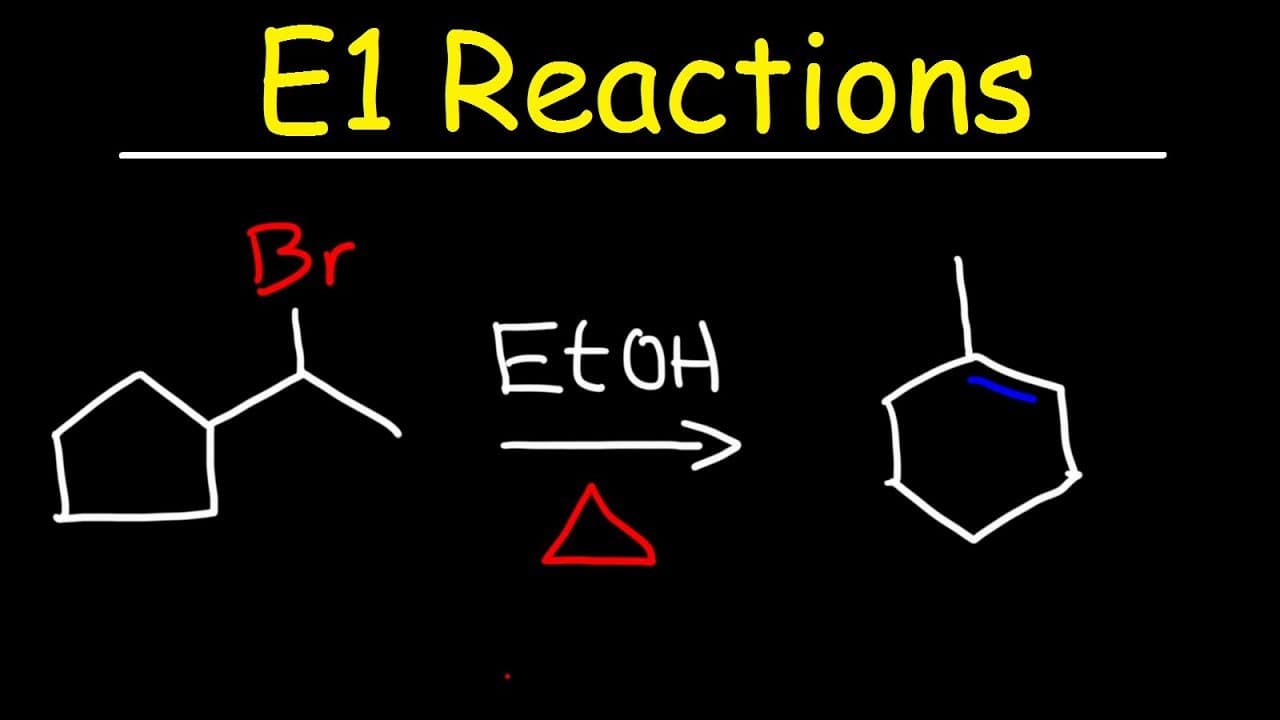
Q: What is the driving force behind the rearrangements and ring expansion in the reaction of a five-carbon ring with ethanol?
The driving force is stability. A six-carbon ring is more stable than a five-carbon ring, prompting the rearrangements and ring expansion to form a more stable carbocation and a ring with no strain.
Summary & Key Takeaways
-
The E1 reaction mechanism involves the leaving group leaving, forming a carbocation intermediate, and using water as a base to abstract a proton and form an alkene.
-
In the case of two bromobutane reacting with water, the major E1 product is the trans-2-butene, while a mixture of cis-2-butene and 1-butene can also be produced.
-
In a reaction between a secondary alcohol and sulfuric acid, the major E1 product is the tetra-substituted alkene, which is the most stable alkene formed.
-
Another example discusses the reaction of an alcohol with sulfuric acid, leading to a ring expansion and the formation of a six-membered ring alkene as the major product.
Read in Other Languages (beta)
Share This Summary 📚
Summarize YouTube Videos and Get Video Transcripts with 1-Click
Try YouTube Summary with ChatGPT & Claude or YouTube Transcript Generator
Explore More Summaries from The Organic Chemistry Tutor 📚





Summarize YouTube Videos and Get Video Transcripts with 1-Click
Try YouTube Summary with ChatGPT & Claude or YouTube Transcript Generator