What Are the Applications of Simulating Repulsive Forces?
TL;DR
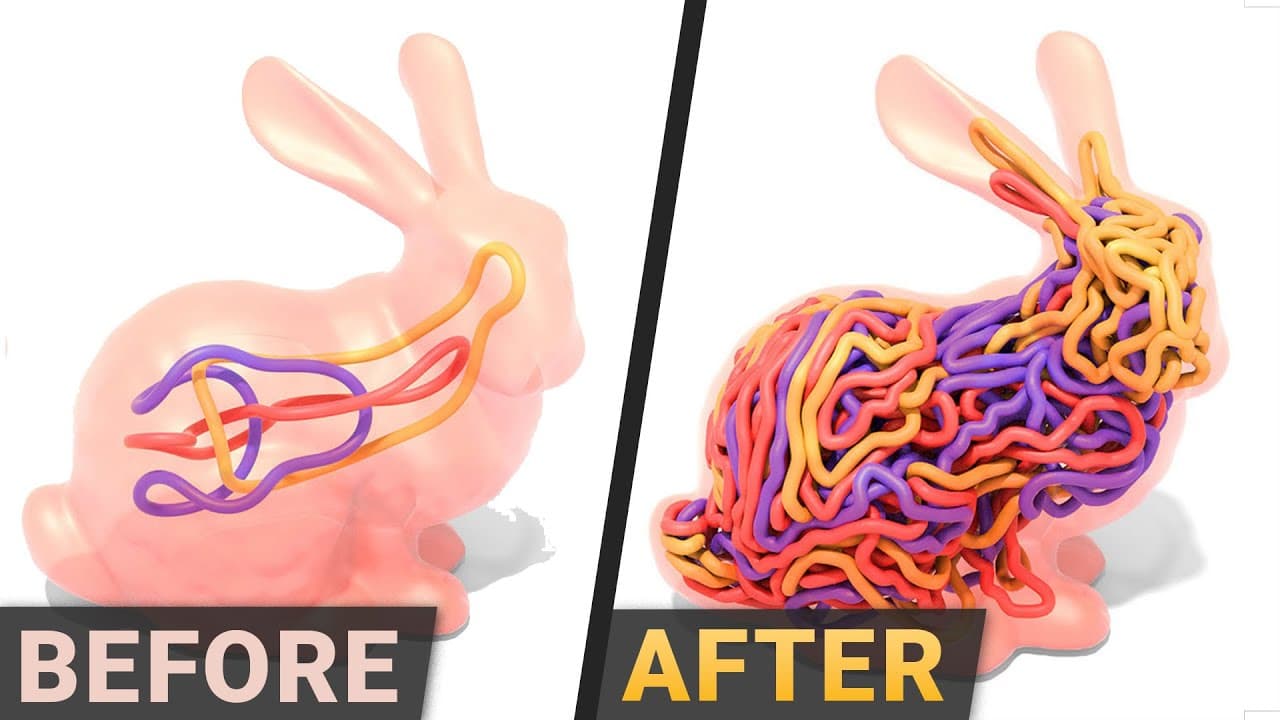
Simulating repulsive forces can untangle complex objects and prevent intersections, making it useful in various fields. Applications range from untangling earbuds and fixing mesh geometries to path planning in virtual environments and visualizing social media connections. The technique allows for innovative solutions in computer graphics by generating clean, non-intersecting paths.
Transcript
Dear Fellow Scholars, this is Two Minute Papers with Dr. Károly Zsolnai-Fehér. Today we are going to learn why you should not even try to handcuff a computer graphics researcher. And it’s not because they are criminal masterminds, no-no! So what is it then? Well, if they have read this paper, handcuffing them will not work. See? They will g... Read More
Key Insights
- 🧡 Simulating repulsion on curves and surfaces has numerous practical applications, ranging from untangling handcuffs to creating art installations.
- 🦡 The repulsive force algorithm can fix bad mesh geometries and generate ideal shrink wrap for objects.
- 😶🌫️ Point cloud reconstruction can be greatly improved using repulsive forces, allowing for accurate 3D geometries even with incomplete data.
- 🤗 Simulating repulsion on curves opens up new possibilities, such as untangling earbuds and path planning for virtual characters.
- 😒 The repulsive force algorithm has potential uses in visualizing social media connections, family trees, and moving muscle fibers.
- ❓ The complexity of the algorithm is highlighted, requiring careful implementation to avoid undesirable outcomes.
- 👨🔬 This video showcases the significance of basic academic research and its potential impact on various fields.
Install to Summarize YouTube Videos and Get Transcripts
Explore YouTube Video Summarizer or Get YouTube Transcript Extractor
Questions & Answers
Q: How does simulating repulsion on curves and surfaces prevent intersections and collisions?
Simulating repulsion can create forces that push curves and surfaces apart, preventing them from intersecting or colliding with each other. This technique ensures that objects remain separate and do not overlap.
Q: Can the repulsive force algorithm be used to untangle objects like handcuffs?
Yes, the repulsive force algorithm can be applied to untangle objects like handcuffs. By applying repulsive forces to the tangled geometry, it is possible to find a way to untangle them without any intersections or breaking.
Q: What are some applications of simulating repulsion on point clouds?
Simulating repulsion on point clouds allows for the reconstruction of complete 3D geometries, even if the point clouds are incomplete. This technique has potential applications in various fields, such as architecture, archaeology, and computer graphics.
Q: How can simulating repulsion be used for path planning in virtual worlds?
By applying the repulsive force algorithm to characters in a virtual world, path planning can be achieved without any intersections. This ensures smooth movement for characters without any collisions and enhances the overall simulation experience.
Summary & Key Takeaways
-
Repulsion can prevent intersections and collisions, creating flows and mingling with geometry in interesting ways.
-
The repulsive force algorithm can be used to untangle handcuffs, shrink wrap geometries, reconstruct point clouds, fix bad mesh geometries, and create unique surfaces.
-
It can also be applied to curves, allowing for untangling earbuds, path planning for characters in virtual worlds, and visualizing social media connections and family trees.
Read in Other Languages (beta)
Share This Summary 📚
Summarize YouTube Videos and Get Video Transcripts with 1-Click
Try YouTube Summary with ChatGPT & Claude or YouTube Transcript Generator
Explore More Summaries from Two Minute Papers 📚




Summarize YouTube Videos and Get Video Transcripts with 1-Click
Try YouTube Summary with ChatGPT & Claude or YouTube Transcript Generator