How to Learn Recursion in JavaScript Effectively
TL;DR
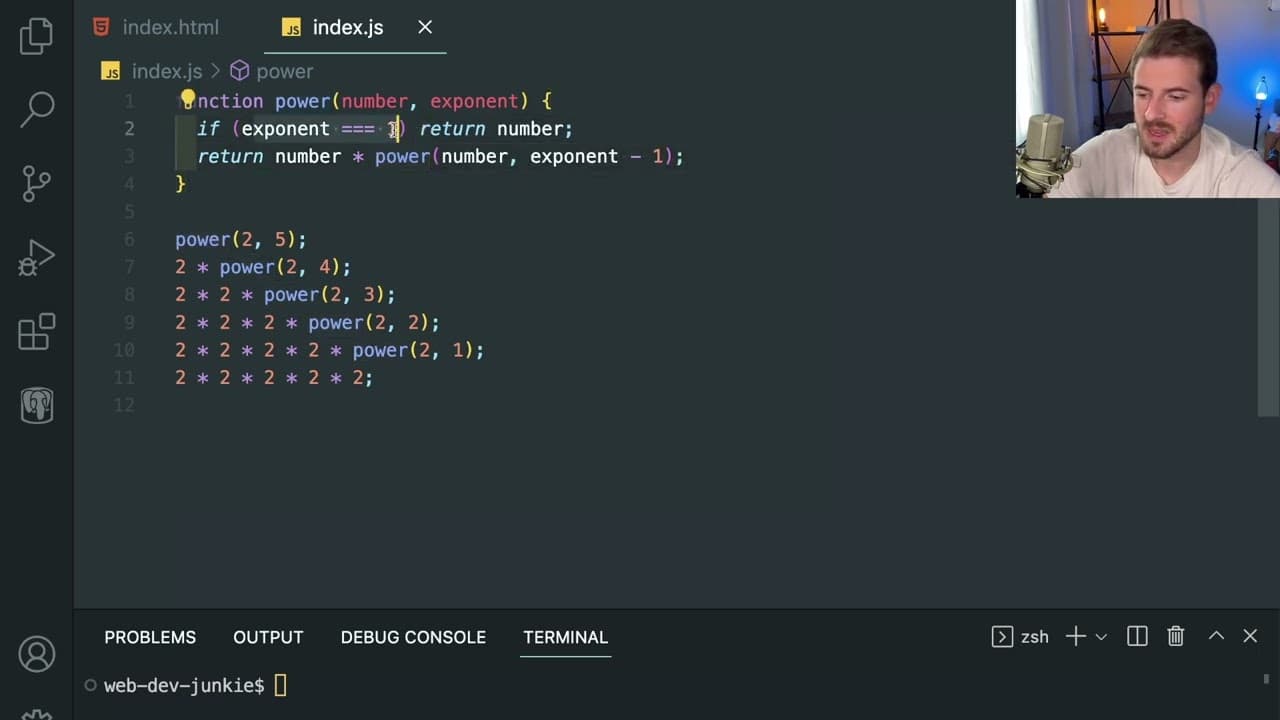
To learn recursion in JavaScript, focus on understanding that recursion involves functions calling themselves to solve problems. A crucial concept is the base case, which prevents infinite loops by providing a stopping condition. Practical examples such as printing arrays, calculating powers, and generating Fibonacci sequences illustrate how recursion can be applied in programming.
Transcript
so someone on my discord was kind of asking me if i can help them with recursion and that is exactly what i'm going to do in this video i'm going to try to walk you through what exactly is recursion why do you want to use it when do you want to use it et cetera so i got a little index.html file with the script and then i have my index file here tha... Read More
Key Insights
- 👻 Recursion allows functions to call themselves, creating a powerful tool for solving problems that can be broken down into smaller, repetitive tasks.
- ⚾ Identifying a base case is crucial to prevent infinite loops and potential crashes due to stack overflow.
- 🤙 Visualizing recursion as a tree can clarify how functions operate and return values through multiple layers of calls.
- 🤙 Recursive solutions offer elegance and simplicity but can often be less efficient than iterative counterparts due to overhead associated with multiple function calls.
- ✊ Real-world examples of recursion include computing mathematical operations like powers and generating sequences such as Fibonacci numbers.
- ❓ Understanding recursion also enhances skills in complex problem-solving, particularly in competitive programming scenarios.
- 👨💻 Learning to debug recursive functions and predict their behavior through the call stack improves coding proficiency and troubleshooting abilities.
Install to Summarize YouTube Videos and Get Transcripts
Explore YouTube Video Summarizer or Get YouTube Transcript Extractor
Questions & Answers
Q: What is recursion in programming?
Recursion is a programming technique where a function calls itself in order to solve a problem. This can simplify code, enabling more elegant solutions for complex tasks. However, it's crucial to define a base case to prevent infinite loops, where the function continues to call itself without a clear stopping point.
Q: How can recursion be visualized?
Recursion can be visualized as a tree structure where each function call branches out to further calls. Starting from a root call at the top, each subsequent call can be seen as a new branch until reaching the base case, where the function returns values back up through the branches.
Q: Why is a base case important in recursion?
A base case is essential in recursion as it dictates when the function should stop calling itself. Without a base case, a recursive function can lead to a stack overflow by continuing to invoke itself indefinitely, exhausting available memory and causing runtime errors.
Q: Can all recursive functions be converted to iterative functions?
Yes, every recursive function can be rewritten as an iterative function using loops such as while or for loops. However, recursive solutions often provide a cleaner and more understandable approach, particularly when dealing with tree-like data structures or combinatorial problems.
Q: What are some practical applications of recursion?
Recursion is commonly used in programming for tasks such as traversing tree structures, solving combinatorial problems, generating permutations, and implementing algorithms like quicksort and mergesort. It can make code simpler and more intuitive by breaking down complex problems into smaller, manageable parts.
Q: How does the call stack function in recursion?
The call stack in recursion keeps track of function calls, storing parameters and local variables for each call. As functions return values, the stack unwinds, allowing the program to consolidate results. It's vital to understand the call stack when debugging recursive functions to track the flow of execution.
Summary & Key Takeaways
-
This video explains recursion as a programming concept, detailing its definition and practical applications in coding. It highlights how functions can invoke themselves to solve complex problems elegantly.
-
A key focus is on the importance of a base case in recursive functions, which prevents infinite loops by providing a stopping condition during function calls.
-
Real-life examples, including printing arrays, calculating powers, and the Fibonacci sequence, illustrate the concept of recursion, emphasizing its utility in various programming scenarios.
Read in Other Languages (beta)
Share This Summary 📚
Summarize YouTube Videos and Get Video Transcripts with 1-Click
Try YouTube Summary with ChatGPT & Claude or YouTube Transcript Generator
Explore More Summaries from Web Dev Cody 📚
Summarize YouTube Videos and Get Video Transcripts with 1-Click
Try YouTube Summary with ChatGPT & Claude or YouTube Transcript Generator