How to Adapt LLMs for YouTube Video Recommendations
TL;DR
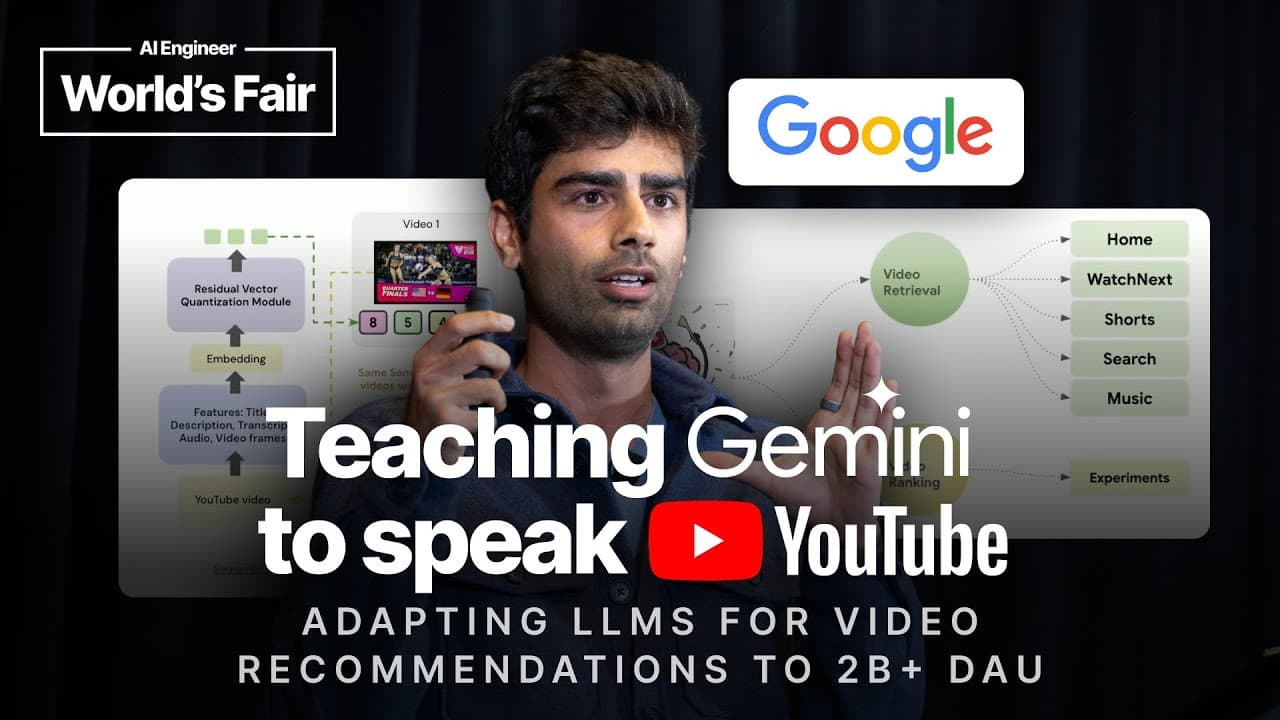
Adapting large language models (LLMs) for YouTube recommendations addresses the challenge of delivering personalized content to billions of users. The process involves creating a semantic ID language for videos, adapting Gemini checkpoints, and implementing generative retrieval. This approach enhances recommendation quality and engagement, although serving costs and model scalability remain challenges.
Transcript
There's a lot of attention in terms of how LLMs are going to transform search. Uh Google search is having a revolution. Chat GPT has a big chat interface. Perplexity is a product that a lot of people use. Um, but I think recommendations is uh probably a bigger problem that is underhyped because it's kind of transparent to the user. Um, and I think ... Read More
Key Insights
- LLMs like Gemini are transforming recommendation systems, surpassing traditional search in consumer engagement.
- YouTube's recommendation system drives the majority of user watch time, utilizing user demographics and engagement data.
- Semantic ID creates a language for videos, organizing billions of videos into semantically meaningful tokens.
- The LRM model adapts Gemini for YouTube, aligning it for tasks like retrieval and ranking.
- Generative retrieval uses user demographics and video context to provide unique recommendations.
- LRM is data-efficient and handles complex recommendation tasks but incurs high serving costs.
- Continuous pre-training is crucial for adapting to the dynamic YouTube video corpus.
- Future directions include user-interactive recommendations and merging recommendation with generative content creation.
Install to Summarize YouTube Videos and Get Transcripts
Explore YouTube Video Summarizer or Get YouTube Transcript Extractor
Questions & Answers
Q: How does YouTube use LLMs for video recommendations?
YouTube utilizes large language models (LLMs) like Gemini to enhance its video recommendation system. The process involves creating a semantic ID language for videos, which organizes billions of videos into semantically meaningful tokens. This enables the LRM model to align for tasks like retrieval and ranking, providing personalized recommendations based on user demographics and engagement history.
Q: What is the role of Semantic ID in YouTube recommendations?
Semantic ID plays a crucial role in YouTube recommendations by creating a language for videos. It organizes the vast video library into semantically meaningful tokens, facilitating the adaptation of LLMs like Gemini for retrieval and ranking tasks. This approach enhances the personalization and relevance of video recommendations for users.
Q: What challenges does YouTube face with LRM model serving?
The LRM model, while efficient and capable of handling complex recommendation tasks, faces challenges related to high serving costs. Given YouTube's scale with billions of users, optimizing these costs is critical. The model's continuous pre-training requirement to adapt to YouTube's dynamic video corpus also adds complexity to its implementation.
Q: How does generative retrieval work in YouTube's recommendation system?
Generative retrieval in YouTube's recommendation system constructs personalized prompts using user demographics and video context. This process allows the LRM model to decode video recommendations as semantic IDs, providing unique and relevant content suggestions. This method is particularly effective for users with limited known data, offering more tailored recommendations.
Q: Why is continuous pre-training important for YouTube's LRM model?
Continuous pre-training is vital for YouTube's LRM model due to the dynamic nature of its video corpus. With millions of new videos added daily, the model must quickly adapt to ensure recommendations remain relevant and timely. This differs from traditional LLM pre-training, which occurs less frequently, highlighting the unique challenges of video recommendation systems.
Q: What future developments are anticipated for LLMs in recommendations?
Future developments for LLMs in recommendations include enhancing user interactivity, where users can guide recommendations through natural language. Additionally, the integration of recommendation and generative content creation is anticipated, potentially leading to personalized content generation. These advancements aim to further blur the lines between search and recommendations, offering a more seamless user experience.
Q: How does the LRM model improve recommendation quality?
The LRM model improves recommendation quality by leveraging the semantic ID language, which organizes videos into meaningful tokens. This allows the model to align for tasks like retrieval and ranking, providing more personalized and relevant content suggestions. The model's efficiency and ability to handle complex recommendation tasks contribute to a significant enhancement in user engagement and satisfaction.
Q: What is the significance of Gemini checkpoints in YouTube recommendations?
Gemini checkpoints are significant in YouTube recommendations as they serve as the foundation for adapting LLMs to the platform's specific needs. By aligning these checkpoints with the semantic ID language, the LRM model can effectively handle retrieval and ranking tasks, enhancing the personalization and relevance of video recommendations. This adaptation marks a major shift from traditional recommendation methods.
Summary & Key Takeaways
-
Large language models (LLMs) like Gemini are being adapted for YouTube video recommendations, offering a more personalized and engaging user experience. By creating a semantic ID language for videos and aligning LLMs for retrieval and ranking tasks, YouTube aims to enhance recommendation quality, although challenges in serving costs and scalability persist.
-
Semantic ID organizes YouTube's vast video library into meaningful tokens, enabling the LRM model to deliver personalized recommendations based on user demographics and engagement history. Despite its efficiency and ability to handle complex tasks, LRM's high serving costs necessitate ongoing optimization.
-
The adaptation of LLMs for recommendations marks a significant shift from traditional search, with potential future developments including interactive user recommendations and the integration of recommendation and generative content creation. Continuous pre-training is essential to maintain relevance in YouTube's dynamic video environment.
-
(Content reviewed on 2026-08-27.)
Read in Other Languages (beta)
Share This Summary 📚
Summarize YouTube Videos and Get Video Transcripts with 1-Click
Try YouTube Summary with ChatGPT & Claude or YouTube Transcript Generator
Explore More Summaries from AI Engineer 📚



Summarize YouTube Videos and Get Video Transcripts with 1-Click
Try YouTube Summary with ChatGPT & Claude or YouTube Transcript Generator