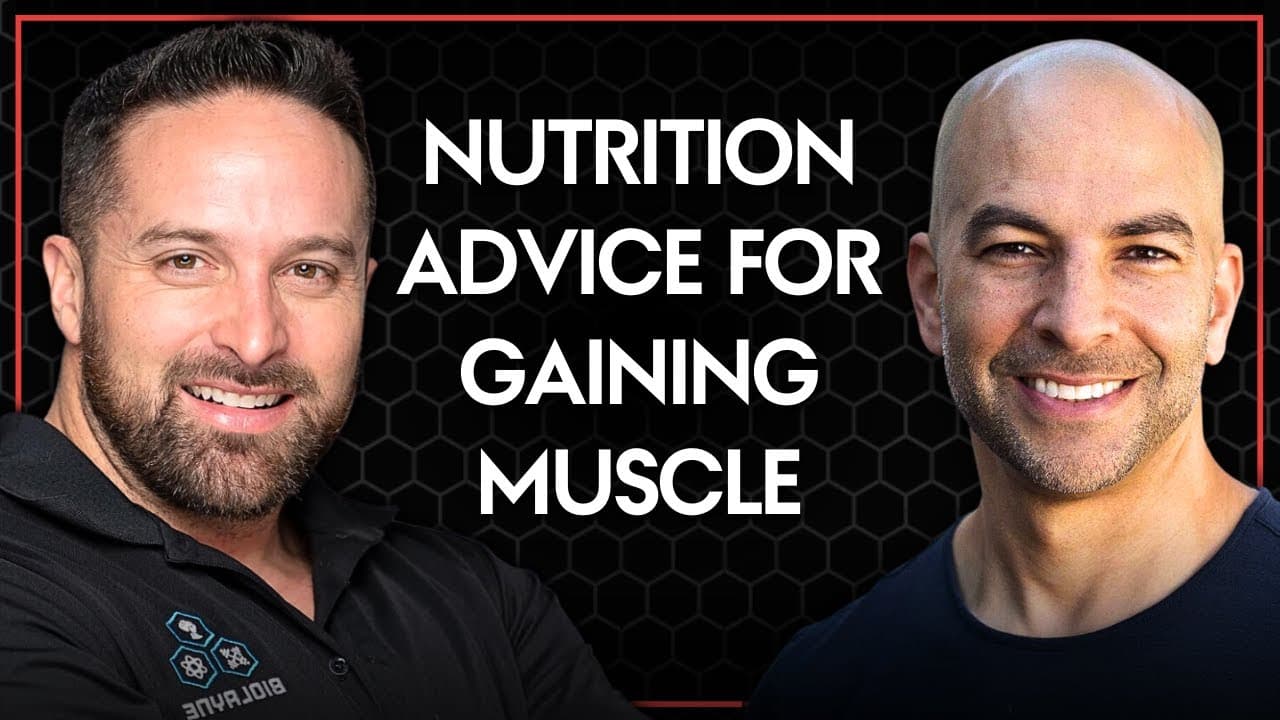
How Should You Eat for Muscle Gain Without Excess Fat? Peter Attia and Layne Norton
TL;DR
To gain muscle while limiting excess fat, experienced trainees should combine sufficient protein and carbohydrates with resistance training, recovery, and a slight calorie surplus. For the hypothetical 180-pound trainee, Layne Norton suggests about 200 grams of protein daily and a surplus of roughly 100–200 calories above maintenance. Weight gain should be extremely slow, five pounds over at least 12 weeks, and assessed through monthly averages. Read on for practical guidance on gaining phases, fat gain, and calorie deficits.
Transcript
let's talk about his nutrition now so so so uh let's pretend that you you you assess him so I forget what I said he weighs uh let's make up a weight he's 175 pounds he's 180 pounds I don't know whatever um and I think we said he's 20ish per by dexa low 20s um and let's say he's eating 120 grams of protein a day so right off the bat you're going to ... Read More
Key Insights
- A slight calorie surplus is important for experienced trainees because gaining lean mass becomes increasingly difficult after years of training. The suggested surplus is approximately 100–200 calories per day above maintenance, alongside adequate protein, carbohydrates, recovery, and resistance-training stimulus.
- Protein intake alone cannot guarantee lean-mass retention or growth when total calories are exceptionally low. A person eating 200 grams of protein within a severe deficit might avoid some lean-mass loss, but an experienced trainee would be very unlikely to gain muscle under those conditions.
- A 180-pound trainee can reasonably target about 200 grams of protein daily if protein-rich foods are acceptable to them. This was presented as a practical target without expected downsides for the hypothetical person, who had previously been consuming approximately 120 grams per day.
- Muscle gain and fat loss can occur together more readily in someone who has never trained, but advanced trainees face different constraints. After years of resistance training, gaining even ounces of lean tissue may require training, calories, protein, carbohydrates, and recovery to be aligned.
- Weight gain should occur at a snail's pace for a well-trained person seeking lean mass. A proposed target is five pounds over at least 12 weeks, with the hope that roughly three pounds are lean tissue and two pounds are body fat.
- Gaining weight often adds both lean mass and fat mass in trained people. The discussion estimates that gains may be approximately 50 percent lean and 50 percent fat, or even 40 percent lean and 60 percent fat for someone who is particularly well trained.
- Gaining and trimming phases can support long-term body-composition progress. One example involves gaining five pounds, losing three pounds of accumulated fat, and then beginning another gaining cycle, with the expectation that the resulting composition may improve across repeated cycles.
- Monthly weight averages are more informative than short-term scale changes during a gaining phase. Body weight can remain stable for several weeks and then rise by two pounds, so progress should be evaluated against longer-term milestones instead of reactions to a few days of data.
Install to Summarize YouTube Videos and Get Transcripts
Explore YouTube Video Summarizer or Get YouTube Transcript Extractor
Questions & Answers
Q: How should an experienced trainee eat to gain muscle without excess fat?
Use a slight calorie surplus while consuming sufficient protein and carbohydrates to support resistance training and recovery. For the hypothetical 180-pound trainee, about 200 grams of protein daily and roughly 100–200 calories above maintenance were suggested. Weight gain should proceed very slowly because trained people are likely to add some body fat along with lean mass.
Q: How much protein should a 180-pound trainee eat to gain muscle?
Layne Norton suggests approximately 200 grams of protein per day for the hypothetical 180-pound trainee, particularly if he enjoys protein-rich foods. The trainee had been consuming about 120 grams daily, which was described as a little light. Calories and carbohydrates must also be adequate for recovery and muscle growth.
Q: What calorie surplus is recommended for lean muscle gain?
A small surplus of approximately 100–200 calories per day above maintenance was recommended for an experienced trainee. This provides energy for recovery and lean-mass growth while avoiding unnecessarily rapid weight gain. The surplus should accompany adequate protein, carbohydrates, and resistance training.
Q: How quickly should a well-trained person gain weight?
Weight gain should occur at a snail's pace for a well-trained person. The example target is five pounds over at least 12 weeks, with the hope that roughly three pounds are lean tissue and two pounds are fat. Gaining phases can be separated by maintenance or fat-loss periods.
Q: Can experienced trainees gain muscle and lose fat simultaneously?
It is much less likely for someone who has trained for years than for a person who has never trained. An advanced trainee may need resistance training, calories, protein, carbohydrates, and recovery aligned just to gain ounces of lean mass. A slight calorie surplus may therefore be necessary.
Q: Can high protein prevent muscle loss during a severe calorie deficit?
High protein cannot guarantee lean-mass retention when total calories are exceptionally low. During a two-week diet of 1,000 calories per day that is almost entirely protein, a trained person might avoid losing lean mass, but gaining lean mass would be very unlikely. A single day in an energy deficit was not presented as a major concern.
Q: How much fat might be gained during a muscle-building phase?
A trained person may gain weight in a split near 50 percent lean mass and 50 percent fat mass. For someone particularly well trained, the split may be closer to 40 percent lean mass and 60 percent fat mass. In the five-pound example, the hoped-for result is about three pounds of lean tissue and two pounds of fat.
Q: Why should muscle-building progress be assessed with monthly weight averages?
Body weight can remain unchanged for several weeks and then rise by two pounds and stay there. Monthly averages show the overall rate of gain more reliably than a few daily readings. This helps prevent unnecessary calorie increases during a deliberately slow gaining phase.
Summary & Key Takeaways
-
Experienced trainees need a slight calorie surplus, sufficient protein, adequate carbohydrates, and sustained resistance training to gain lean mass. For the hypothetical 180-pound trainee eating 120 grams of protein daily, Layne Norton suggests targeting approximately 200 grams because no downside is expected for someone who enjoys protein-rich foods.
-
Weight gain should proceed extremely slowly because trained people commonly gain body fat alongside lean tissue. A reasonable example is gaining five pounds over at least 12 weeks, then maintaining or trimming some accumulated fat before beginning another gaining cycle. Repeating these phases may gradually improve body composition over time.
-
A slight surplus of 100–200 calories above maintenance supports recovery and muscle growth without forcing rapid weight gain. Progress may appear flat for weeks before body weight rises suddenly and remains elevated. Monthly averages provide a better assessment than daily changes, especially during a deliberately slow, lean gaining phase.
Read in Other Languages (beta)
Share This Summary 📚
Summarize YouTube Videos and Get Video Transcripts with 1-Click
Try YouTube Summary with ChatGPT & Claude or YouTube Transcript Generator
Explore More Summaries from Peter Attia MD 📚



Summarize YouTube Videos and Get Video Transcripts with 1-Click
Try YouTube Summary with ChatGPT & Claude or YouTube Transcript Generator