How Does AI Think with Visual Primitives?
TL;DR
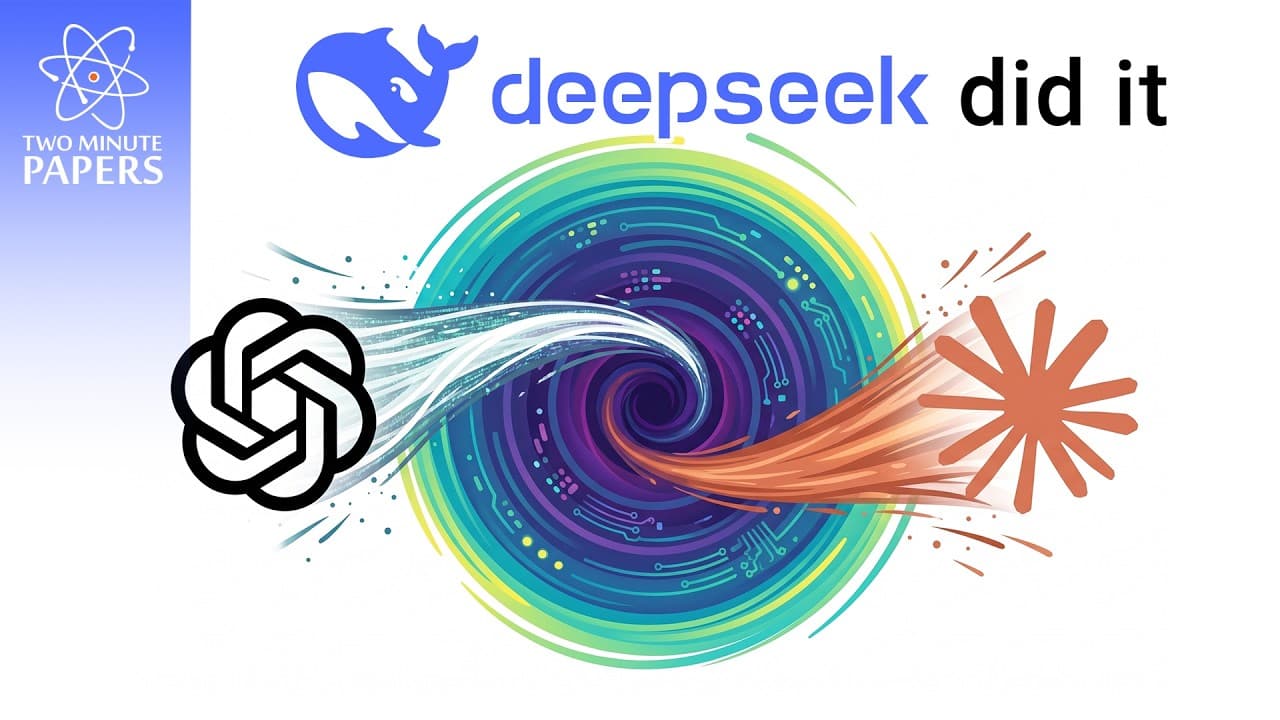
Visual primitives let an AI point, draw boxes, and trace paths while reasoning, making visual tasks more accurate, faster, and easier to inspect. The presented technique reportedly uses about 90% fewer visual tokens than most frontier models while matching or beating nearly all compared systems, although it still needs a cue, struggles with thin structures, and has limited generalization in topological reasoning.
Transcript
Hmm, why does this deep sea quirk exist? I mean, it adds vision capabilities to the deep sea AI system, but that's not new. A lot of other AI systems have vision capabilities. You just drop an image here and it works. Even video and even for open models. So, why do we need this paper? Well, they did something incredible here and it is an absolute g... Read More
Key Insights
- Visual primitives are actions such as pointing, drawing bounding boxes, and tracing paths that allow an AI to reason directly on an image instead of describing every relevant detail with words.
- Object counting is more efficient when the AI can mark or point to each object because a long verbal description of positions, rows, and poses is both cognitively expensive and prone to mistakes.
- Topological reasoning works by visually tracing connections through structures such as mazes or node diagrams, allowing the system to answer a question while also displaying the path that led to its conclusion.
- Visible reasoning traces are useful for inspection because people can review the model's points, boxes, or paths and identify where a mistake occurred, potentially making later model improvements easier.
- The reported efficiency gain is about 90% fewer visual tokens than most frontier models, while the presented comparisons indicate that the free system matches or beats nearly all systems included in the evaluation.
- The benchmark result is an average across seven benchmarks with in-house benchmarks excluded, a detail presented as important because it avoids relying on a custom test designed around the technique's strengths.
- Policy distillation is the training method used to transfer different visual reasoning skills from multiple expert teacher models into one student model that can perform several kinds of visual thinking.
- The technique is limited because visual reasoning requires a word cue, low-resolution boxes can miss thin structures such as grass blades or hair strands, and topological reasoning does not generalize as robustly as desired.
Install to Summarize YouTube Videos and Get Transcripts
Explore YouTube Video Summarizer or Get YouTube Transcript Extractor
Questions & Answers
Q: What are visual primitives in AI reasoning?
Visual primitives are actions that an AI can use directly on an image while reasoning, including pointing at objects, drawing bounding boxes, and tracing paths. They provide an alternative to describing every visual relationship in words. In the examples presented, these actions support object counting, maze solving, and identifying connections between elements while leaving a visible record of the reasoning process.
Q: How do visual primitives improve object counting?
Visual primitives improve object counting by letting an AI point to or mark each person or object sequentially, similar to how a human might count with a finger. Earlier approaches may spend many tokens describing rows, positions, clothing, or whether people are sitting or standing. That verbal process takes more reasoning and is prone to errors, while direct pointing simplifies the task.
Q: Why can visual reasoning use fewer tokens?
Visual reasoning can use fewer tokens because points, boxes, and paths can represent spatial information more directly than lengthy verbal descriptions. The presented technique reportedly needs about 90% fewer visual tokens than most frontier models. The claimed benefit is not only lower token use, since the system also matches or beats nearly all compared systems in the reported evaluation.
Q: How does the method make AI reasoning easier to inspect?
The method makes reasoning easier to inspect by showing visual traces of intermediate decisions. For a maze, the AI can display the path it followed from the starting point to the destination. For a connection question, it can trace the relevant link. If the answer is wrong, these visible steps can help reveal where the reasoning failed and guide efforts to improve the model.
Q: How is policy distillation used for visual reasoning?
Policy distillation trains one student model using guidance from multiple expert teacher models. One teacher may be especially capable at creating boxes, while another may specialize in tracing maze paths with points. The student proposes what it would do, receives demonstrations or corrections from the teachers, and gradually learns to combine their distinct visual reasoning abilities within a single model.
Q: How credible are the reported benchmark results?
The reported score is averaged across seven benchmarks, and in-house benchmarks are excluded. The presenter considers that exclusion important because a custom benchmark could be designed to favor the new method. Within the comparisons shown, the free system reportedly matches or beats nearly all competing systems while using substantially fewer visual tokens. The transcript does not provide individual benchmark names or scores.
Q: Can the visual primitives technique be added to existing models?
The paper describes the technique in enough detail to serve as a blueprint, and the presenter says it could potentially be added to many existing models, including free ones. However, the paper does not have an attached model that the presenter knows of. Its immediate contribution is therefore the method and training concept, rather than a ready-to-use released model associated with the paper.
Q: What are the limitations of visual primitive reasoning?
The technique has three stated limitations. First, the AI does not automatically enter this pointing-based reasoning mode and needs a word as a cue. Second, bounding boxes without very high resolution can perform poorly on thin structures such as grass blades or hair strands. Third, topological reasoning does not generalize as well as desired and may be less robust on completely new examples.
Summary & Key Takeaways
-
The technique replaces lengthy verbal descriptions with visual actions such as pointing, drawing boxes, and tracing paths. These primitives help an AI count objects and solve connected-path problems more directly, while also exposing a visual record of its reasoning that people can inspect when evaluating answers or diagnosing mistakes.
-
The reported results show that the system needs about 90% fewer visual tokens than most frontier models while matching or beating nearly all compared systems. The evaluation averages seven benchmarks and excludes in-house benchmarks, which the presenter highlights as important evidence against designing a favorable custom test.
-
The method uses policy distillation to combine specialized visual abilities in one student model. Multiple expert teachers demonstrate skills such as creating boxes or tracing mazes, and the student learns from their responses. The paper provides a detailed blueprint rather than an attached model, but several limitations remain unresolved.
Read in Other Languages (beta)
Share This Summary 📚
Summarize YouTube Videos and Get Video Transcripts with 1-Click
Try YouTube Summary with ChatGPT & Claude or YouTube Transcript Generator
Explore More Summaries from Two Minute Papers 📚


Summarize YouTube Videos and Get Video Transcripts with 1-Click
Try YouTube Summary with ChatGPT & Claude or YouTube Transcript Generator