Claisen Condensation Reaction Mechanism
TL;DR
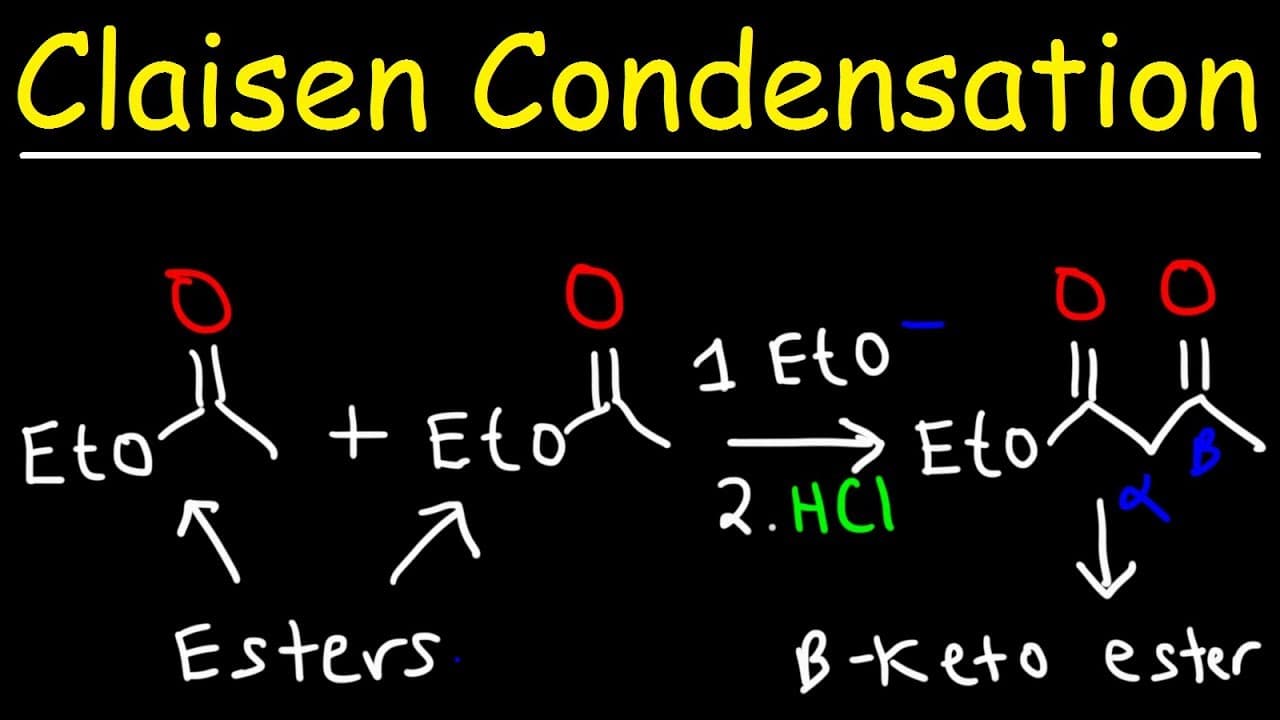
The Claisen condensation reaction involves the reaction of two esters to form a beta keto ester, and it requires the use of a strong base and subsequent acidification.
Transcript
in this video we're going to go over the claisen condensation reaction so in this reaction we're going to react an ester with another ester to produce a beta keto ester this is also known as the acetoacetic ester which is good for the acetoacetic ester synthesis reaction by the way which i'll talk about in a future video but this is the claisen con... Read More
Key Insights
- 🇪🇭 The Claisen condensation reaction involves the reaction of two esters to form a beta keto ester, which has a ketone on the beta carbon.
- 😑 The reaction proceeds through deprotonation of the alpha hydrogen, attack of the enolate ion on the carbonyl carbon, and subsequent elimination of the leaving group.
- ⚾ The choice of base is crucial to achieving the desired product, and using ethoxide as the base is optimal for matching the alkoxide leaving group in the ester.
- 😐 Acidification of the solution converts the deprotonated beta keto ester into its neutral form, making the reaction irreversible.
- 🥺 Using a different base, such as hydroxide or methoxide, can result in hydrolysis or transesterification, leading to a mixture of products.
- 🥳 A directed Claisen condensation reaction can be achieved by using a specific base and a one-to-one ratio of ester molecules, resulting in the desired product as the major product.
Install to Summarize YouTube Videos and Get Transcripts
Explore YouTube Video Summarizer or Get YouTube Transcript Extractor
Questions & Answers
Q: What are the key steps of the Claisen condensation reaction?
The key steps involve the deprotonation of the alpha hydrogen using a strong base, the attack of the enolate ion on the carbonyl carbon of the second ester, and the eventual formation of the beta keto ester through elimination of the ethoxide group.
Q: Why is it important to use ethoxide as the base in the Claisen condensation reaction?
Ethoxide is an ideal base because it matches the alkoxide leaving group in the ester, ensuring efficient deprotonation of the alpha hydrogen and increasing the yield of the desired product.
Q: How does acidification of the solution affect the Claisen condensation reaction?
Acidification with HCl or H3O+ allows the conversion of the deprotonated beta keto ester into its neutral form, making the reaction irreversible and resulting in the final product.
Q: What happens if a different base, such as hydroxide or methoxide, is used in the Claisen condensation reaction?
Hydroxide can lead to hydrolysis of the ester into a carboxylate ion, while methoxide can cause transesterification, resulting in a mixture of products rather than the desired beta keto ester.
Summary & Key Takeaways
-
The Claisen condensation reaction involves reacting two esters to produce a beta keto ester, also known as acetoacetic ester.
-
The reaction requires the use of a strong base, such as ethoxide, to deprotonate the alpha hydrogen of one ester molecule.
-
The resulting enolate ion then attacks the carbonyl carbon of the second ester, forming a tetrahedral intermediate that eventually collapses to yield the beta keto ester.
Read in Other Languages (beta)
Share This Summary 📚
Summarize YouTube Videos and Get Video Transcripts with 1-Click
Try YouTube Summary with ChatGPT & Claude or YouTube Transcript Generator
Explore More Summaries from The Organic Chemistry Tutor 📚






Summarize YouTube Videos and Get Video Transcripts with 1-Click
Try YouTube Summary with ChatGPT & Claude or YouTube Transcript Generator