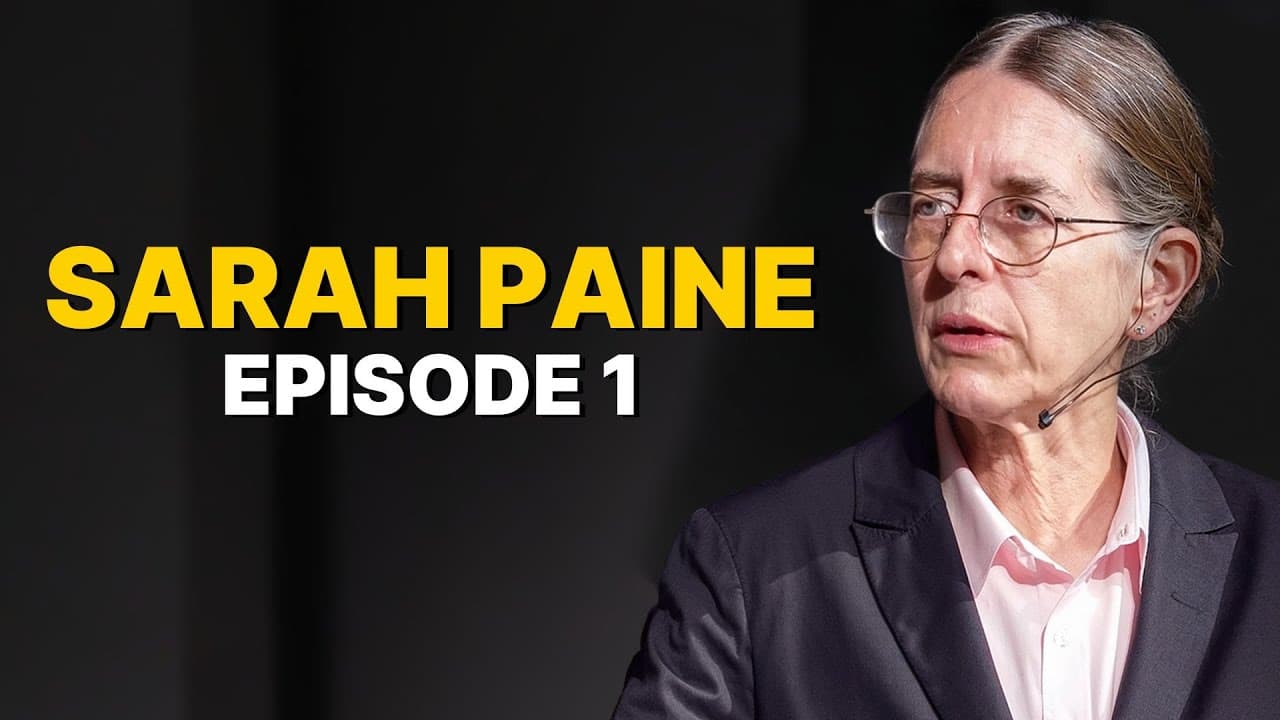
How Did the War for India Reshape Asia? Sarah Paine on the China-India Rivalry
TL;DR
China’s conquest of Tibet transformed its rivalry with India by removing a major buffer, enabling new roads and intensifying disputes over Aksai Chin and Arunachal Pradesh. Sarah Paine connects that decision to the 1962 Sino-Indian War, the 1971 Bangladesh War of Independence, and shifting relationships among India, Pakistan, China, Russia, and the United States. Read on to understand the pivotal decisions behind Asia’s changing alignments.
Transcript
I need to start with a disclaimer, because I work for the US Government, and they require you to do a disclaimer. So: the ideas that you're about to hear are my ideas. They don't necessarily represent those of the US Government, the US Navy Department, the US Department of Defense, let alone the Naval War College where I work. Are we all good... Read More
Key Insights
- The Sino-Indian War of 1962 and the Bangladesh War of 1971 were pivotal conflicts that reshaped regional power dynamics.
- China's decision to conquer Tibet reduced the buffer zone with India, escalating tensions and territorial disputes.
- The United States' military pact with Pakistan in the 1950s altered South Asian power balances, straining US-India relations.
- The Sino-Soviet split and subsequent border conflict in 1969 realigned global alliances, affecting US-China and US-Soviet relations.
- India's non-alignment policy shifted towards aligning with the Soviet Union post-1971, influenced by US-Pakistan relations.
- The US faced challenges in balancing its alliances with India and Pakistan, often resulting in strained relations with both.
- The Cold War's geopolitical strategies involved complex alliances, with countries like India and Pakistan leveraging superpower rivalries.
- China and India's missed opportunity for cooperation could have significantly altered the global power structure.
Install to Summarize YouTube Videos and Get Transcripts
Explore YouTube Video Summarizer or Get YouTube Transcript Extractor
Questions & Answers
Q: How did the China-India rivalry reshape Asia?
China’s conquest of Tibet removed much of the buffer separating China and India and brought their territorial disputes into sharper focus. The 1962 Sino-Indian War and the 1971 Bangladesh War of Independence then altered regional power dynamics and encouraged new alignments involving Pakistan, the Soviet Union, and the United States.
Q: Why was China’s conquest of Tibet a pivotal decision?
After winning the Chinese Civil War in 1949, Mao spent the next two years eliminating Nationalist remnants and conquering Xinjiang and Tibet. Taking Tibet and building roads there gave China greater military access while reducing the buffer with India to Nepal, Bhutan, and Sikkim.
Q: Which territories remain disputed between China and India?
The two highlighted areas are the Aksai Chin Plateau and Arunachal Pradesh. China controls Aksai Chin while India still claims it, whereas India controls Arunachal Pradesh while China claims it.
Q: Why was the western road through Tibet strategically important to China?
Between 1950 and 1957, China built road systems through Tibet, but the western route was the only one described as supporting year-round traffic. It helped China control Tibet and also provided an approach toward Xinjiang, while the other routes faced mountain ranges, monsoon rains, snow, mudslides, and major river systems.
Q: What caused the Sino-Indian War of 1962?
The lecture links the conflict to China’s conquest of Tibet, the disappearance of the former buffer, and competing claims over Aksai Chin and Arunachal Pradesh. Chinese roads also enabled troop deployment into areas that India could not readily reach, sharpening the strategic imbalance and territorial rivalry.
Q: What was the impact of the US-Pakistan military pact?
Under Eisenhower, the United States pursued alliances intended to contain the Soviet Union, including the Baghdad Pact’s Northern tier strategy. Pakistan received a major US military aid treaty as an incentive to join, alarming Indian Prime Minister Nehru and straining US-India relations.
Q: Why were the wars of 1962 and 1971 considered limited wars?
Sarah Paine defines a limited war as one fought for something less than regime change, leaving the governments that began it in place. She identifies the 1962 Sino-Indian War and the 1971 Bangladesh War of Independence as limited wars that produced quick victories and both expected short-term and unexpected long-term consequences.
Q: How did the Bangladesh War of Independence change South Asia?
The 1971 war caused Pakistan to lose East Pakistan, which became Bangladesh. It altered regional power dynamics, strained US-India relations because of US support for Pakistan, and helped move India toward a closer relationship with the Soviet Union.
Summary & Key Takeaways
-
The Sino-Indian War of 1962 and the Bangladesh War of 1971 significantly impacted Asia's geopolitical landscape by altering power dynamics and territorial boundaries. China's conquest of Tibet reduced the buffer zone with India, escalating tensions and disputes. The US military pact with Pakistan strained US-India relations, leading to India's alignment with the Soviet Union.
-
The Sino-Soviet split in 1969 realigned global alliances, affecting US-China and US-Soviet relations. The US struggled to balance its alliances in South Asia, often resulting in strained relations with both India and Pakistan. The Cold War's geopolitical strategies involved complex alliances, with countries leveraging superpower rivalries for regional advantage.
-
India's non-alignment policy shifted post-1971, influenced by US-Pakistan relations. The missed opportunity for China-India cooperation could have significantly altered the global power structure, highlighting the complex interplay of alliances and rivalries that have defined the region's history.
Read in Other Languages (beta)
Share This Summary 📚
Summarize YouTube Videos and Get Video Transcripts with 1-Click
Try YouTube Summary with ChatGPT & Claude or YouTube Transcript Generator
Explore More Summaries from Dwarkesh Patel 📚






Summarize YouTube Videos and Get Video Transcripts with 1-Click
Try YouTube Summary with ChatGPT & Claude or YouTube Transcript Generator