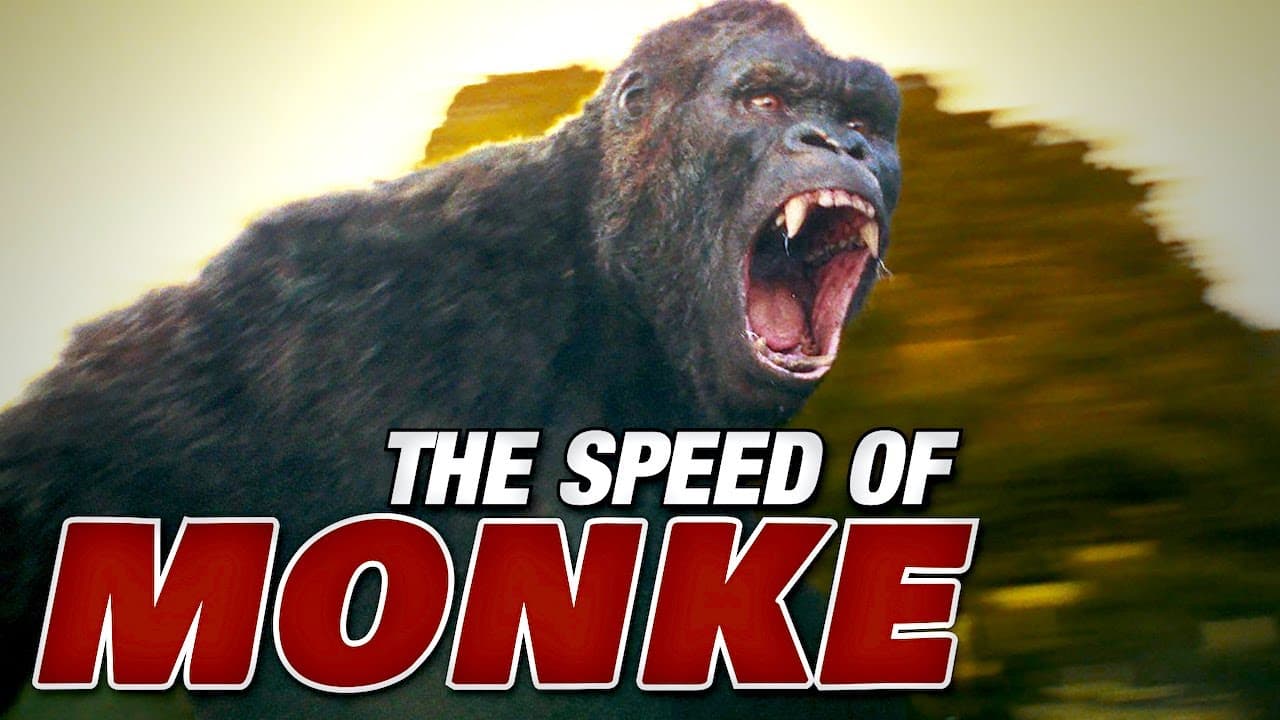
Why Would King Kong Move So Slowly in Reality?
TL;DR
King Kong’s enormous mass would make rapid movement biologically unrealistic, with the model presented estimating a top speed just above one kilometer per hour. His metabolism could not supply energy quickly enough for fast acceleration, potentially making each step take more than two and a half minutes, while Godzilla’s implied nuclear power could avoid the same constraint.
Transcript
mainframe intrusion detected oh don't worry about that aria they'll never find us here why not well because i'm using surf shark my super computing companion today's episode is sponsored by surf shark surfshark is an award-winning vpn that secures your digital life with top of the line servers that encrypt your data and allow you to change your ip ... Read More
Key Insights
- King Kong’s greatest realistic combat weakness is speed, because an ape with his enormous mass could not simply retain the movement and agility of a proportionally enlarged gorilla.
- Scaling laws are observed relationships that connect one biological variable to another, including body mass with heart rate, heating, volume, or maximum movement speed.
- Maximum land-animal speed initially increases with body mass, but the relationship eventually declines because very large animals cannot mobilize metabolic resources and move molecules through their bodies quickly enough for rapid acceleration.
- King Kong’s estimated top speed is just over one kilometer per hour, or about 0.8 miles per hour, when his assumed mass is entered into the empirical model discussed in the presentation.
- King Kong’s individual steps could take more than two and a half minutes if his step length were approximately half his height and he moved at the calculated realistic top speed.
- King Kong’s gorilla-like diet would require about 20 million pounds of food every 24 hours if he consumed approximately 15 percent of his body weight daily, as silverback gorillas do.
- King Kong’s skeletal structure would be threatened by his mass, because bones supporting creatures weighing tens of millions of kilograms would likely shatter before the creatures could take a single step.
- Godzilla’s implied nuclear energy could let him avoid Kong’s metabolic movement constraint, since he would not depend on the relatively slow production and use of ATP to power his body.
Install to Summarize YouTube Videos and Get Transcripts
Explore YouTube Video Summarizer or Get YouTube Transcript Extractor
Questions & Answers
Q: Why would King Kong move slowly in real life?
King Kong would move slowly because his immense body could not mobilize metabolic resources quickly enough to accelerate like a normal gorilla. The empirical model presented connects maximum velocity with body mass and predicts that impossibly large land animals become extremely slow. Using Kong’s estimated mass, the calculation produces a top speed just above one kilometer per hour, or about 0.8 miles per hour.
Q: How fast could King Kong realistically move?
King Kong’s theoretical top speed would be just over one kilometer per hour, which the presentation also gives as about 0.8 miles per hour. That estimate comes from entering his assumed mass and the model’s fitting parameters into an empirical equation for maximum land-animal velocity. The result is slower than ordinary human walking and even slower than the movement of turtles, according to the comparison presented.
Q: How long would one of King Kong’s steps take?
One King Kong step would take more than two and a half minutes under the realistic speed estimate presented. That calculation assumes his step length is approximately half his height in the newer film and uses a maximum speed slightly above one kilometer per hour. The resulting movement would look dramatically slower than his cinematic fighting and rampaging, making quick reactions or agile combat biologically implausible.
Q: What are biological scaling laws?
Biological scaling laws are empirical, observed relationships that connect one variable in an organism to another. Examples given include relationships between heart rate and mass, and between heating and volume. For movement, an empirical model links an animal’s body mass with its maximum velocity. These relationships help estimate how an extremely large creature might function instead of assuming it behaves exactly like a scaled-up smaller animal.
Q: Why are elephants slower than cheetahs despite being larger?
Elephants have longer legs and more muscle mass than cheetahs, but their greater size does not keep increasing their maximum speed. The model described suggests that beyond a certain body mass, large animals cannot mobilize metabolic resources or move molecules through their bodies quickly enough to accelerate rapidly. As a result, the relationship between size and speed turns downward instead of continuing to rise indefinitely.
Q: How much food would King Kong need each day?
King Kong would need about 20 million pounds of food every 24 hours under the estimate presented. The calculation treats him like a giant silverback gorilla and assumes that he eats roughly 15 percent of his body weight daily, mostly as vegetation. Meeting that requirement would leave him eating nearly constantly, as gorillas often do, and would quickly deforest Skull Island because it could not provide enough food.
Q: Why would King Kong’s bones fail at his size?
King Kong’s bones would likely fail because his body mass is on the order of tens of millions of kilograms. Bones have structures that make them both light and strong, but the presentation argues that no realistic increase in their size or change in orientation could support such a walking creature. Under that enormous load, the bones would probably shatter before Kong could take even one step.
Q: Why would Godzilla have an advantage over King Kong?
Godzilla would have an advantage because he is heavily implied to draw power from nuclear energy, while King Kong remains essentially a giant ape dependent on ordinary biological metabolism. Kong would rely on the relatively slow production and use of ATP, severely limiting his acceleration and speed. Godzilla’s internal nuclear energy could let him bypass those size-related constraints and move more like his cinematic portrayal.
Summary & Key Takeaways
-
Biological scaling laws connect characteristics such as body mass, heart rate, and maximum velocity. Although speed generally rises with animal size initially, the relationship reverses among sufficiently large animals because their bodies cannot mobilize metabolic resources quickly enough to accelerate toward the higher speeds that simple scaling would otherwise predict.
-
Applying an empirical land-animal velocity model to King Kong’s estimated mass produces a theoretical top speed just above one kilometer per hour, or about 0.8 miles per hour. If his step length is approximately half his height, the calculation suggests that completing one step would take more than two and a half minutes.
-
King Kong would also face severe structural and dietary constraints. His bones could shatter under a mass of tens of millions of kilograms, while a gorilla-like diet equal to 15 percent of his body weight would require 20 million pounds of food daily. Godzilla’s implied nuclear power gives him the advantage.
Read in Other Languages (beta)
Share This Summary 📚
Summarize YouTube Videos and Get Video Transcripts with 1-Click
Try YouTube Summary with ChatGPT & Claude or YouTube Transcript Generator
Explore More Summaries from Kyle Hill 📚
![🔴 Viral "Hanger Reflex" Explained! | [OFFICE HOURS] Podcast 090 thumbnail](/_next/image?url=https%3A%2F%2Fi.ytimg.com%2Fvi%2F-GQPNu0erKc%2Fhqdefault.jpg&w=750&q=75)
![What Made MEGALODON So Huge? | [OFFICE HOURS] Podcast #025 thumbnail](/_next/image?url=https%3A%2F%2Fi.ytimg.com%2Fvi%2F2F_zCTfPt-I%2Fhqdefault.jpg&w=750&q=75)

Summarize YouTube Videos and Get Video Transcripts with 1-Click
Try YouTube Summary with ChatGPT & Claude or YouTube Transcript Generator