How US Europe diesel prices affect trade with Canada
TL;DR
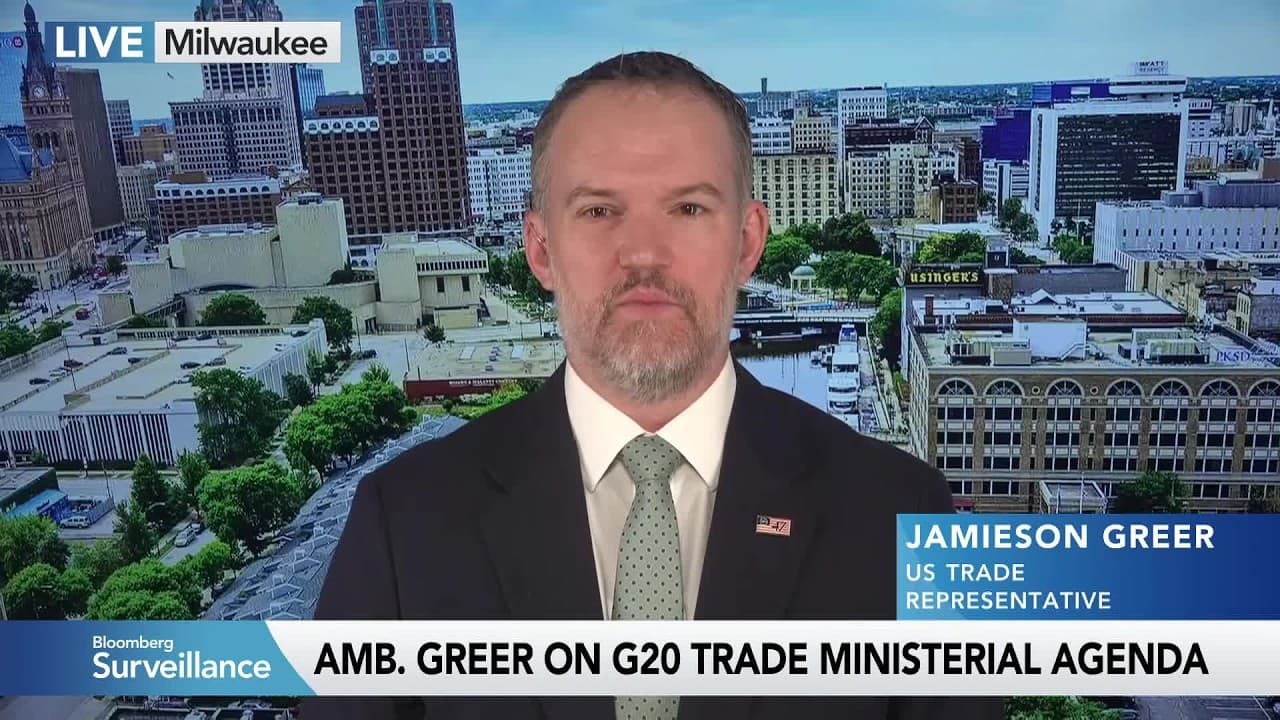
The US argues excess capacity from some countries hurts global trade, and Europe should release diesel reserves to help lower prices. Canada relations remain cautious with talks on a potential deal, while the US notes it is protecting manufacturing and seeking terms that avoid zero tariffs. A broader G20 discussion frames these issues.
Transcript
US trade representative Jamieson Greer hosting g 20 ministers for another round of talks in Wisconsin and joins us now for more. Ambassador, it's good to see you, sir. It's always good to catch up. There is a phrase that's dominated talks like these for a long time. It's dumping. And we often think about steel and overcapacity overproduction from c... Read More
Key Insights
- Excess capacity and subsidized production are a core focus when evaluating global trade dynamics and a source of significant deficits for some economies.
- Europe has reduced tariffs on US exports and provided duty free quotas for ag products under a bilateral framework, yet faces its own challenges from external supply and demand pressures.
- Diesel prices are a concern with a sense that the spike may be temporary, and there is a push for coordinated actions in Europe including potential release of reserves.
- The US position stresses the need for Europe to act on excess capacity to support global demand and avoid dampening investment incentives.
- Canada trade negotiations are ongoing with attention to gaps that prevent a deal, while the US emphasizes manufacturing job recovery and cautious tariff alignment.
- US trade policy seeks to reassure through balance, maintaining some tariffs while still pursuing deals with multiple countries without zero tariffs.
- G20 discussions are used as a platform to align approaches to excess capacity, with some countries resisting structural changes while others push for stronger controls.
- The dialogue demonstrates an intent to maintain manufacturing growth and protect key sectors while engaging partners like the EU and Canada on policy measures.
Install to Summarize YouTube Videos and Get Transcripts
Explore YouTube Video Summarizer or Get YouTube Transcript Extractor
Questions & Answers
Q: What is the main trade issue discussed in relation to global capacity and production?
The main issue is structural excess capacity and subsidized production abroad, which drive unfair trading practices and deficits for some countries. This topic dominates G20 conversations about how large economies manage and respond to overproduction, particularly when it affects manufacturing and global demand. The focus is on identifying sources of excess capacity and how to curb its impact on fair trade.
Q: How does the EU trade relationship with the US appear under the discussed terms?
The EU and US have an agreement described as a European term barrier agreement, under which tariffs on US industrial exports have been reduced and duty free quotas for important agricultural products have been provided. This has improved trade flow, yet the speaker notes that the EU has not fully tackled excess capacity issues affecting global demand, so gaps remain in alignment on trade policy.
Q: What is said about diesel prices and Europe’s reserves?
Diesel prices are acknowledged as high, and there is a suggestion that Europe should release some of its diesel reserves to help bring prices down. The idea is to coordinate a response with European counterparts, especially given that price spikes may affect energy costs and manufacturing inputs across regions. The discussion emphasizes collaboration rather than unilateral action.
Q: Has the diesel export ban been discussed with European counterparts?
Yes, the topic has been raised in bilateral conversations. The speaker notes having spoken with a French counterpart and plans to engage with EU officials to carry the same message. While not a plenary topic, bilateral discussions exist to explore a collaborative response to diesel price movements and reserve releases.
Q: What is the status of Canada-US trade talks according to the interview?
Canada and the US have ongoing discussions with a focus on whether a deal can be reached. The US notes there are gaps between the two sides and stresses that any agreement would avoid zero tariffs and aim to sustain manufacturing growth. The approach is careful and conditional, seeking terms that balance openness with protection of American manufacturing gains.
Q: What manufacturing impact is highlighted as part of the US policy stance?
The speaker references a target of 60,000 net manufacturing jobs added this year, emphasizing a policy stance that prioritizes bringing manufacturing back to the US and avoiding terms that would undermine that objective. This reflects the broader goal of reinforcing domestic production capacity through selective tariff policies and strategic deals.
Q: How does the US view China and its role in excess capacity?
China is described as a proponent of excess capacity in Asia, contributing to the global imbalance. This underscores the US focus on addressing unfair practices that stem from such capacity, and it frames the need for actions that can temper overproduction while maintaining robust trade relationships with other major economies.
Q: What is the overarching aim of the US in the G20 discussions according to the transcript?
The overarching aim is to manage excess capacity and ensure fair trading practices among the world’s largest economies. The US seeks collaborative measures with partners like Europe and Canada, while preserving manufacturing growth and a balanced tariff approach, to prevent market distortions and sustain global demand growth.
Summary & Key Takeaways
-
The talk highlights structural excess capacity as a global trade issue and cites China and other Asian producers as contributors, with particular attention to how this affects Europe and global demand.
-
The German and French energy ministers are touched on indirectly through discussions of diesel prices and potential collaborative responses to price spikes, alongside US and EU trade cooperation.
-
The interview frames ongoing US concerns about Canadian trade talks, emphasizing gaps that hinder a quick agreement while stressing manufacturing revival metrics and the desire for favorable but non zero-tariff terms.
Read in Other Languages (beta)
Share This Summary 📚
Summarize YouTube Videos and Get Video Transcripts with 1-Click
Try YouTube Summary with ChatGPT & Claude or YouTube Transcript Generator
Explore More Summaries from Bloomberg Television 📚




Summarize YouTube Videos and Get Video Transcripts with 1-Click
Try YouTube Summary with ChatGPT & Claude or YouTube Transcript Generator