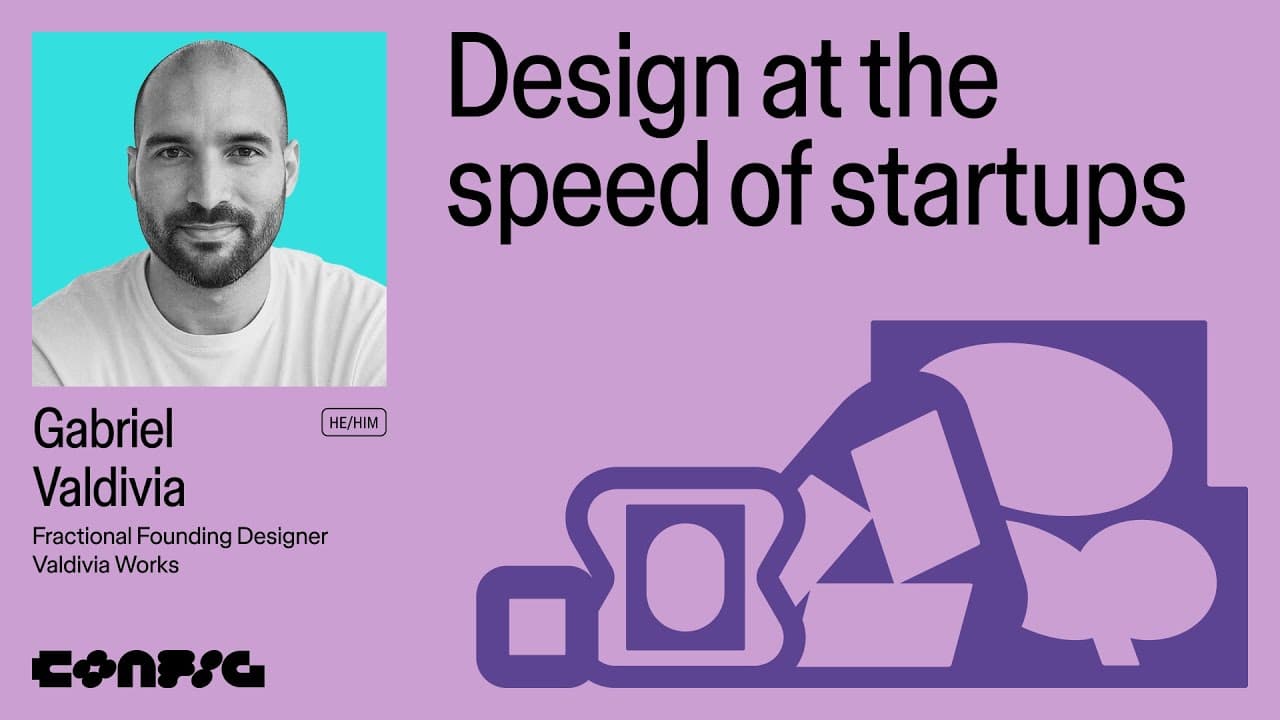
Config 2025: How Does Gabriel Valdivia Design at the Speed of Startups?
TL;DR
Early-stage startups can design faster by producing many low-cost experiments and leading discussions with tangible artifacts instead of pursuing perfection. Gabriel Valdivia recommends quickly sharing a sketch, mockup, prototype, or AI-powered demo so teams can react, invalidate weak ideas, and make decisions. The Wright brothers illustrate the principle: they spent roughly $1,000 and tested hundreds of prototypes. Read on for practical ways to turn rapid iteration into better design.
Transcript
Hello everyone. Uh, it's great to be here with you today. We are in the middle of one of the most intense technology races in history. AI is moving faster than anyone expected. Every few weeks we have a new breakthrough, a new model, a new company pushing the limits. But believe it or not, this isn't the first time we've seen the story play out. I'... Read More
Key Insights
- Quantity leads to quality in early-stage environments. Failing repeatedly through trial and error becomes the engine of innovation, whereas theorizing about perfection produces only speculation, as shown by the Wright brothers beating the far better-funded Langley team.
- The Wright brothers won the flight race with about $1,000, a team of two plus one or two assistants, and hundreds of iterated glider prototypes, while Langley's $70,000 lab-style project crashed into the river twice and lost the race.
- Early-stage and late-stage design are effectively two different roles. Early-stage designers define and validate what works, moving fast and wearing many hats; late-stage designers refine and grow what already works, balancing trade-offs and aligning stakeholders.
- Design at the early stage is a decision-making tool, not a precious artifact. The goal is to make as many decisions as possible, reducing the cost of bad decisions by speeding up the time it takes to invalidate them.
- The single most important technique is to lead every interaction with an artifact. Sketching on a whiteboard or screen-sharing a Figma canvas shifts a team from imagining to reacting and turns the designer into the person leading the conversation.
- Design artifacts should shift teams from a scarcity mindset, where design feels expensive and slow, to an abundance mindset, where the team can design multiple competing ideas and prove which fails by showing it rather than debating it.
- Jerry Uelsmann's photography experiment showed the quantity group, graded on volume, produced consistently better work than the quality group, who theorized about the perfect shot and ended with one mediocre photo.
- Speed matters more than fidelity in the early stage. An artifact can be any fidelity, sketch, mockup, prototype, or AI-powered demo, but if a polished prototype takes too long to share, it slows the team and misses the point.
Install to Summarize YouTube Videos and Get Transcripts
Explore YouTube Video Summarizer or Get YouTube Transcript Extractor
Questions & Answers
Q: How can early-stage startups design faster?
Early-stage startups can design faster by treating design as a decision-making tool and producing many inexpensive experiments. Teams should share artifacts quickly, gather reactions, invalidate weak ideas, and iterate instead of waiting for a polished solution.
Q: What is Gabriel Valdivia’s most important technique for early-stage design?
Valdivia’s top technique is to lead every interaction with an artifact. A designer can sketch on a whiteboard or share a Figma canvas so the team reacts to something tangible rather than debating an abstract idea.
Q: Why does quantity lead to quality in early-stage design?
Producing more work creates more opportunities to try, fail, receive feedback, and improve. In early-stage environments, that repeated cycle replaces speculation with evidence and helps teams discover stronger solutions faster.
Q: What is the difference between an early-stage and a late-stage designer?
An early-stage designer defines and validates what works, moves quickly, changes direction as needed, and wears many hats. A late-stage designer refines and grows an established product, balancing trade-offs, maintaining consistency, delegating responsibilities, and aligning stakeholders.
Q: Why did the Wright brothers beat Samuel Langley in the race to fly?
The Wright brothers started small and tested hundreds of glider prototypes, making changes after each flight to improve stability and control. They spent roughly $1,000 and worked with only one or two assistants, while Langley received $70,000, relied heavily on theory, and saw his grand launch crash into the river twice.
Q: What did Jerry Uelsmann’s photography experiment show?
Uelsmann divided his students into a quantity group and a quality group. The quantity group, which needed 100 photos for an A, produced consistently better work through repeated shooting and experimentation, while the group pursuing one nearly perfect image ended with a mediocre photo.
Q: How do design artifacts improve startup decision-making?
Artifacts turn conversations into visible options that teams can examine, refine, and build upon. Because a sketch, mockup, prototype, or AI-powered demo makes assumptions tangible, the team can identify bad ideas sooner and move forward with greater clarity.
Q: What is the right level of fidelity for an early-stage design artifact?
An early-stage artifact can be a sketch, mockup, prototype, or AI-powered demo. Speed matters more than fidelity, so the right format is the one that can be shared quickly enough to prompt feedback and help the team decide.
Summary & Key Takeaways
-
The talk opens by contrasting Samuel Langley, who received $70,000, hired dozens of experts, and relied on theory and a single grand launch, with the Wright brothers, who spent roughly $1,000 and iterated through hundreds of prototypes to fly first on December 17, 1903.
-
Gabriel Valdivia, a fractional founding designer who has worked at Meta and with Daylight, Gather, Workmate, and Dex, argues early-stage and late-stage design are different roles. Early-stage design defines and validates what works through speed, experimentation, and adaptability.
-
His central lesson is that quantity leads to quality, illustrated by Jerry Uelsmann's photography classes. His top technique is to lead every interaction with an artifact, sketching or prototyping ideas quickly so teams react to something tangible and shift from a scarcity to an abundance mindset.
Read in Other Languages (beta)
Share This Summary 📚
Summarize YouTube Videos and Get Video Transcripts with 1-Click
Try YouTube Summary with ChatGPT & Claude or YouTube Transcript Generator
Explore More Summaries from Figma 📚



Summarize YouTube Videos and Get Video Transcripts with 1-Click
Try YouTube Summary with ChatGPT & Claude or YouTube Transcript Generator