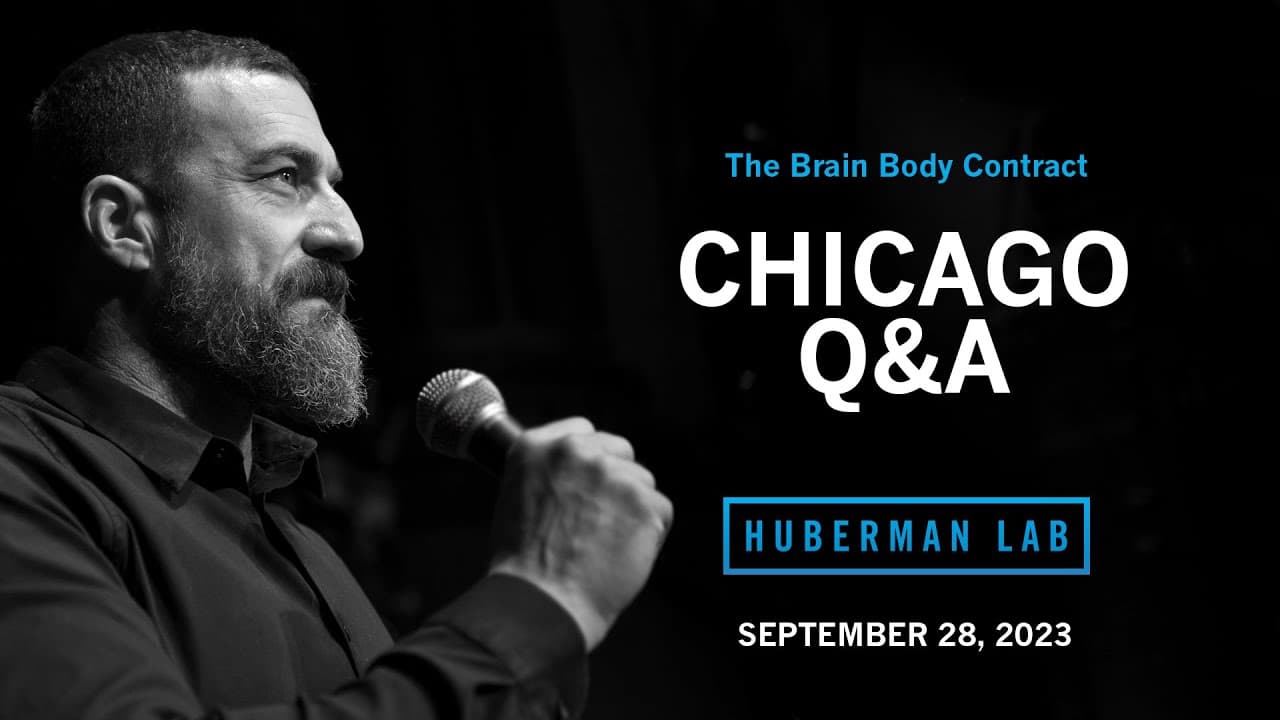
LIVE EVENT Q&A: Dr. Andrew Huberman Question & Answer in Chicago, IL
TL;DR
Andrew Huberman’s Chicago Q&A recommends supporting brain health with cardiovascular exercise, load-bearing movement, and resistance training two or three times per week. He suggests roughly 150 to 200 minutes of zone 2 cardio weekly and explains how sleep depends on body-temperature changes of about 1 to 3 degrees. Read on for his specific guidance on exercise, grip strength, sleep temperature, Eight Sleep, and AG1.
Transcript
ANDREW HUBERMAN: Welcome to the Huberman Lab podcast, where we discuss science and science-based tools for everyday life. [MUSIC PLAYING] Recently, the Huberman Lab hosted a live event at The Chicago Theater in Chicago, Illinois. The event consisted of a lecture entitled "The Brain Body Contract" followed by a question and answer session. We wanted... Read More
Key Insights
- 😴 The proper temperature in the sleeping environment is crucial for falling and staying asleep and feeling refreshed upon waking.
- 🧑⚕️ Load-bearing exercises can release hormones that support brain health, while cardiovascular and strength training exercises are beneficial for overall cognitive health.
- 🏃 Drugs that increase acetylcholine and dopamine levels may have potential in improving cognitive function, but caution should be exercised due to potential side effects.
- 😒 Psychedelics have gained attention for their potential therapeutic effects, but their use should be approached with caution, especially in individuals with a predisposition to mental health conditions.
- ❓ Hypnosis is a state of heightened attention and deep relaxation that can enhance neuroplasticity and be used for clinical and wellness purposes.
- 😪 Non-sleep deep rest practices like NSDR and meditation can offset sleep loss and improve focus and cognitive function.
- ⌛ The concept of time changes due to daylight saving time is not biologically favorable and can have negative effects on health and well-being.
- 🤳 Maximizing neuroplasticity in younger years involves engaging in physical activity, developing self-awareness practices, and seeking diverse experiences.
- 💗 The American education system should prioritize teaching students about the brain, body, and effective stress management strategies to navigate the challenges of growing up.
Install to Summarize YouTube Videos and Get Transcripts
Explore YouTube Video Summarizer or Get YouTube Transcript Extractor
Questions & Answers
Q: What does Andrew Huberman recommend for keeping the brain healthy in old age?
Huberman recommends doing the same things that improve cardiovascular health and the delivery of fuel to bodily tissues. He specifically highlights zone 2 cardio, load-bearing movement when tolerable, and resistance training two or three times per week.
Q: How much zone 2 cardio does Huberman recommend each week?
He suggests about 150 to 200 minutes of zone 2 cardio per week. He describes the intensity as movement during which you can just barely carry out a conversation.
Q: Why does cardiovascular health matter for brain function?
Huberman says the brain consumes substantial fuel and needs healthy capillaries, microcapillaries, and arteries to deliver it. For that reason, activities that improve cardiovascular health and tissue perfusion can improve brain functionality.
Q: How may load-bearing exercise support brain health?
Huberman says load-bearing movements can trigger bones to release hormones that cross the blood-brain barrier and may influence neurons in areas such as the hippocampus. He notes that this idea extends partly from preclinical animal data, although some human data are beginning to emerge.
Q: How often should people do resistance training?
Huberman says all people should perform some form of resistance training two or three times per week. He also cites a strong correlation between cognitive health and measures related to strength.
Q: How is grip strength related to cognitive decline?
Huberman says increasing asymmetry in grip strength between the two hands can indicate deficits in the brain’s control of the body. He adds that this asymmetry is correlated with cognitive decline.
Q: How does body temperature affect falling asleep and waking up?
Huberman says body temperature must drop by about 1 to 3 degrees to fall asleep and remain deeply asleep. To wake feeling refreshed and energized, body temperature must then increase by about 1 to 3 degrees.
Q: What sleep features does the Eight Sleep mattress cover provide?
Eight Sleep provides cooling, heating, and sleep-tracking capabilities. Users can program temperatures for the beginning, middle, and end of the night, while the cover tracks rapid eye movement and slow-wave sleep.
Summary & Key Takeaways
-
Andrew Huberman emphasizes the critical role of sleep in brain health and offers tips for improving sleep quality, including maintaining the correct temperature in the sleeping environment.
-
He recommends Eight Sleep mattress covers for regulating sleeping temperature and tracking sleep metrics, such as rapid eye movement and slow wave sleep.
-
Huberman also introduces AG1 drinks, which provide foundational nutritional needs to support mental and physical health.
Read in Other Languages (beta)
Share This Summary 📚
Summarize YouTube Videos and Get Video Transcripts with 1-Click
Try YouTube Summary with ChatGPT & Claude or YouTube Transcript Generator
Explore More Summaries from Andrew Huberman 📚



Summarize YouTube Videos and Get Video Transcripts with 1-Click
Try YouTube Summary with ChatGPT & Claude or YouTube Transcript Generator