How Does YouTube's Algorithm Really Work? (Uncovered With Claude Code)
TL;DR
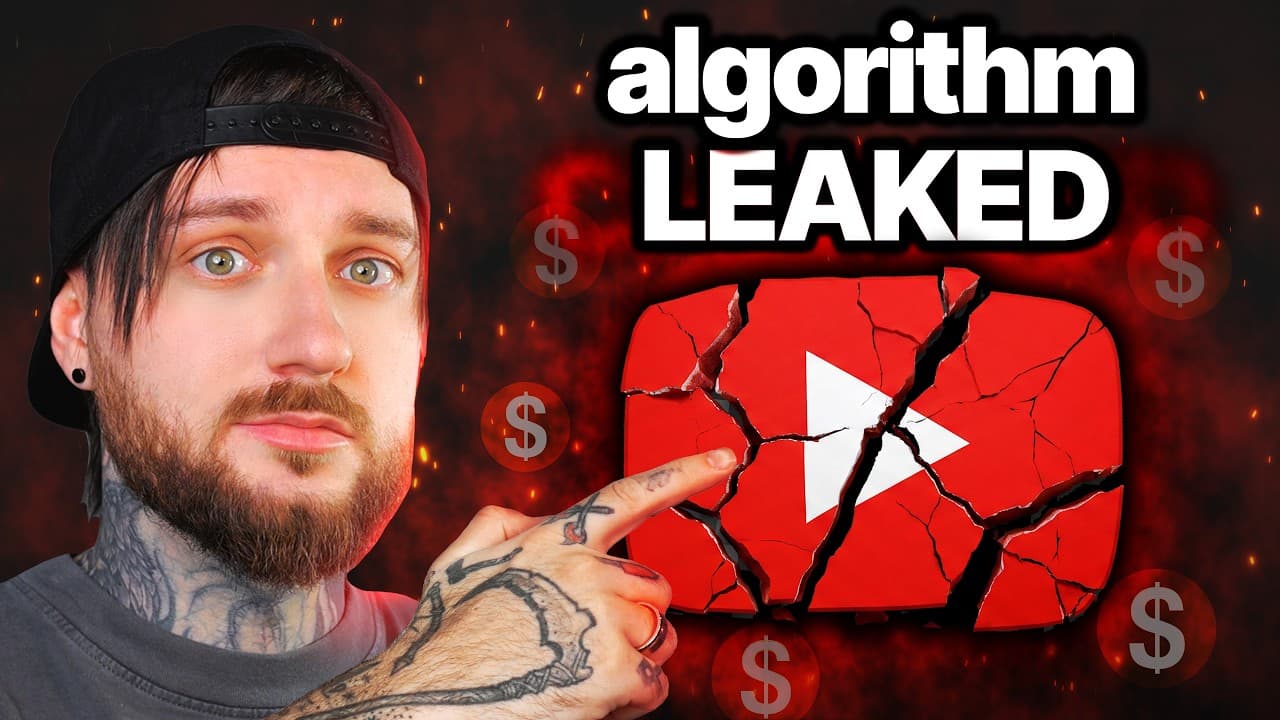
YouTube's algorithm is a matching system, not a ranking one: for every viewer it predicts what that person will most want to watch right now, so satisfaction is predicted before a video is ever shown. That is why a 6% click-through video reached almost 400,000 views while a polished 14% CTR, 60%-retention video stalled at 3,000. The system reads meaning through semantic IDs, topic clusters, and viewer intent. Read on for the triggers that actually spark reach.
Transcript
So, I just used clot code to leak me the YouTube algorithm and it worked. And what I've learned is that everything I knew about the YouTube algorithm is wrong. Clickthrough rate doesn't matter as much as I thought. Watch time doesn't matter as much as I thought. And the reason why I did this is because I posted a video on my channel that got a 10% ... Read More
Key Insights
- The YouTube algorithm is a matching system, not a ranking system, focusing on viewer satisfaction.
- Traditional metrics like click-through rate and watch time are less relevant than previously thought.
- Semantic understanding, topic clustering, and viewer intent modeling are key to how videos are recommended.
- Videos succeed when they match a viewer's current demand and satisfaction prediction.
- A video's semantic ID, not its keywords, determines its recommendation potential.
- Demand spikes, timing windows, external traffic, and session resonance are major triggers for video success.
- Viewer satisfaction is predicted before a video is shown, impacting its reach and engagement.
- Creators should focus on aligning content with viewer needs rather than trying to 'beat' the algorithm.
Install to Summarize YouTube Videos and Get Transcripts
Explore YouTube Video Summarizer or Get YouTube Transcript Extractor
Questions & Answers
Q: Why did a video with worse stats go viral while the better one flopped?
In the creator's own test, a video with 10% click-through and 5-minute average view duration underperformed, while another with only 6% click-through and 3-minute duration went viral to nearly 400,000 views. This happens because YouTube matches videos to current viewer demand rather than ranking them by their metrics. The messy video simply matched a topic the system had high demand and low supply for at that moment.
Q: Is YouTube a ranking system or a matching system?
It is a matching system, not a ranking system. Instead of ranking your video against others and pushing the winner, it asks a different question for every viewer: of everything on the platform, what is this specific person most likely to enjoy right now? Your video competes to be the best answer to that question, which is asked millions of times a day.
Q: Do click-through rate and watch time still matter on YouTube?
They matter far less than most creators assume. A decade ago the system mostly rewarded CTR and retention, but the system running YouTube in 2026 is a recommendation engine, not a spreadsheet of CTR and watch time. A video can hit 14% click-through and 60% retention and still die at 3,000 views if its intended audience is not currently in a state where the system will recommend it.
Q: What are semantic IDs in the YouTube algorithm?
A semantic ID is a compact numeric fingerprint that reduces your video to a list of numbers describing meaning, not keywords, capturing the topic, tone, pacing, emotional arc, and the kind of viewer who tends to finish it. Two videos with completely different titles can have nearly identical semantic IDs. Google's research teams have published extensively on semantic IDs, and YouTube's internal system is almost certainly the same shape.
Q: How does YouTube understand a video without matching keywords?
Three things run in parallel. Semantic understanding reads your title, transcript, thumbnail, and comments as meaning, so "make money online" and "side hustle ideas" land in the same neighborhood without sharing a word. Topic clustering turns every video into a point in high-dimensional space, where videos watched in the same session drift closer together. Viewer intent modeling then predicts what each viewer watches next based on patterns across millions of similar viewers.
Q: What triggers cause a video to succeed on YouTube?
Major triggers include demand spikes, timing windows, external traffic, and session resonance. Demand spikes come from news events or cultural moments, timing windows favor early videos in a new cluster, external traffic signals real human interest, and session resonance rewards videos that keep viewers on YouTube longer. These matter more than polishing craft, because trends are simply visible demand.
Q: How does external traffic help a video get recommended?
External traffic from sources like Reddit, Twitter, or newsletters signals to YouTube that real humans are interested in the video, not just its internal recommendations. This can boost the video's recommendation potential because it demonstrates genuine viewer interest coming from outside the platform.
Q: How should creators adapt to how the algorithm actually works?
Stop trying to beat a machine that stopped working that way years ago and stop optimizing purely for CTR and watch time. Instead, focus on understanding and matching current viewer demand and predicted satisfaction, since the algorithm matches your video to viewers rather than ranking it against other videos. You are effectively writing for a viewer the algorithm has already imagined in detail.
Summary & Key Takeaways
-
The YouTube algorithm functions as a matching system, prioritizing viewer satisfaction over traditional metrics like click-through rate and watch time. It uses semantic understanding, topic clustering, and viewer intent modeling to recommend videos. Success depends on aligning content with current viewer demand and satisfaction predictions.
-
Traditional metrics such as click-through rate and watch time have become less relevant in determining a video's success on YouTube. The algorithm now focuses on matching content to viewer demand and satisfaction, utilizing semantic IDs and predicting viewer engagement before showing videos.
-
Key triggers for video success include demand spikes, timing windows, external traffic, and session resonance. Creators should focus on understanding and meeting viewer needs, as the algorithm matches videos to viewers rather than ranking them against each other.
Read in Other Languages (beta)
Share This Summary 📚
Summarize YouTube Videos and Get Video Transcripts with 1-Click
Try YouTube Summary with ChatGPT & Claude or YouTube Transcript Generator
Explore More Summaries from Danny Why 📚

Summarize YouTube Videos and Get Video Transcripts with 1-Click
Try YouTube Summary with ChatGPT & Claude or YouTube Transcript Generator