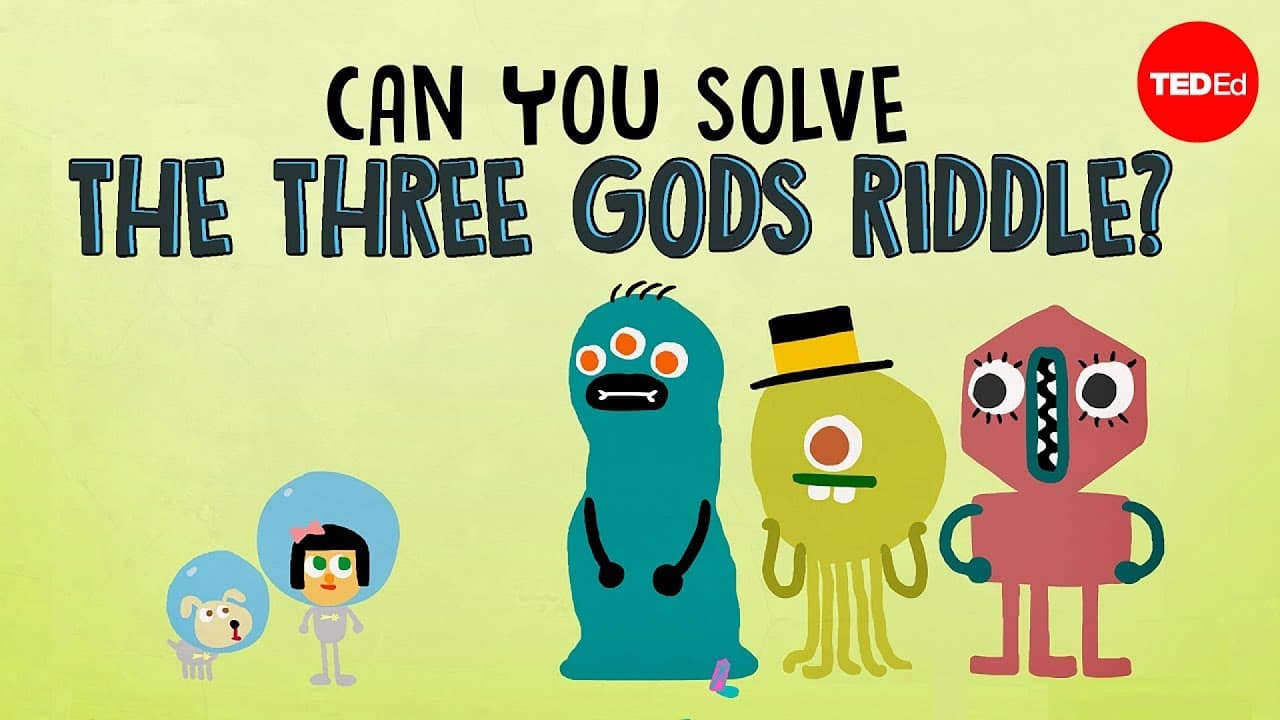
Can you solve the three gods riddle? - Alex Gendler
TL;DR
To solve the Three Gods riddle, strategically use embedded hypothetical questions to determine the identities of the aliens Tee, Eff, and Arr. By asking carefully crafted questions, you can navigate their truth-telling behavior and successfully identify each overlord despite language barriers, allowing for a logical path to escape the alien planet.
Transcript
Created by logician Raymond Smullyan and popularized by his colleague George Boolos, this riddle has been called the hardest logic puzzle ever. You and your team have crash-landed on an ancient planet. The only way off is to appease its three alien overlords, Tee, Eff, and Arr, by giving them the correct artifacts. Unfortunately, you don't know who... Read More
Key Insights
- 👽 Utilize embedded hypothetical questions to navigate a logic puzzle with alien overlords.
- 👽 Strategic questioning overcomes language barriers to reveal the truth-telling behavior of alien overlords.
- ⚾ The logical structure of questions enables the identification of Tee, Eff, and Arr based on their responses.
- 👽 Eliminate possibilities systematically to determine the identities of the alien overlords accurately.
- 👽 Craft precise questions to reveal the true nature of each alien overlord and secure escape from the planet.
- 👽 Leveraging unique behavioral traits of alien overlords to deduce their identities strategically.
- 🧩 Effective questioning techniques assist in unraveling complex puzzles involving truth-telling and deceptive beings.
Install to Summarize YouTube Videos and Get Transcripts
Explore YouTube Video Summarizer or Get YouTube Transcript Extractor
Questions & Answers
Q: What is the premise of the logic puzzle involving the alien overlords?
The logic puzzle entails identifying alien overlords Tee, Eff, and Arr on an ancient planet by asking strategic yes or no questions while dealing with a language barrier that obscures the meanings of 'ozo' and 'ulu.'
Q: How is the challenging puzzle solved in the scenario with Tee, Eff, and Arr?
By formulating questions with embedded hypothetical conditions, the answer to which reveals the true identity of each alien overlord based on their behavior of telling the truth, lying, or responses that are random.
Q: How does the questioning strategy help differentiate between Tee, Eff, and Arr?
The strategic questioning approach allows for the elimination of possibilities by asking each overlord tailored questions that expose their truthfulness or deceit, ultimately leading to the identification of each alien lord.
Q: How does the logical structure of questions aid in solving the puzzle?
Crafting questions with embedded hypothetical scenarios leverages the logic of double positives and negatives to ensure that responses from Tee and Eff will yield consistent outcomes indicative of the truth, allowing for the deduction of alien identities.
Summary
Created by logician Raymond Smullyan and popularized by his colleague George Boolos, this riddle has been called the hardest logic puzzle ever. You and your team have crash-landed on an ancient planet. The only way off is to appease its three alien overlords, Tee, Eff, and Arr, by giving them the correct artifacts. Unfortunately, you don't know who is who. From an inscription, you learn that you may ask three yes or no questions, each addressed to any one lord. Tee's answers are always true, Eff's are always false, and Arr's answer is random each time. But there's a problem. You've deciphered the language enough to ask any question, but you don't know which of the two words 'ozo' and 'ulu' means yes and which means no. How can you still figure out which alien is which?
Questions & Answers
Q: How can you figure out which alien is which?
At first, this puzzle seems not just hard, but downright impossible. What good is asking a question if you can neither understand the answer nor know if it's true? But it can be done. The key is to carefully formulate our questions so that any answer yields useful information.
Q: How do we deal with not knowing what 'ozo' and 'ulu' mean?
To get around not knowing the meanings of 'ozo' and 'ulu', we can include the words themselves in our questions. This way, even if we don't understand their answers, we can still gather information from the response.
Q: How can we make sure that whether an alien is lying or not won't matter?
By loading each question with a hypothetical condition, whether an alien is lying or not won't actually matter. This is because we can be sure that asking either Tee or Eff a question in this way will yield 'ozo' if the hypothetical question is true and 'ulu' if it's false regardless of what each word actually means.
Q: Can you give an example to illustrate how this works?
Imagine if our question is whether two plus two is four. Instead of asking it directly, we say, "If I asked you whether two plus two is four, would you answer 'ozo'?" If 'ozo' means yes and the overlord is Tee, it truthfully replies, "ozo." But if we ask Eff, it would answer "ulu," or no to the embedded question, so it lies and replies 'ozo' instead. And if 'ozo' actually means no, then the answer to our embedded question is 'ulu,' and both Tee and Eff still reply 'ozo,' each for their own reasons. This way, we can still gather useful information from their responses.
Q: How can we identify one alien lord that definitely isn't Arr?
We can use our first question to identify one alien lord that definitely isn't Arr. We ask the alien in the middle, "If I asked you whether the overlord on my left is Arr, would you answer 'ozo'?" If the reply is 'ozo,' there are two possibilities. Either we are already talking to Arr, in which case the answer is meaningless, or we are talking to either Tee or Eff. In both cases, getting 'ozo' means that our hypothetical question was correct, and the left overlord is indeed Arr. Either way, we can be sure that the alien on the right is not Arr.
Q: How can we determine whether the alien we identified is Tee or Eff?
Once we have determined that the alien on the right is not Arr, we can use the second question to find out whether it is Tee or Eff. We ask the alien we've identified, "If I asked 'are you Eff?' would you answer 'ozo'?" Since we don't have to worry about the random possibility for Arr, either answer will establish the alien's identity.
Q: How can we identify the remaining alien lord?
Now that we know whether the alien's answers are true or false, we can ask the same alien whether the center overlord is Arr. Using the process of elimination, we can identify the remaining alien lord.
Q: What happens after we identify all the alien lords?
Once we have identified all the alien lords, the satisfied overlords help us repair our ship and we prepare for takeoff. However, we still don't know the meaning of 'ozo' and 'ulu', which leaves us unsure of Tee's answer when we ask if it's a long way to Earth.
Takeaways
In this logic puzzle, although initially difficult, it is possible to figure out which alien is which by carefully formulating questions that yield useful information, despite not knowing the meaning of certain words. By using hypothetical conditions in our questions and eliminating possibilities through a process of elimination, we can determine the identity of each alien lord. However, it is important to note that understanding the meaning of their responses may still be a challenge.
Summary & Key Takeaways
-
Crash-landed on an alien planet, solve a logic puzzle to identify alien lords Tee, Eff, and Arr.
-
Through strategic questioning, deduce alien identities by leveraging knowledge of their truth-telling behavior.
-
Craft questions carefully to reveal each overlord's identity and secure escape from the planet.
Read in Other Languages (beta)
Share This Summary 📚
Summarize YouTube Videos and Get Video Transcripts with 1-Click
Try YouTube Summary with ChatGPT & Claude or YouTube Transcript Generator
Explore More Summaries from TED-Ed 📚

Summarize YouTube Videos and Get Video Transcripts with 1-Click
Try YouTube Summary with ChatGPT & Claude or YouTube Transcript Generator