How to Use OpenAI, AssemblyAI, and Replicate APIs in Python?
TL;DR
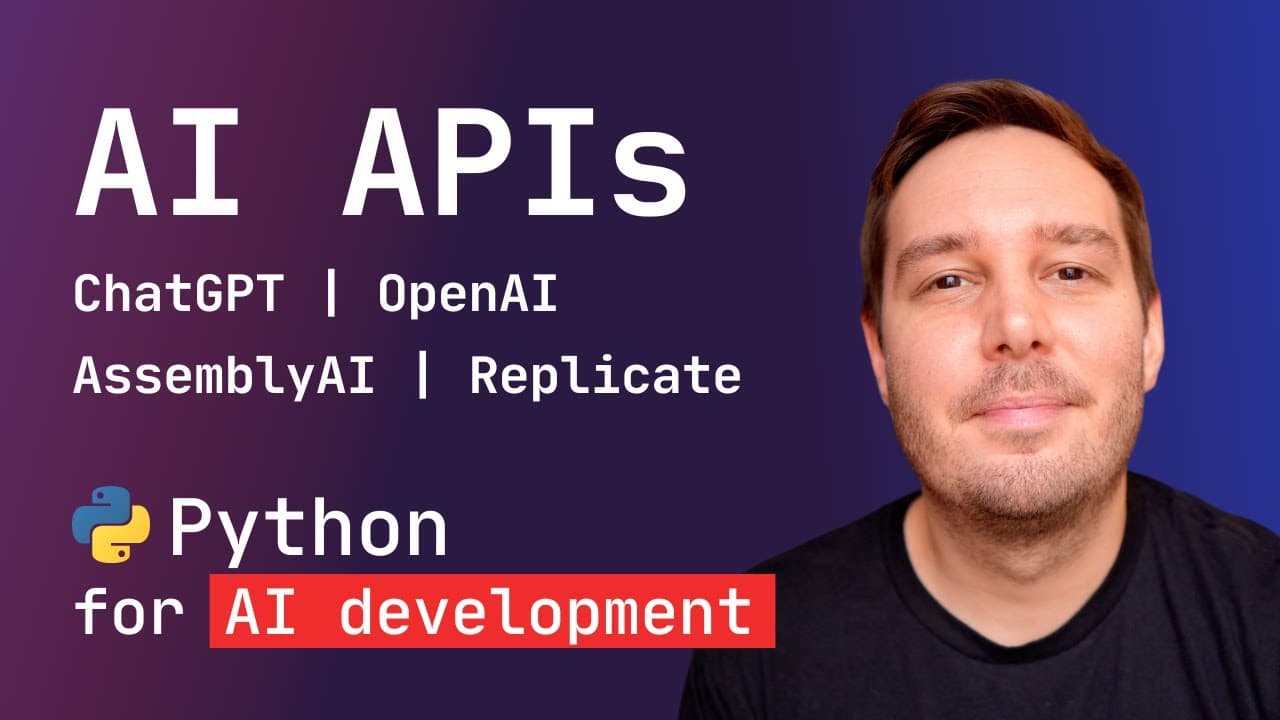
To use OpenAI, AssemblyAI, and Replicate APIs in Python, start by signing up for each service to obtain your API keys. Utilize the OpenAI API for language processing, AssemblyAI for transcribing and understanding audio files, and Replicate for deploying machine learning models with minimal code. This enables you to build diverse AI applications efficiently.
Transcript
hi everyone I'm Patrick from assembly Ai and welcome back to our final lesson of the Python 4 AI development course so far you have learned how to set up a development environment with python how to prepare data and then build your own models how to leverage model hubs and now we look at apis for AI development so using apis is for sure the simples... Read More
Key Insights
- 🔠 OpenAI API allows access to large language models with simple API calls like chat examples and text generation.
- 😯 Assembly AI facilitates speech recognition and transcription by uploading audio files for conversion to text.
- 😶🌫️ Replicate API offers easy deployment of machine learning models in the cloud for various tasks like image generation.
- 🔠 Securing API tokens in Python is crucial for safe and efficient access to different APIs.
- 😒 Python libraries like python-dotenv make it easy to load and use API tokens securely in Python code.
- 🤗 AI development with APIs opens up possibilities for diverse applications like language processing, speech recognition, and machine learning tasks.
- 📽️ Experimenting with different AI APIs like OpenAI, Assembly AI, and Replicate broadens the scope of AI development projects.
Install to Summarize YouTube Videos and Get Transcripts
Explore YouTube Video Summarizer or Get YouTube Transcript Extractor
Questions & Answers
Q: How can you access large language models using the OpenAI API?
You can access large language models by signing up on platform.openai.com, obtaining an API key, and making API calls to leverage models like GPT for chat examples and text generation.
Q: What is the functionality of Assembly AI in AI development?
Assembly AI is used for speech recognition and transcription, enabling users to upload audio files for conversion to text, with options for different AI models like transcription and summarization.
Q: How can you work with the Replicate API for running machine learning models?
To work with the Replicate API, sign up on replicates.com, obtain an API token, and explore and use various machine learning models available on the platform, running them in the cloud with a few lines of Python code.
Q: How can you securely store and load API tokens in Python for different APIs?
You can securely store API tokens in Python by creating a .env file with environment variables like API tokens, then load them using python-dotenv to access them in your code securely.
Summary & Key Takeaways
-
Learn to use OpenAI API for accessing large language models through simple API calls.
-
Explore Assembly AI for speech recognition and transcription by uploading audio files.
-
Discover Replicate API for running machine learning models in the cloud effortlessly.
Read in Other Languages (beta)
Share This Summary 📚
Summarize YouTube Videos and Get Video Transcripts with 1-Click
Try YouTube Summary with ChatGPT & Claude or YouTube Transcript Generator
Explore More Summaries from AssemblyAI 📚


Summarize YouTube Videos and Get Video Transcripts with 1-Click
Try YouTube Summary with ChatGPT & Claude or YouTube Transcript Generator