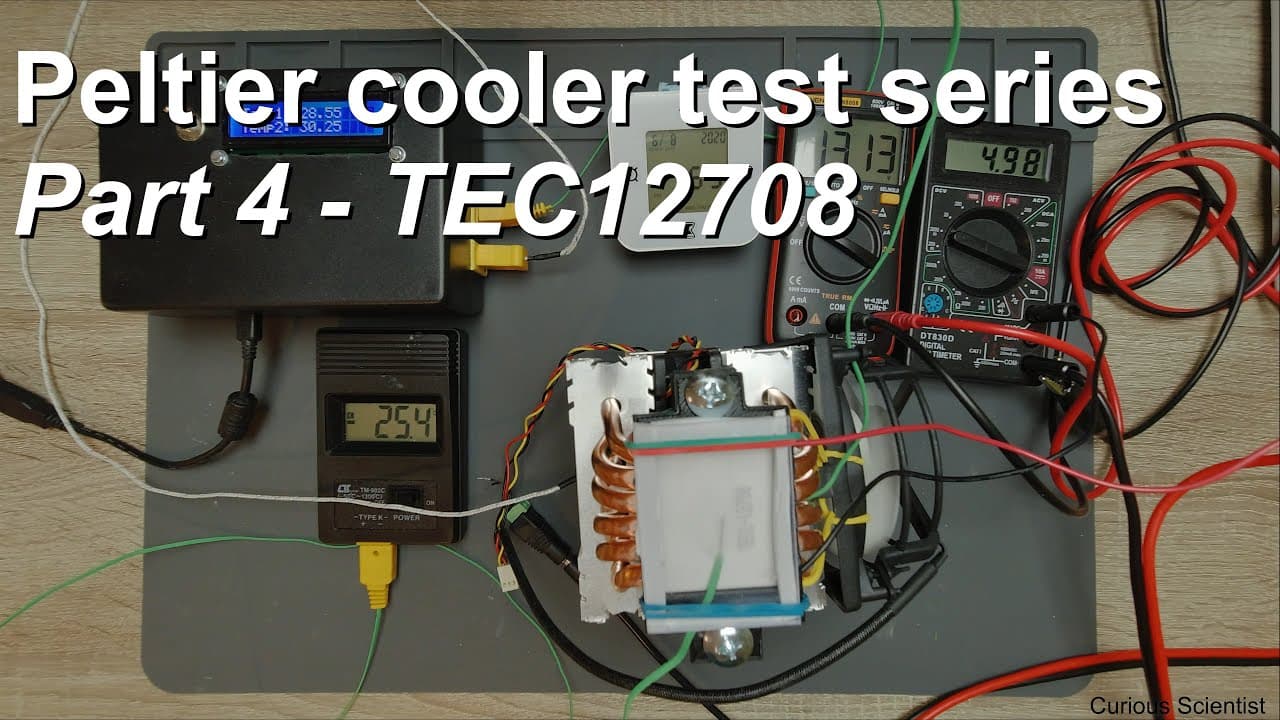
How Does the DEC 12708 Thermoelectric Cooler Perform?
TL;DR
The DEC 12708 thermoelectric cooler achieves a cold side temperature of approximately -25 degrees Celsius at optimal current settings of around 4 to 5 amperes, proving efficient cooling performance. However, exceeding certain currents leads to reduced efficiency due to the Joule effect, demonstrating the importance of balancing current supply and thermal management.
Transcript
welcome everyone this is the next part of the series where i'm testing different types of thermoelectric coolers and in this episode i'm going to test the dec 12708 so this is the 8 ampere unit so that's the maximum current and the setup is the same but i repeat it quickly so the temp one here is the green wire which goes to the back side of the he... Read More
Key Insights
- 🛀 The DEC 12708 cooler shows a notable ability to create substantial temperature differentials, achieving up to -25 degrees Celsius under optimal conditions.
- ⚖️ There is a critical balance between the current supplied and the cooler's efficiency; exceeding certain current thresholds results in reduced performance due to the Joule effect.
- ❓ Maintaining thermal contact is essential for precise temperature measurement, highlighting the importance of setup stability in experimental conditions.
- 💱 The method of testing is systematic, involving a stepwise approach in current adjustments to progressively observe temperature changes, supporting scientific rigor in the analysis.
- 💐 The experiment reinforces the principle that Peltier devices have variable thermal resistance based on temperature changes, influencing current flow during operation.
- 🙂 Realizations from the experiment emphasize that even under light loads, effective cooling is achievable, as seen with the cooler still maintaining reasonable cold side temperatures at lower currents.
- 😘 The cooling capability of the DEC 12708 is notable for applications requiring low temperatures in confined spaces, making it versatile for various uses.
Install to Summarize YouTube Videos and Get Transcripts
Explore YouTube Video Summarizer or Get YouTube Transcript Extractor
Questions & Answers
Q: What is the DEC 12708 thermoelectric cooler and what are its specifications?
The DEC 12708 is an 8-ampere thermoelectric cooler designed for efficient cooling through Peltier effect technology. It can achieve significant temperature differentials, making it suitable for applications requiring controlled cooling. The tests performed showcase how this unit operates when subject to varying electrical currents and its ability to maintain low temperatures in controlled conditions.
Q: How was the experiment structured to test the DEC 12708 cooler?
The experiment involved setting up a controlled environment where the DEC 12708 was connected to various measuring instruments. The setup included a CPU cooler to dissipate heat from the hot side of the Peltier, along with thermocouples to accurately measure cold and hot side temperatures while adjusting the current in small increments, allowing for precise observation of temperature changes over time.
Q: What were the key findings related to temperature changes as current varied?
As the current was increased from 1 to 8 amperes, the cold side temperature was observed to drop significantly, reaching -25.4 degrees Celsius at 5 amperes. However, at higher currents, particularly beyond 5 amperes, a slight temperature increase was noted due to the Joule effect, indicating reduced efficiency of cooling.
Q: What challenges were encountered during the testing?
One of the main challenges noted during testing was ensuring good thermal contact between the thermocouples and the surfaces being measured. This affected temperature readings, especially when adjusting the setup, which required careful positioning to obtain accurate data reflecting the cooler's performance.
Summary & Key Takeaways
-
The video explores the performance of the DEC 12708 thermoelectric cooler, measuring temperature variations at various current levels from 1 to 8 amperes.
-
Initial tests showed a cold side temperature of approximately -23.4 degrees Celsius at around 4 amperes, demonstrating efficient cooling capabilities.
-
The presenter discusses the interplay between current, voltage, and temperature, noting the occurrence of the Joule effect as current increases, affecting cooling performance.
Read in Other Languages (beta)
Share This Summary 📚
Summarize YouTube Videos and Get Video Transcripts with 1-Click
Try YouTube Summary with ChatGPT & Claude or YouTube Transcript Generator
Explore More Summaries from Curious Scientist 📚

![Building a coil winder [Part 6] - A few improvements thumbnail](/_next/image?url=https%3A%2F%2Fi.ytimg.com%2Fvi%2F3eyxG_g2iUA%2Fhqdefault.jpg&w=750&q=75)


Summarize YouTube Videos and Get Video Transcripts with 1-Click
Try YouTube Summary with ChatGPT & Claude or YouTube Transcript Generator