TU Wien Rendering #6 - Snell's Law and Total Internal Reflection
TL;DR
Snell’s law determines how a light ray changes direction when it crosses into a medium where its speed differs, while total internal reflection occurs above the critical angle. TU Wien Rendering #6 shows that glass with an index of refraction of 1.5 slows light from 300 million m/s to 200 million m/s and calculates a transmitted angle of 34.75° for a 60° incident angle. Read on for the equations and physical intuition behind these effects.
Transcript
there is still one thing that we don't know and it's about angles so we know about probabilities whatever you give me i can tell you what is the probability that light gets reflected or refracted i know the probabilities but i don't know about angles and what we need to know is that light rays of light slow down they travel with the speed of light ... Read More
Key Insights
- 🚄 The index of refraction determines the speed of light in a medium, with a higher index of refraction resulting in slower light speed.
- 🙂 Light waves slow down and change direction, or refract, when they enter a different medium.
- 🙌 Refraction can be explained by imagining light as both a wave and a ray, with the wavefronts bending and the ray changing direction.
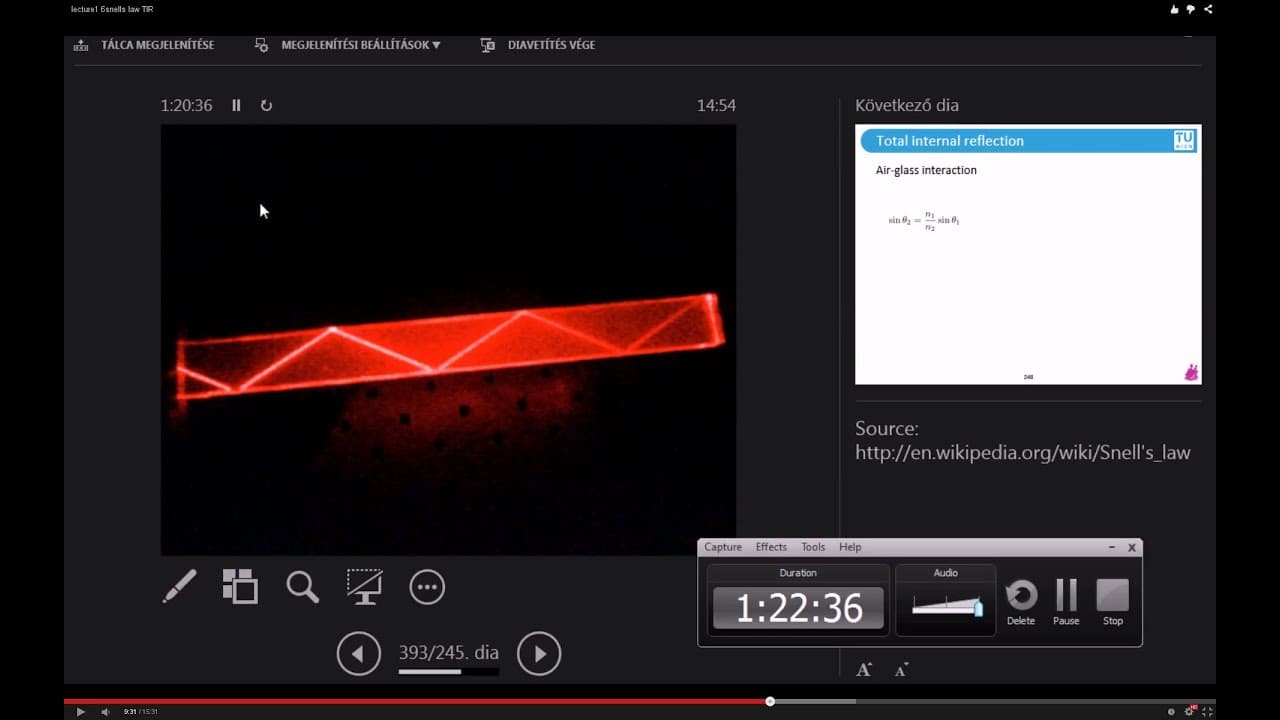
- 🔉 Total internal reflection occurs when light is reflected back into the original medium instead of refracting into a new medium, and it happens when the angle of incidence is greater than the critical angle.
- 🫰 The critical angle can be calculated using the equation sin(theta_c) = n2/n1, where n2 is the index of refraction of the medium the light is coming from and n1 is the index of refraction of the new medium.
- 🔺 The critical angle determines the maximum angle of incidence at which refraction is possible.
- 🙂 Light waves continue to follow the laws of physics and mathematics, as evidenced by the success of calculations and predictions in the study of refraction.
Install to Summarize YouTube Videos and Get Transcripts
Explore YouTube Video Summarizer or Get YouTube Transcript Extractor
Questions & Answers
Q: How does Snell’s law determine the angle of a refracted light ray?
Snell’s law relates the incident and transmitted angles to the light velocities and the reciprocal of the media’s indices of refraction. Using the known incident angle and refractive indices, the equation can be rearranged and the inverse sine applied to calculate the transmitted angle.
Q: What is the index of refraction?
The index of refraction of a medium is the speed of light in a vacuum divided by the speed of light in that medium. It therefore states exactly how much light slows down after entering the medium.
Q: How fast does light travel through glass with an index of refraction of 1.5?
The lecture uses a vacuum speed of 300 million m/s and a glass index of refraction of 1.5. Rearranging the index equation gives a speed of 200 million m/s in the glass, meaning the light loses one-third of its vacuum velocity.
Q: Why does light bend when it enters a different medium?
Light slows down when it enters a medium because it encounters atoms and particles there. Viewed as a wave, its wavefronts bend as they slow; viewed as a ray, this appears as a change in direction.
Q: Why does light refract inward when it enters glass from air or a vacuum?
The lecture illustrates this with a large car moving from a road into mud: the wheel entering the mud first slows while the other side keeps moving faster, causing the car to turn inward. This is explicitly presented as intuition rather than a literal physical model of light.
Q: What transmitted angle does Snell’s law give for a 60° incident angle in the lecture example?
The calculation gives a transmitted angle of 34.75°. This is close to the initial estimate of 35° and confirms the expectation that the transmitted angle is smaller than the 60° incident angle.
Q: What is total internal reflection?
Total internal reflection occurs when light is reflected back into its original medium instead of refracting into the new medium. It happens when the angle of incidence is greater than the critical angle for the two media.
Q: What does the critical angle represent?
The critical angle is the maximum angle of incidence at which refraction remains possible. The page gives its relationship as sin(theta_c) = n2/n1; beyond the critical angle, total internal reflection occurs.
Summary & Key Takeaways
-
Light slows down when it enters a medium because of the atoms and particles it encounters, which makes it more difficult for the light to travel through.
-
The speed of light in a medium is determined by the index of refraction, which is the ratio of the speed of light in vacuum to the speed of light in the medium.
-
When light enters a medium, it changes direction, or bends, due to the bending of the wavefronts of the light waves.
Read in Other Languages (beta)
Share This Summary 📚
Summarize YouTube Videos and Get Video Transcripts with 1-Click
Try YouTube Summary with ChatGPT & Claude or YouTube Transcript Generator
Explore More Summaries from Two Minute Papers 📚




Summarize YouTube Videos and Get Video Transcripts with 1-Click
Try YouTube Summary with ChatGPT & Claude or YouTube Transcript Generator