TU Wien Rendering #31: What Are Unbiased and Consistent Algorithm Classes?
TL;DR
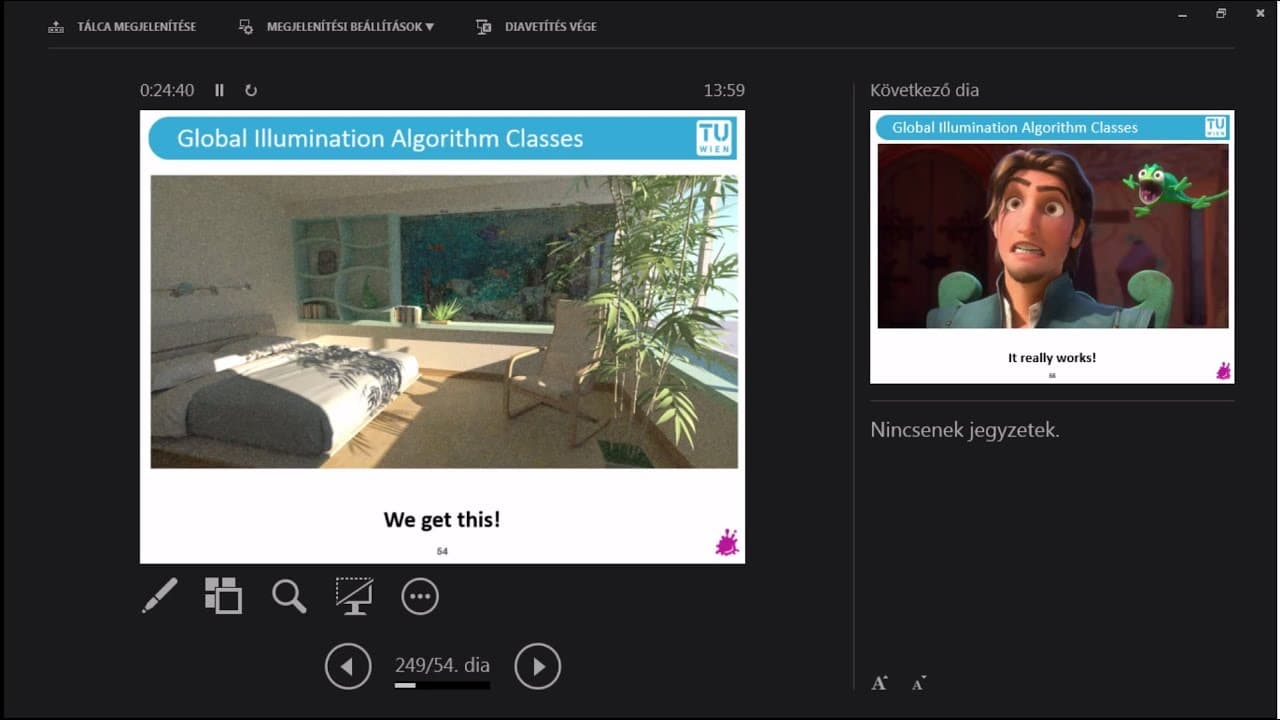
Consistent rendering algorithms converge to the correct integral with infinitely many Monte Carlo samples, while unbiased algorithms have an expected estimation error of zero regardless of sample count. Neither property guarantees an immediately accurate image: consistency says nothing about convergence speed, and unbiasedness says nothing about variance. The lecture also explains the sampler–camera–integrator–film architecture shared by PBRt and LuxRender, so read on for practical examples of these distinctions.
Transcript
let's talk about just briefly about the pbrt architecture pbrt is not exactly the renderer that we are going to use we're going to use Lux render but Lux render was built upon pbrt and therefore the basic structure remained completely intact and this is a really good architecture that you would see that many of the rendering engines out there globa... Read More
Key Insights
- 🌐 PBRt serves as the foundation for the Luxrender rendering engine, providing a reliable and widely-used architecture for global illumination rendering.
- 🙂 Luxrender offers additional features such as a film class and light groups, allowing for greater control and flexibility in the rendering process.
- ⌛ Consistent algorithms guarantee convergence to the correct answer over time, while unbiased algorithms have an expected error of zero, reducing the impact of noise in the final image.
Install to Summarize YouTube Videos and Get Transcripts
Explore YouTube Video Summarizer or Get YouTube Transcript Extractor
Questions & Answers
Q: What is the difference between unbiased and consistent rendering algorithms?
A consistent algorithm converges exactly to the correct integral when given an infinite number of Monte Carlo samples. An unbiased algorithm instead has an expected estimation error of zero for any number of samples, but that does not mean each individual estimate is error-free.
Q: What does consistency mean in Monte Carlo rendering?
Consistency means that an algorithm approaches the exact integral as the number of Monte Carlo samples becomes infinite. It guarantees eventual convergence to the right answer, not how quickly that convergence occurs.
Q: Does a consistent rendering algorithm have to be fast?
No. The lecture notes that a theoretically consistent algorithm might still fail to produce the correct image after two weeks because consistency places no limit on convergence time.
Q: What does unbiasedness mean in rendering?
Unbiasedness means that the expected error of the estimate is zero, independently of the number of samples taken. It does not mean that the actual error is zero or that one sample per pixel produces the correct result.
Q: Does an unbiased algorithm guarantee low variance?
No. Unbiasedness describes the expected value of the estimation error and says nothing about variance, so an unbiased result can still be noisy.
Q: How does the PBRt rendering architecture work?
A render task asks a sampler for random samples and sends a sample to the camera, which returns a ray aimed at the selected pixel. The integrator calculates the radiance traveling along that ray, and the result is written to a film.
Q: How is LuxRender related to PBRt?
LuxRender was built upon PBRt and retains the same basic rendering architecture. That structure uses a sampler, camera, integrator, and film, and the lecture says many global-illumination rendering engines follow it.
Q: What can LuxRender's film class and light groups do?
The film class can store contributions such as direct and indirect illumination or individual light sources in separate buffers. LuxRender can then dim, remove, or recombine those contributions through its GUI without rendering the entire scene again.
Summary & Key Takeaways
-
PBRt serves as the foundation for Luxrender, with Luxrender building upon PBRt's architecture.
-
The rendering process involves the use of a sampler to generate random samples, which are then used to calculate radiance for each pixel.
-
Luxrender offers a film class that allows for the separation and manipulation of different contributions in the rendering process.
Read in Other Languages (beta)
Share This Summary 📚
Summarize YouTube Videos and Get Video Transcripts with 1-Click
Try YouTube Summary with ChatGPT & Claude or YouTube Transcript Generator
Explore More Summaries from Two Minute Papers 📚




Summarize YouTube Videos and Get Video Transcripts with 1-Click
Try YouTube Summary with ChatGPT & Claude or YouTube Transcript Generator