What Are the Different Electron Sources in Microscopy?
TL;DR
The main electron sources in microscopy are tungsten filament, lanthanum hexaboride, and field emission guns. Tungsten provides a larger size but lower brightness, while lanthanum hexaboride and field emission guns offer higher brightness and better imaging quality. Each source has specific vacuum and operational temperature requirements that impact electron emission quality and resolution.
Transcript
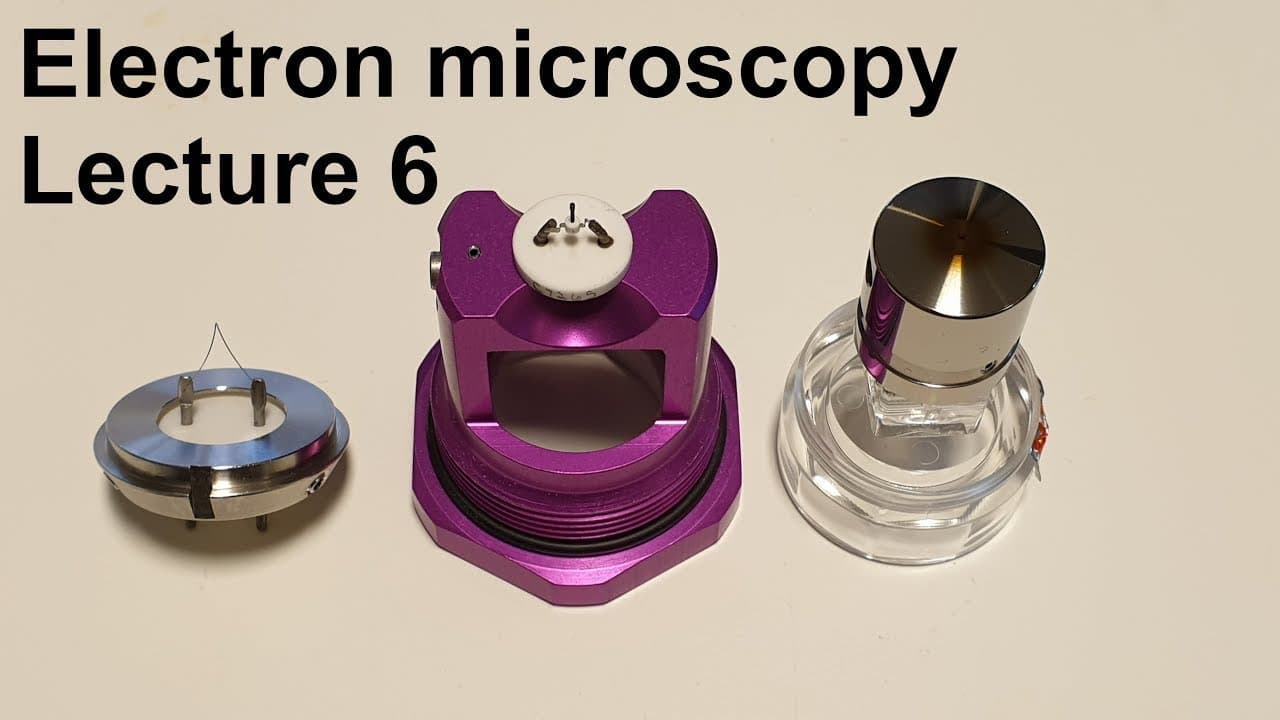
welcome everyone in this video I'm going to talk about the different sources used in electron microscopy as you can see on the picture there are three objects so each of them are different sources so I wrote their name below them so if we start from the left so this is a small piece of tungsten filament so you can see that filament goes up and down... Read More
Key Insights
- 🏑 Tungsten filament, lanthanum hexaboride, and field emission guns are the primary sources for electron emission in microscopy.
- 🔅 The tungsten filament provides a larger source size but with lower brightness compared to lanthanum hexaboride and field emission guns.
- ✋ All electron sources require specific vacuum conditions, with field emission guns necessitating the highest vacuum levels for optimal performance.
- 🔅 Enhanced brightness in electron sources correlates with improved imaging capabilities and is quantified in amperes per square centimeter.
- 😁 The energy spread of emitted electrons affects image quality by influencing the focusing ability of the electron beam, with lower spread leading to better resolution.
- 🪡 Operating temperature varies significantly across different sources, impacting their efficiency and the conditions needed for emission.
- 👻 Higher current densities in field emission guns allow for superior imaging quality, making them preferred in advanced microscopy applications.
Install to Summarize YouTube Videos and Get Transcripts
Explore YouTube Video Summarizer or Get YouTube Transcript Extractor
Questions & Answers
Q: What are the three main electron sources discussed in the video?
The video discusses tungsten filament, lanthanum hexaboride, and field emission guns as the main electron sources used in microscopy. Each source has unique characteristics that affect electron emission, including size, brightness, and efficiency, which are critical for obtaining high-quality images in electron microscopy.
Q: How does the size of the electron source affect microscopy results?
The size of the electron source impacts the resolution and beam current. Smaller sources, like lanthanum hexaboride and field emission guns, enable higher resolution images due to reduced electron spread, while larger sources may provide more significant beam currents but poorer image quality as they can compromise resolution.
Q: Why are vacuum requirements important in electron sources?
Vacuum requirements are crucial because they prevent contamination and interference with electron paths. Higher vacuum levels are necessary for sources like field emission guns to achieve good reliability and lifetimes since lower contamination levels extend the life and performance of the electron source.
Q: What is the operating temperature for the tungsten filament in electron microscopy?
The operating temperature for tungsten filament sources in electron microscopy is around 2,800 Kelvin. This high temperature is required to allow sufficient thermal energy for electron emission. In contrast, other types of sources like lanthanum hexaboride operate at lower temperatures, approximately 1,900 Kelvin, highlighting the temperature sensitivity of different electron sources.
Summary & Key Takeaways
-
The video describes three main electron sources for microscopy: tungsten filament, lanthanum hexaboride, and field emission guns, including their characteristics and applications.
-
It provides detailed illustrations of each source's structure, emphasizing their physical size, brightness, energy spread, vacuum requirements, and operational temperatures.
-
The discussion highlights how these factors influence electron emission quality and reliability, which directly impacts microscopic imaging resolution.
Read in Other Languages (beta)
Share This Summary 📚
Summarize YouTube Videos and Get Video Transcripts with 1-Click
Try YouTube Summary with ChatGPT & Claude or YouTube Transcript Generator
Explore More Summaries from Curious Scientist 📚


![Building a coil winder [Part 6] - A few improvements thumbnail](/_next/image?url=https%3A%2F%2Fi.ytimg.com%2Fvi%2F3eyxG_g2iUA%2Fhqdefault.jpg&w=750&q=75)

Summarize YouTube Videos and Get Video Transcripts with 1-Click
Try YouTube Summary with ChatGPT & Claude or YouTube Transcript Generator