What Is the Thalamus and Its Major Functions in the Brain?
TL;DR
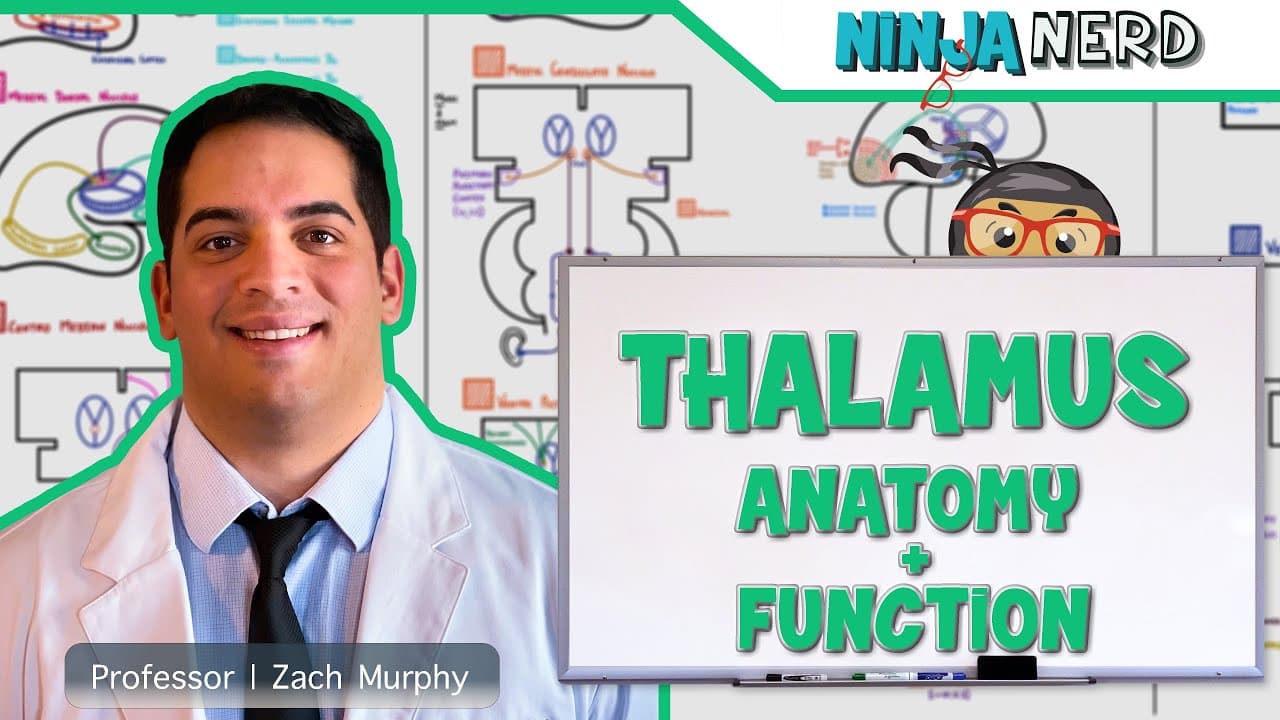
The thalamus serves as a crucial relay station for limbic, sensory, and motor information, transmitting this data to the cerebral cortex. Key nuclei include the anterior and medial dorsal nuclei for emotional memory, the lateral and medial geniculate nuclei for visual and auditory information, and the ventral posterior nuclei for processing sensory data like pain and touch.
Transcript
all right ninja nerds in this video today we are going to talk about the thalamus we're going to get into tons of detail on all the various nuclei their overall functions i just want to give a big shout out because this video that we're going to do on the thalamus today is because of one of our ninja nerds aim so because aim is one of our master ni... Read More
Key Insights
- 🌵 The thalamus acts as a relay station for limbic, sensory, and motor information, sending it to the cerebral cortex.
- 👨🦼 Different nuclei within the thalamus have specialized functions, including emotional episodic memory, visual and auditory processing, coordination of movement, and motor modulation.
- 🔢 The thalamus receives input from structures like the basal ganglia and the cerebellum to refine and modulate motor movements.
- ℹ️ The ventral lateral nucleus receives information from the basal ganglia and the cerebellum, contributing to the coordination and modulation of motor movements.
- ▶️ The pulvinar nucleus plays a role in visual processing, receiving information from the lateral geniculate nucleus, superior and inferior colliculi, and sending it to the visual association areas and primary visual cortex.
- 🎨 The ventral posterior lateral nucleus processes sensory information related to pain, temperature, touch, and proprioception, sending it to the primary somatosensory cortex.
- 🅰️ The thalamus has a complex network of connections with various brain regions, allowing for the integration and processing of different types of information.
Install to Summarize YouTube Videos and Get Transcripts
Explore YouTube Video Summarizer or Get YouTube Transcript Extractor
Questions & Answers
Q: What is the basic function of the thalamus?
The thalamus acts as a relay station for three types of information: limbic, sensory, and motor, by sending the information to the cerebral cortex.
Q: Which nucleus is responsible for emotional episodic memory?
The anterior thalamic nucleus is involved in emotional episodic memory, particularly through a circuit called the Papez circuit. Damage to this circuit can result in conditions like Alzheimer's and Parkinson's disease.
Q: What is the role of the ventral lateral nucleus?
The ventral lateral nucleus receives input from the basal ganglia and the cerebellum to coordinate and modulate motor movements, sending the refined motor plan to the primary motor cortex.
Q: Which nucleus is responsible for the visual pathway?
The lateral geniculate nucleus receives visual information from the optic tract and sends it to the primary visual cortex in the occipital lobe.
Q: How is auditory information processed in the thalamus?
The medial geniculate nucleus receives auditory information from the inferior colliculus and sends it to the primary auditory cortex in the temporal lobe.
Q: What is the main function of the ventral posterior lateral nucleus?
The ventral posterior lateral nucleus processes sensory information related to pain, temperature, touch, and proprioception and sends it to the primary somatosensory cortex.
Q: What is the significance of the pulvinar nucleus?
The pulvinar nucleus receives visual and auditory information from several sources and sends it to the visual association areas and the primary visual cortex for perception and recognition of visual stimuli.
Q: How does the ventral anterior nucleus contribute to motor movement?
The ventral anterior nucleus receives input from the basal ganglia and plays a role in initiating and planning motor movements, sending the refined motor plan to the premotor cortex.
Key Insights:
- The thalamus acts as a relay station for limbic, sensory, and motor information, sending it to the cerebral cortex.
- Different nuclei within the thalamus have specialized functions, including emotional episodic memory, visual and auditory processing, coordination of movement, and motor modulation.
- The thalamus receives input from structures like the basal ganglia and the cerebellum to refine and modulate motor movements.
- The ventral lateral nucleus receives information from the basal ganglia and the cerebellum, contributing to the coordination and modulation of motor movements.
- The pulvinar nucleus plays a role in visual processing, receiving information from the lateral geniculate nucleus, superior and inferior colliculi, and sending it to the visual association areas and primary visual cortex.
- The ventral posterior lateral nucleus processes sensory information related to pain, temperature, touch, and proprioception, sending it to the primary somatosensory cortex.
- The thalamus has a complex network of connections with various brain regions, allowing for the integration and processing of different types of information.
- Damage or dysfunction in specific thalamic nuclei can result in conditions such as Alzheimer's, Parkinson's, and Korsakoff's syndrome.
Summary & Key Takeaways
-
The thalamus is divided into various nuclei and acts as a relay station for limbic, sensory, and motor information.
-
The nuclei discussed in this video include the anterior, medial dorsal, and centromedian nuclei involved in limbic information, as well as the lateral and medial geniculate nuclei for visual and auditory pathways.
-
The ventral posterior lateral and ventral posterior medial nuclei process sensory information, while the ventral anterior and ventral lateral nuclei are involved in motor coordination and modulation.
Read in Other Languages (beta)
Share This Summary 📚
Summarize YouTube Videos and Get Video Transcripts with 1-Click
Try YouTube Summary with ChatGPT & Claude or YouTube Transcript Generator
Explore More Summaries from Ninja Nerd 📚
Summarize YouTube Videos and Get Video Transcripts with 1-Click
Try YouTube Summary with ChatGPT & Claude or YouTube Transcript Generator