How will AI agents boost productivity and economy?

TL;DR
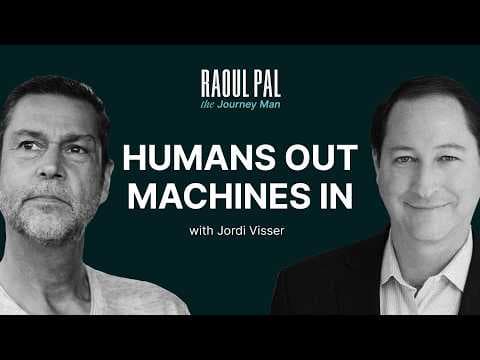
AI agents are moving from simple tools to autonomous, coordinating workers that can outpace traditional systems. The key drivers are scalable intelligence, cheaper compute, and new coordination layers that enable digital twins and AI swarms. This shift could dramatically raise productivity across industries while reshaping work and markets.
Transcript
So quickly before we get to today's show, this episode is brought to you by Pith. Pith Network is the fastest growing financial data company today. Trusted by Fidelity Investments, the US Department of Commerce, Revolute, Kelshi, Jain Street, Coinbase, and many more. They provide realtime financial market data across over 3,000 equities, commoditie... Read More
Key Insights
- AI agents are moving from tools to workers that can stand in for human labor in many tasks.
- The personal AI agent could become the most valuable interface for interacting with machines and data.
- Digital twins and AI swarms enable large scale coordination among many agents.
- Model releases are speeding up, with cadence moving from months to days.
- Quantization and memory efficiency allow running capable models on smaller hardware.
- Agents can coordinate into hundreds or thousands, forming scalable, collaborative systems.
- Taste and cross context resonance help AI perform tasks in a natural, useful way.
- The coordination layer among agents is a critical driver of future AI productivity.
Install to Summarize YouTube Videos and Get Transcripts
Explore YouTube Video Summarizer or Get YouTube Transcript Extractor
Questions & Answers
Q: What is the main shift in how AI tools are used according to the video
The main shift is that AI tools are becoming autonomous workers, capable of coordinating with many other AI agents to perform tasks more efficiently than traditional tools. This transition moves AI from a passive helper role to an active, scalable workforce that can handle complex workflows across multiple domains.
Q: Why could a personal AI agent become the most valuable interface
A personal AI agent can organize and coordinate other agents, access diverse data, and manage tasks across contexts. This creates a single, efficient interface that can supervise multiple specialized agents, streamline decision making, and act as a dynamic assistant that adapts to changing goals and information in real time.
Q: What role do digital twins and AI swarms play
Digital twins provide a virtual replica of a person, process, or system that AI swarms can manage and optimize. Together, they enable hundreds or thousands of agents to coordinate toward common objectives, improving efficiency, scalability, and execution across complex environments.
Q: How is the model release cadence changing
Model releases are accelerating from every several months to every few days, creating a rapidly evolving ecosystem of capabilities. This pace drives continual improvement, but also increases the need for robust coordination among agents and safer deployment practices as new features emerge quickly.
Q: What is the significance of quantization and memory efficiency
Quantization dramatically reduces model size and memory requirements, enabling near frontier performance on much smaller hardware. This lowers the barrier to running capable AI locally, increases inference speed, and facilitates broader deployment of AI agents across devices and edge environments.
Q: How many agents could be coordinated, and why is this important
Agents can coordinate into hundreds or thousands, potentially forming large, collaborative networks that tackle complex problems more effectively than a single system. This scalability is crucial for handling multifaceted tasks and distributing workload across a constellation of specialized, interacting agents.
Q: What is meant by taste and cross context resonance in AI
Taste and cross context resonance refer to an AI's ability to produce outputs that feel natural, contextually appropriate, and useful across different domains. This quality makes AI interactions more human like, improving adoption and effectiveness in real world tasks.
Q: What privacy considerations are discussed regarding AI data
There is caution about sharing private data with AI systems. The talk suggests creating a private environment or separating sensitive data from public AI services to protect privacy while still leveraging AI capabilities, highlighting the need for secure, private AI workflows.
Summary & Key Takeaways
-
AI agents are transitioning into productive, autonomous workers that can coordinate with other agents to perform tasks more efficiently. This shift is driven by improvements in coordination, intelligence, and compute costs, enabling new business models and productivity gains across sectors.
-
Digital twins and AI swarms represent a practical architecture for large scale agent collaboration, allowing персонal assistants to augment decision making and execution at scale.
-
The pace of AI model releases is accelerating, and the resulting ecosystem is moving toward ubiquitous, specialized agents that can organize and optimize complex workflows.
Read in Other Languages (beta)
Share This Summary 📚
Summarize YouTube Videos and Get Video Transcripts with 1-Click
Try YouTube Summary with ChatGPT & Claude or YouTube Transcript Generator
Explore More Summaries from Raoul Pal The Journey Man 📚





Summarize YouTube Videos and Get Video Transcripts with 1-Click
Try YouTube Summary with ChatGPT & Claude or YouTube Transcript Generator