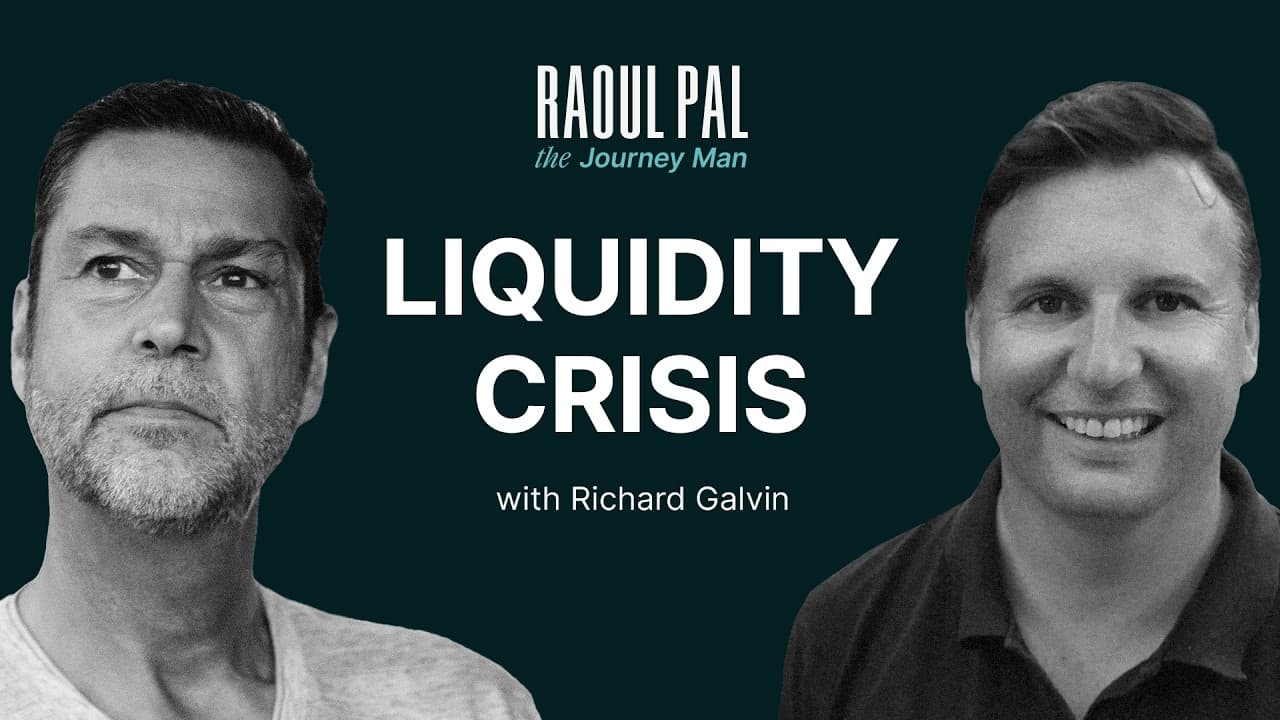
What Caused the Crypto Bloodbath? Debt Dynamics ft. Richard Galvin
TL;DR
Crypto prices fell despite record onchain growth because constrained liquidity and asset flows outweighed improving fundamentals. Richard Galvin and Raoul Pal point to a Treasury General Account above $1 trillion, depleted reverse repo capacity, institutional performance pressure, changing ownership through spot ETFs, and excess digital asset treasury-company supply. Read on to understand the selloff, shifting crypto cycles, and where structural opportunities may remain.
Transcript
Today's video is sponsored by Figure Markets, the largest non-bank mortgage lender in the US with over 15 billion unlocked on their lending platform. They've just lowered rates on their Bitcoin and ETHback loans even more to 8.91% which is 9.999% APR, improving their already industry low fixed rate 50% LTV loans. They keep building as well, having ... Read More
Key Insights
- Crypto market prices can diverge sharply from network fundamentals. Galvin says onchain revenues, applications, and user activity were reaching new highs while prices continued falling, creating one of the strongest disconnects he had observed during his seven years working in the sector.
- Liquidity is a central explanation for the crypto selloff. Pal argues that the government shutdown prevented spending from the Treasury General Account, which had grown beyond $1 trillion, while the absence of reverse repo funds removed a mechanism that could previously offset the liquidity drain.
- Institutional performance pressure can hurt crypto at the margin. Pal cites a figure that 80% of funds had underperformed the market that year, leading managers to chase technology exposure into year-end while comparatively marginal and liquidity-sensitive crypto positions were sold.
- Crypto projects with established utility may be delivering stronger results than their prices suggest. Galvin contrasts the sector's historical reputation for being overhyped and underdelivering with a market in which projects built during the previous five years were producing growth and profitability without receiving corresponding valuation rewards.
- The four-year crypto cycle may partly reflect broader debt dynamics. Pal argues that zero rates in 2021 and 2022 allowed debt maturities to be extended by a year, contributing to roughly $10 trillion needing to roll during the current year and following 12 months.
- Spot ETFs are changing the composition of crypto ownership. Galvin says Bitcoin and Ethereum, followed increasingly by Solana, are moving into ETF structures owned by investors who approach markets differently, weakening cycles previously driven by similar participants trading similar assets over similar time horizons.
- Digital asset treasury companies connect equity-market liquidity with crypto-market opportunities. Galvin says they emerged because rapidly growing crypto assets lacked adequate flows, while expensive equity markets possessed excess liquidity and were prepared to fund structures offering exposure to comparatively undervalued digital assets.
- Digital asset treasury companies can remain below net asset value for extended periods. Galvin expects clear winners rather than 50 companies owning the same asset, but warns that equity-market consolidation may proceed more slowly than crypto investors expect because managers often have little incentive to liquidate recently funded vehicles.
Install to Summarize YouTube Videos and Get Transcripts
Explore YouTube Video Summarizer or Get YouTube Transcript Extractor
Questions & Answers
Q: Why can crypto prices fall while onchain activity grows?
Crypto prices and network activity respond to different forces over shorter periods. Galvin says onchain revenues, applications, and user activity were reaching new highs even as prices fell. Pal argues that constrained liquidity can overwhelm those improving fundamentals.
Q: How did the government shutdown affect crypto liquidity?
Pal says the shutdown prevented money in the Treasury General Account from being spent normally, allowing the account to grow beyond $1 trillion. With no reverse repo funds available to offset that accumulation, repo rates rose and emergency repo lending became necessary. Crypto was hit particularly hard because it sits at the margin of liquidity.
Q: Why were fund managers selling crypto while chasing technology assets?
Pal cites a figure showing that 80% of funds had underperformed the market that year. As year-end approached, underweight managers chased technology exposure to narrow their performance gaps. Comparatively marginal and liquidity-sensitive crypto positions were vulnerable to selling during that shift.
Q: Is the traditional four-year crypto cycle becoming less reliable?
Galvin expects the traditional cycle to weaken as crypto ownership changes. Earlier cycles involved similar participants trading similar assets over similar horizons, while spot ETFs are moving Bitcoin, Ethereum, and increasingly Solana into the hands of investors with different strategies. Pal also connects cycle timing to changing debt-refinancing dynamics.
Q: How could debt maturities affect the crypto cycle?
Pal argues that the crypto cycle partly reflects the broader debt cycle. When rates fell to zero in 2021 and 2022, debt maturities were extended by roughly a year. He says about $10 trillion needed to roll during the current year and following 12 months, potentially delaying expected liquidity effects.
Q: How are spot ETFs changing Bitcoin, Ethereum, and Solana ownership?
Galvin says spot ETFs are transferring Bitcoin, Ethereum, and increasingly Solana into structures owned by investors with different strategies and holding periods. That changes a market previously driven by similar participants trading similar assets over similar time horizons. He believes this ownership shift could weaken familiar crypto-cycle patterns.
Q: What are digital asset treasury companies designed to do?
Digital asset treasury companies connect liquid, highly valued equity markets with comparatively illiquid crypto assets showing strong growth. Galvin says crypto lacked adequate flows beyond Bitcoin and, to a lesser extent, Ethereum. These companies created a public-market structure for directing equity capital toward digital assets.
Q: Why can digital asset treasury companies trade below net asset value for long periods?
Galvin says rapid proliferation produced too many vehicles holding similar assets, creating market indigestion and weakening their ability to raise more funds. He expects clear winners and eventual consolidation rather than 50 companies owning the same asset. Discounts may persist because managers with long-term mandates often have little incentive to liquidate recently funded vehicles.
Summary & Key Takeaways
-
Crypto prices were falling despite strong underlying activity across onchain revenues, applications, and users. Galvin describes this as an unusually large disconnect between operating progress and market performance. Pal connects the weakness to constrained liquidity during the government shutdown, a growing Treasury General Account, depleted reverse repo capacity, and pressure in repo markets.
-
The traditional four-year crypto cycle may be becoming less reliable. Pal argues that debt maturities were extended when rates fell to zero in 2021 and 2022, shifting refinancing dynamics. Galvin emphasizes a different structural change: spot ETFs are transferring Bitcoin, Ethereum, and increasingly Solana into the hands of investors with different strategies and time horizons.
-
Digital asset treasury companies emerged as a bridge between expensive, liquid equity markets and comparatively illiquid crypto assets with strong growth. Their rapid proliferation created indigestion, however, with many trading near or below net asset value. Galvin expects clear category winners, eventual consolidation, and potentially long periods of discounted valuations before market structures adjust.
Read in Other Languages (beta)
Share This Summary 📚
Summarize YouTube Videos and Get Video Transcripts with 1-Click
Try YouTube Summary with ChatGPT & Claude or YouTube Transcript Generator
Explore More Summaries from Raoul Pal The Journey Man 📚





Summarize YouTube Videos and Get Video Transcripts with 1-Click
Try YouTube Summary with ChatGPT & Claude or YouTube Transcript Generator