How Does the Hermes AI Agent Work for Beginners?
TL;DR
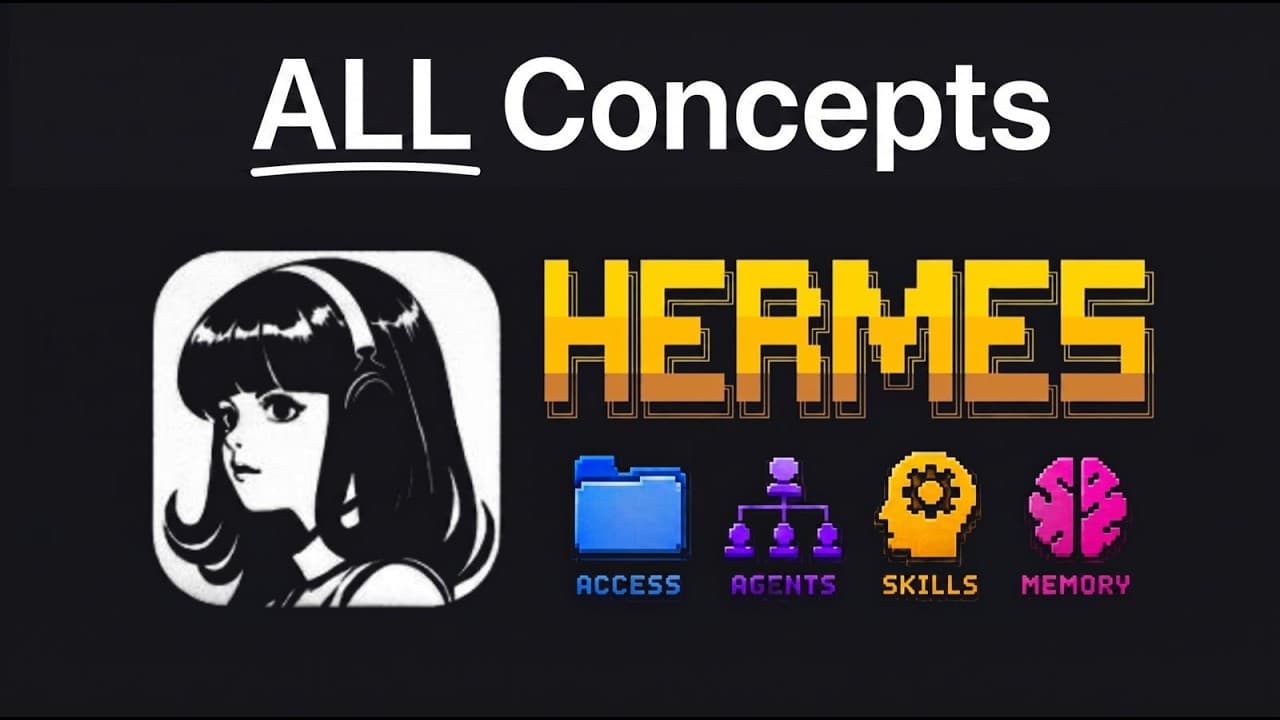
Hermes is an AI agent that can use connected tools to perform actions, rather than only describing what a user should do. It can run locally or on a virtual private server, retain knowledge about the user, and expose the same underlying intelligence through more than 22 messaging interfaces, including Telegram, Discord, WhatsApp, Slack, Matrix, and a browser.
Transcript
Hermes is the world's most powerful AI agent, but if you're new, it can be incredibly overwhelming. You're probably looking at the app and asking, "How does this make my life easier? What is a heartbeat? What is an operating system? How does this work?" And without knowing the basics, you will never unlock its full capabilities. So, in this video, ... Read More
Key Insights
- Hermes is an AI agent, not merely a chatbot. The distinction is that a chatbot tells users how to perform a task, while an agent can make a plan, access tools, gather information, and take actions toward the requested goal.
- Hermes gains practical capabilities through connected tools. Access to services such as Gmail, calendars, and other systems allows the agent to affect external information and workflows instead of limiting its output to conversational advice.
- Hermes is designed to become more personalized through continued use. Its memory can improve its understanding of the user over time, making it suitable as a persistent assistant that can travel with the user through mobile messaging interfaces.
- Hermes uses one underlying intelligence across more than 22 interfaces. Users can communicate with the same agent through platforms such as Telegram, Discord, WhatsApp, Slack, Matrix, or a browser without being restricted to one application.
- Local hosting runs Hermes on the user's own computer at no hosting charge. The setup can begin through a terminal installation command, and another coding assistant can also be asked to perform the installation using the supplied code.
- A locally hosted Hermes depends on its computer remaining powered on. If that machine shuts down, the agent stops working, which is why some users dedicate an old laptop, desktop, or another computer to continuous operation.
- A virtual private server runs Hermes on rented hardware located elsewhere. This option supports remote operation, but it costs money each month and introduces security considerations involving exposed ports, protection measures, and the possibility of attacks.
- Hermes can be managed through commands issued on the host computer. The demonstration shows the agent being shut down and rebooted, with the messaging bot reporting that the gateway is shutting down and that an active task will be interrupted.
Install to Summarize YouTube Videos and Get Transcripts
Explore YouTube Video Summarizer or Get YouTube Transcript Extractor
Questions & Answers
Q: What is the difference between Hermes and a chatbot?
Hermes is described as an agent that can act on a goal, while a chatbot primarily provides information or instructions. A chatbot might explain how to book a flight. Hermes can use its available tools to search for the flight, check information, and present a result. Its ability to plan and perform actions is the central distinction.
Q: How can Hermes perform actions for a user?
Hermes performs actions by using tools connected to the agent. The transcript mentions possible connections to Gmail, calendars, and other systems. In the demonstrated flight task, the user asks Hermes to find the cheapest flight from Dubai to Toronto within the next two weeks, after which it checks options and displays a selected flight in HTML.
Q: Why does Hermes become more useful over time?
Hermes is designed to remember information about the user and improve that understanding through continued use. The more the user interacts with it, the more personalized and specific it can become. This persistent memory is presented as a defining feature, especially for people who want an assistant they can access while away from their desktop.
Q: How can users access the same Hermes agent from different apps?
Hermes provides one central intelligence that can receive conversations from more than 22 interfaces. The transcript specifically identifies Telegram, Discord, WhatsApp, Slack, Matrix, and a browser-based operating system. These interfaces act as different entry points to the same agent, so the user is not confined to one messaging application or device.
Q: Where can the Hermes AI agent be hosted?
Hermes can run locally on the user's own computer or remotely on a virtual private server. Local hosting uses hardware the user controls and does not require paying a hosting provider. A virtual private server uses rented computing resources elsewhere in the world, remains remote from the user, and normally involves a monthly charge.
Q: What are the benefits and limitations of running Hermes locally?
Local hosting is presented as easy, quick, free, and potentially safer in some respects because the system runs on the user's own computer. It can be installed by pasting a command into the terminal. Its main limitation is availability: Hermes works only while that computer is powered on, so shutting down the machine also stops the agent.
Q: What should users consider before hosting Hermes on a VPS?
A virtual private server allows Hermes to run on a computer operated by a hosting provider rather than on the user's own machine. The user pays monthly to rent that capacity. The transcript also warns that remote servers can be attacked and may require work to secure and protect ports, making security configuration an important consideration.
Q: How is Hermes different from a task-specific coding tool?
Hermes is compared to a dog that lives with the user, remembers them, travels with them, and improves its understanding over time. Claude Code is compared to a contractor that may be excellent for a specific desktop job but does not necessarily retain the same personal context. Hermes emphasizes mobility, persistence, and increasingly personalized memory.
Summary & Key Takeaways
-
Hermes is presented as an agent rather than a chatbot. A chatbot can explain how to complete a task, while an agent can create a plan, use connected tools, gather information, and take actions. The flight-search demonstration shows Hermes checking options and presenting a selected result through an HTML interface.
-
Hermes is designed as a persistent, increasingly personalized assistant that users can access while moving between devices and communication platforms. The same underlying intelligence can connect with more than 22 interfaces, so conversations from Telegram, Discord, WhatsApp, Slack, Matrix, a browser, and other locations can reach one central agent.
-
Hermes can live on a personal computer or a virtual private server. Local hosting is free and keeps the system on hardware the user controls, but the computer must remain powered on. A VPS runs remotely for a monthly charge and requires attention to ports, protection, and potential attacks.
Read in Other Languages (beta)
Share This Summary 📚
Summarize YouTube Videos and Get Video Transcripts with 1-Click
Try YouTube Summary with ChatGPT & Claude or YouTube Transcript Generator
Explore More Summaries from Jack Roberts 📚




Summarize YouTube Videos and Get Video Transcripts with 1-Click
Try YouTube Summary with ChatGPT & Claude or YouTube Transcript Generator