How Nvidia's AI is Reshaping Technology in 2026
TL;DR
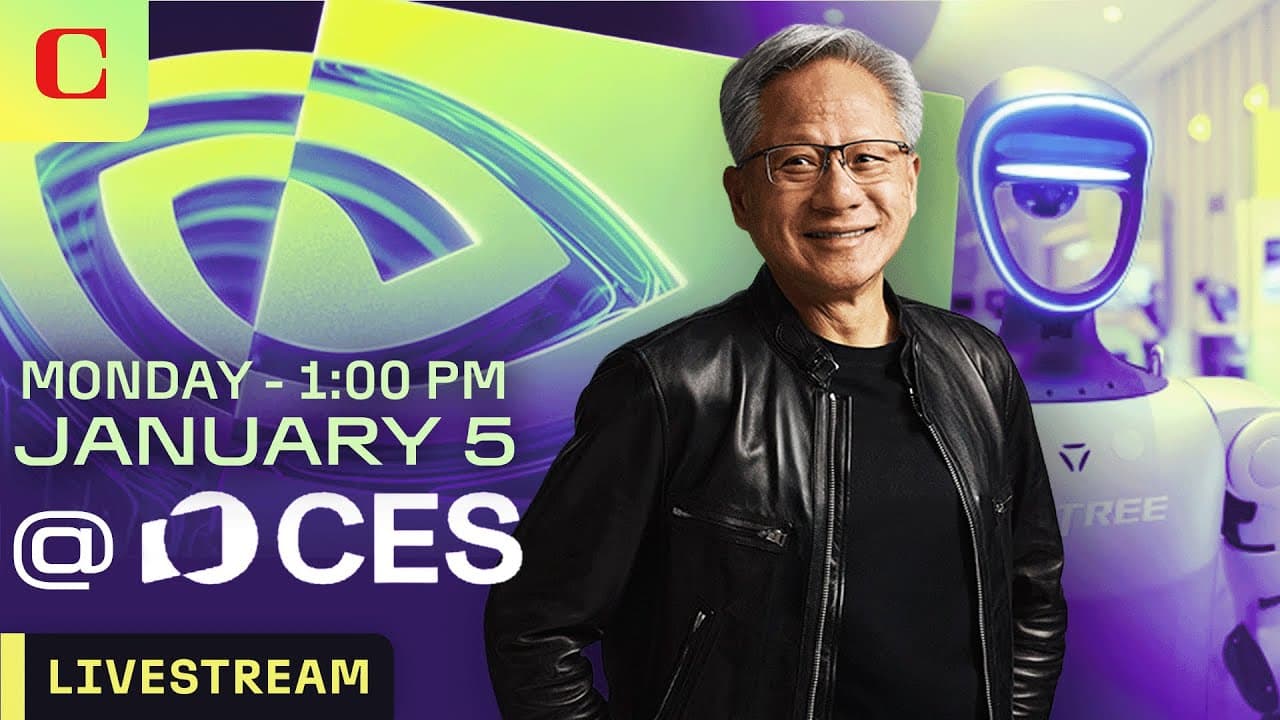
Nvidia's 2026 CES keynote, led by CEO Jensen Huang, highlights the transformative impact of AI on computing and robotics. Nvidia is pioneering AI-driven platform shifts, emphasizing accelerated computing and open models. The company's innovations in AI supercomputers, self-driving technology, and robotics are set to redefine industries, promising enhanced efficiency and groundbreaking advancements in AI applications.
Transcript
Ready, go. >> [music] >> Heat. Heat. Heat. Heat. Heat. [music] [music] Heat. [music] Heat. Heat. >> [music] [music] [music] >> Heat. Heat. Heat. [music] [music] Heat. [music] Heat. Heat. [music] [music] Welcome to the stage, Nvidia founder and CEO, Jensen Wong. Hello, Las Vegas. Happy New Year. Welcome to CES. Well, we have about 15 keynotes worth ... Read More
Key Insights
- Nvidia is driving two simultaneous platform shifts towards AI, reshaping the computing industry.
- AI applications are moving from CPUs to GPUs, fundamentally changing software development.
- Open models are proliferating, with Nvidia's contributions leading in AI model development.
- Agentic systems, capable of reasoning and using tools, are emerging as a new frontier in AI.
- Nvidia's self-driving technology, Alpameo, showcases reasoning capabilities in autonomous vehicles.
- Nvidia's AI supercomputers, like Vera Rubin, are advancing AI computation and efficiency.
- Physical AI, integrating AI physics, is revolutionizing industries like robotics and manufacturing.
- Nvidia's partnerships with companies like Siemens are integrating AI into industrial design and operations.
Install to Summarize YouTube Videos and Get Transcripts
Explore YouTube Video Summarizer or Get YouTube Transcript Extractor
Questions & Answers
Q: How is Nvidia reshaping the computing industry with AI?
Nvidia is reshaping the computing industry by driving two simultaneous platform shifts towards AI. This transformation involves moving applications from CPUs to GPUs, fundamentally changing how software is developed. Nvidia's focus on accelerated computing and open models is leading to the creation of new AI-driven applications, enhancing efficiency and innovation across industries.
Q: What are agentic systems in AI?
Agentic systems in AI are advanced models capable of reasoning, using tools, and performing tasks autonomously. These systems can break down complex problems into manageable steps, using reinforcement learning and other techniques to perform tasks they've never been explicitly trained for. Agentic systems represent a new frontier in AI, enabling applications that can adapt and solve problems in real-time.
Q: What is the significance of Nvidia's Vera Rubin AI supercomputer?
Nvidia's Vera Rubin AI supercomputer is significant for its advanced architecture, designed to meet the skyrocketing computational demands of AI. It features co-designed CPU and GPU components, optimized for high performance and efficiency. Vera Rubin's ability to handle large-scale AI workloads makes it a critical tool for advancing AI research and applications, supporting Nvidia's vision for the future of AI-driven technology.
Q: How is Nvidia advancing self-driving technology?
Nvidia is advancing self-driving technology through its Alpameo AI, a reasoning autonomous vehicle system. Alpameo is trained end-to-end, using both human-driven and AI-generated data, to navigate complex driving scenarios. It can reason about its actions, providing explanations for its decisions, and is designed to handle the long tail of driving situations by breaking them down into familiar, manageable components.
Q: What role does physical AI play in Nvidia's strategy?
Physical AI is a key component of Nvidia's strategy, integrating AI with the physical world through robotics and AI physics. This approach enables AI systems to understand and interact with the physical environment, applying common sense and learning from data. Physical AI is set to revolutionize industries like manufacturing and robotics, providing advanced capabilities for automation and innovation.
Q: How are open models influencing AI development?
Open models are influencing AI development by democratizing access to advanced AI technologies, allowing researchers and companies to build upon existing models. Nvidia's contributions to open models are leading the way in AI innovation, with open-source initiatives fostering collaboration and accelerating the development of new AI applications across various domains, ensuring that AI technology is accessible and continually evolving.
Q: What are the benefits of Nvidia's partnership with Siemens?
Nvidia's partnership with Siemens brings AI capabilities to industrial design and operations, integrating Nvidia's CUDA X libraries, AI models, and Omniverse platform into Siemens' tools. This collaboration enhances the efficiency and effectiveness of industrial processes, enabling the simulation and optimization of manufacturing operations, and supporting the development of intelligent, automated systems for the next age of industries.
Q: How does Nvidia ensure the security of its AI systems?
Nvidia ensures the security of its AI systems through confidential computing, which encrypts data in transit, at rest, and during computation. This approach protects sensitive information and models, allowing companies to deploy AI solutions securely. Nvidia's focus on security ensures that its AI technologies can be trusted and safely integrated into various applications, safeguarding data integrity and privacy.
Summary & Key Takeaways
-
Nvidia's keynote at CES 2026, led by CEO Jensen Huang, focuses on the transformative power of AI across industries. The company is pioneering AI-driven platform shifts, emphasizing the role of accelerated computing and open models. Nvidia's innovations in AI supercomputers, self-driving technology, and robotics are set to redefine industries, promising enhanced efficiency and groundbreaking advancements in AI applications.
-
The keynote highlights Nvidia's role in advancing AI technology, with a focus on agentic systems capable of reasoning and using tools. Nvidia's AI supercomputers, like Vera Rubin, are designed to meet the increasing demands of AI computation. The company's physical AI initiatives, including self-driving technology and robotics, are poised to revolutionize industries by integrating AI physics.
-
Nvidia's collaborative efforts with companies like Siemens demonstrate the integration of AI into industrial design and operations. The keynote underscores the importance of open models and AI's role in reshaping computing, with Nvidia leading the charge in developing cutting-edge AI models and technologies. The company's vision for AI-driven innovation promises to accelerate advancements across various sectors.
Read in Other Languages (beta)
Share This Summary 📚
Summarize YouTube Videos and Get Video Transcripts with 1-Click
Try YouTube Summary with ChatGPT & Claude or YouTube Transcript Generator
Explore More Summaries from CNET 📚

Summarize YouTube Videos and Get Video Transcripts with 1-Click
Try YouTube Summary with ChatGPT & Claude or YouTube Transcript Generator