How to Use a Four-Step Storytelling Loop
TL;DR
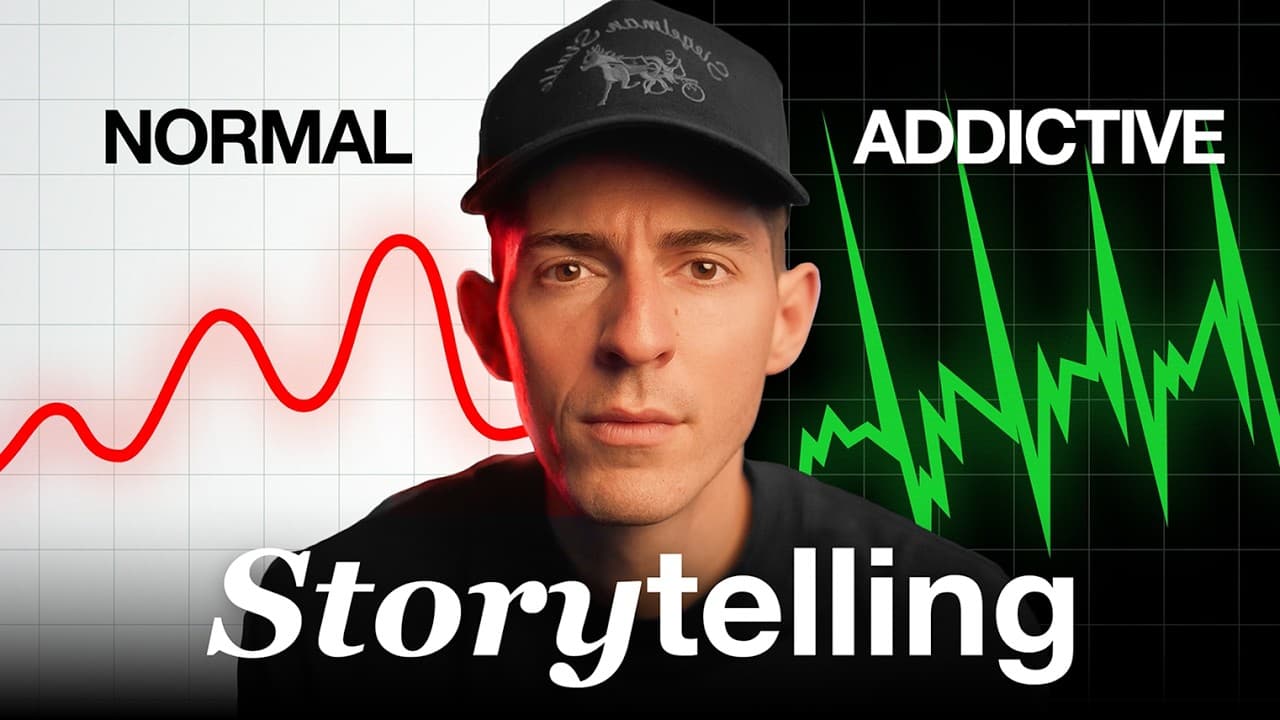
Build compelling stories with a repeating four-step loop: establish meaningful stakes, introduce a question the audience wants answered, disrupt their prediction with an unexpected outcome, and immediately open another unresolved question. The framework sustains attention by keeping the audience anticipating what happens next, while surprises create stronger dopamine responses through prediction error.
Transcript
If you want to learn how to tell better stories, all you have to do is understand one core concept, addiction. Specifically, how the brain is chemically wired to get addicted to certain narratives. I call this the neuroscience of addictive storytelling. Because the truth is, even though great storytelling feels like black magic, it's actually one o... Read More
Key Insights
- Dopamine is described as a prediction chemical that becomes active while the brain anticipates an uncertain outcome. The compelling period is not merely receiving a reward, but waiting, calculating possibilities, and trying to determine what will happen next.
- Uncertainty is the key difference between predictable and compelling experiences in the video's analogy. A vending machine reliably returns a snack, while a slot machine presents an unknown result that keeps the brain generating predictions as the reels spin.
- Stakes are the context that gives an outcome personal or emotional importance. When the audience understands what could be gained, lost, protected, or destroyed, the brain has a reason to care and begins predicting how the situation might resolve.
- The big question is an unresolved problem that directs the audience's attention. Once stakes have created interest, the question encourages continuous internal guessing and produces the sustained, low-grade stream of dopamine associated with anticipating an answer.
- A head fake is an outcome that breaks the audience's prediction. The resulting prediction error produces a dopamine spike, and the video claims that the size of this response is proportional to how surprising the outcome is.
- The rehook is the point where one narrative loop closes while another opens. Introducing a new uncertainty immediately after an answer prevents a gap in attention and keeps the audience mentally engaged with an unresolved prediction.
- Compelling stories work by repeating the sequence of stakes, question, surprise, and renewed uncertainty. The framework can be applied to content, client pitches, presentations, and personal storytelling because each format can guide an audience through predictions and resolutions.
- A story's basic events are not enough to create engagement. In the prince example, the plague, threatened family, rare flower, undefeated dragon, and failed knights transform a simple journey into a consequential situation with danger, urgency, and uncertainty.
Install to Summarize YouTube Videos and Get Transcripts
Explore YouTube Video Summarizer or Get YouTube Transcript Extractor
Questions & Answers
Q: How does the four-step storytelling loop work?
The loop begins with stakes that establish why the outcome matters. It then introduces a big question that prompts the audience to predict what will happen. A head fake produces an outcome that breaks that prediction, creating surprise. Finally, a rehook opens another unresolved question as the previous one closes, allowing the same attention cycle to begin again without a gap.
Q: What are the four steps of addictive storytelling?
The four steps are the stakes, the big question, the head fake, and the rehook. Stakes supply meaningful context, while the big question gives the audience something unresolved to predict. The head fake challenges or overturns that prediction. The rehook immediately creates a fresh unknown, keeping the audience engaged after the earlier question has been answered.
Q: Why are stakes important in a story?
Stakes give the audience a reason to care about what happens. They establish the relevant setting, risks, goals, and consequences, which activate the brain's prediction process. Without meaningful stakes, there is no compelling reason to anticipate an outcome. In the prince example, the dying kingdom, approaching plague, endangered family, and limited time make the quest consequential.
Q: What is the big question in storytelling?
The big question is the unresolved issue that the audience wants the narrative to answer. After the stakes establish importance, this question focuses attention and encourages the brain to calculate possible outcomes. The video describes that anticipation as producing a sustained, low-grade stream of dopamine, similar to waiting to see how a blackjack hand will end.
Q: What is a head fake in storytelling?
A head fake is a development that breaks the audience's current prediction. It might be an unexpected success, failure, reversal, or discovery. The video calls the neurological response to this mismatch prediction error and says it creates a dopamine spike. A more surprising outcome produces a larger response, while a fully expected result produces no comparable surprise.
Q: How does a rehook keep an audience engaged?
A rehook introduces a new uncertainty at the same moment an earlier question is resolved. The audience therefore has no natural pause in which to decide that the experience is complete. Its prediction process transfers directly to the next question. Repeating this transition reduces the distance between anticipated answers and keeps an unresolved prediction active in the audience's mind.
Q: Why is uncertainty useful in storytelling?
Uncertainty gives the brain something to predict. The video contrasts a vending machine, which produces the expected result, with a slot machine, whose outcome remains unknown while the reels spin. Stories use the same principle by withholding answers, offering several possible outcomes, and creating reversals. When everything is immediately predictable, anticipation and surprise both disappear.
Q: How can the four-step loop improve a simple story?
Start by expanding the context so the audience understands who could suffer, what could be lost, and why action is urgent. Then establish an unresolved question about whether the character can succeed. Introduce a development that challenges the expected outcome, and follow each resolution with another question. The prince example adds a plague, a rare cure, an undefeated dragon, failed knights, and endangered loved ones.
Summary & Key Takeaways
-
Dopamine is presented as a prediction chemical rather than simply a pleasure chemical. Anticipating an uncertain result creates a sustained dopamine response, which explains why an unpredictable slot machine can be more compelling than a vending machine that produces the expected result every time.
-
The proposed storytelling loop contains four stages: stakes, the big question, the head fake, and the rehook. Stakes establish why the outcome matters, the big question activates prediction, the head fake violates expectations, and the rehook replaces the resolved question with another unresolved one.
-
The prince-and-flower example contrasts a flat sequence of events with a narrative shaped by stakes. Adding a spreading plague, endangered loved ones, a rare cure, an ancient tower, and an undefeated dragon gives the audience reasons to care and creates uncertainty about whether the prince can succeed.
Read in Other Languages (beta)
Share This Summary 📚
Summarize YouTube Videos and Get Video Transcripts with 1-Click
Try YouTube Summary with ChatGPT & Claude or YouTube Transcript Generator
Explore More Summaries from Kallaway 📚





Summarize YouTube Videos and Get Video Transcripts with 1-Click
Try YouTube Summary with ChatGPT & Claude or YouTube Transcript Generator