How Does Neural Portrait Relighting Work with AI?
TL;DR
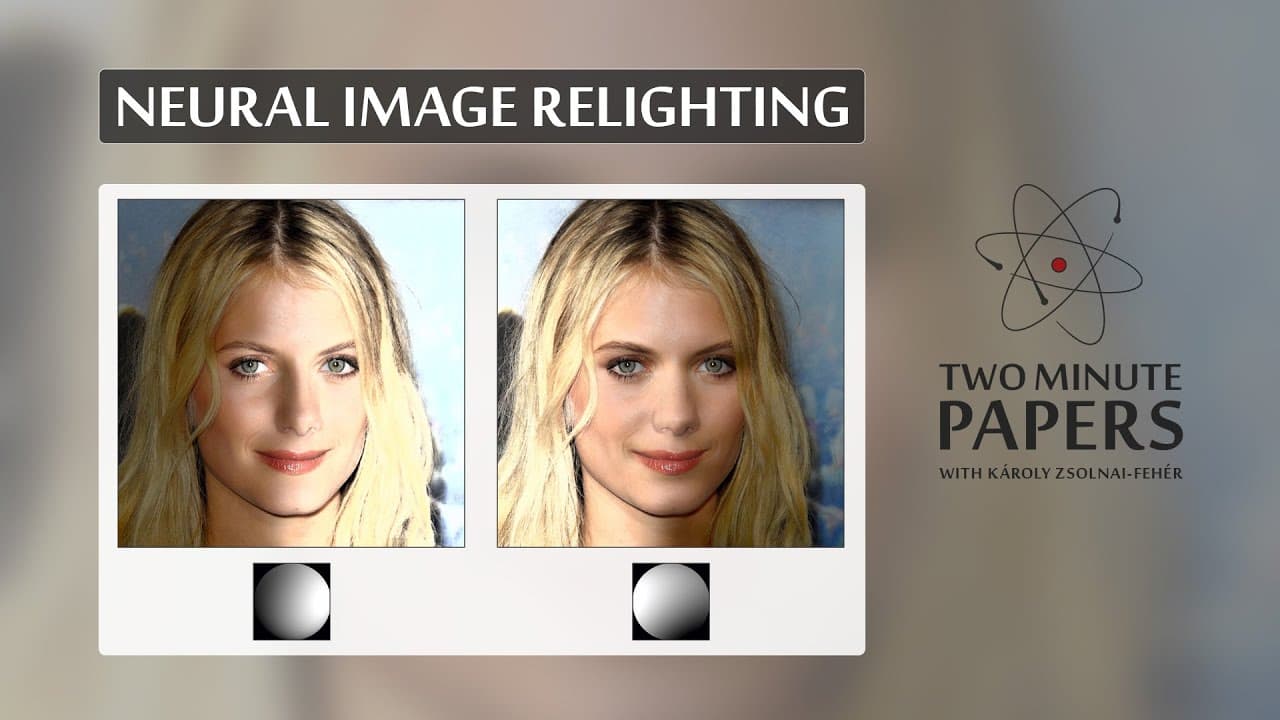
Neural portrait relighting uses advanced algorithms to change lighting and materials in images based on a single input. It employs a neural network structured with an encoder and decoder, leveraging a dataset of over 25,000 relit portraits to produce realistic results. Key features include the importance of skip connections, which enhance the image generation process.
Transcript
Dear Fellow Scholars, this is Two Minute Papers with Károly Zsolnai-Fehér. In computer graphics, when we are talking about portrait relighting, we mean a technique that is able to look at an image and change the lighting, and maybe even the materials or geometry after this image has been taken. This is a very challenging endeavor. So can neural net... Read More
Key Insights
- 🥡 Portrait relighting involves changing the lighting, materials, and geometry of an image after it has been taken, which is challenging in computer graphics.
- 🚂 Neural networks can be trained to learn the concept of portrait relighting using a dataset of relit images.
- 🥳 A new neural network structure with an encoder and decoder parts, along with skip connections, efficiently performs portrait relighting.
- 🖐️ Skip connections play a crucial role in transferring insights from the lighting estimator network to the image generator network.
- 🤮 Omitting skip connections significantly affects the realism and accuracy of the generated images.
- 🙂 Modeling subsurface light transport can greatly enhance the appearance of a human face in portrait relighting.
- ❓ The availability of a dataset with over 25,000 relit portrait images contributes to the development of effective neural network architectures.
Install to Summarize YouTube Videos and Get Transcripts
Explore YouTube Video Summarizer or Get YouTube Transcript Extractor
Questions & Answers
Q: How does portrait relighting using neural networks differ from traditional methods?
Traditional methods require estimating face geometry, materials, and lighting using simulations, while neural networks learn the concept of portrait relighting from a dataset of relit images.
Q: What does the neural network structure for portrait relighting consist of?
The neural network consists of an encoder part that estimates the lighting used in an image and a decoder part that generates an image with changed lighting. Skip connections transfer insights from the encoder to the decoder.
Q: How does skipping the skip connections impact the results of portrait relighting?
Skipping the skip connections significantly affects the results. Without skip connections, the generated images do not have the same level of realism and accuracy in changing lighting as with skip connections.
Q: What is the role of modeling subsurface light transport in portrait relighting?
Modeling subsurface light transport, as demonstrated in a previous paper, greatly enhances the appearance of a human face when relighting. Future research should consider incorporating such advanced effects.
Summary & Key Takeaways
-
Portrait relighting involves changing the lighting, materials, and geometry of an image after it has been taken.
-
Traditional methods require estimating face geometry, materials, and lighting and running simulations, but neural networks can learn portrait relighting concept with training data.
-
A new neural network structure with an encoder and decoder parts, along with skip connections, efficiently learns the relighting operation and generates realistic images.
Read in Other Languages (beta)
Share This Summary 📚
Summarize YouTube Videos and Get Video Transcripts with 1-Click
Try YouTube Summary with ChatGPT & Claude or YouTube Transcript Generator
Explore More Summaries from Two Minute Papers 📚



Summarize YouTube Videos and Get Video Transcripts with 1-Click
Try YouTube Summary with ChatGPT & Claude or YouTube Transcript Generator