What Is Scanning Electron Microscopy and Its Advantages?
TL;DR
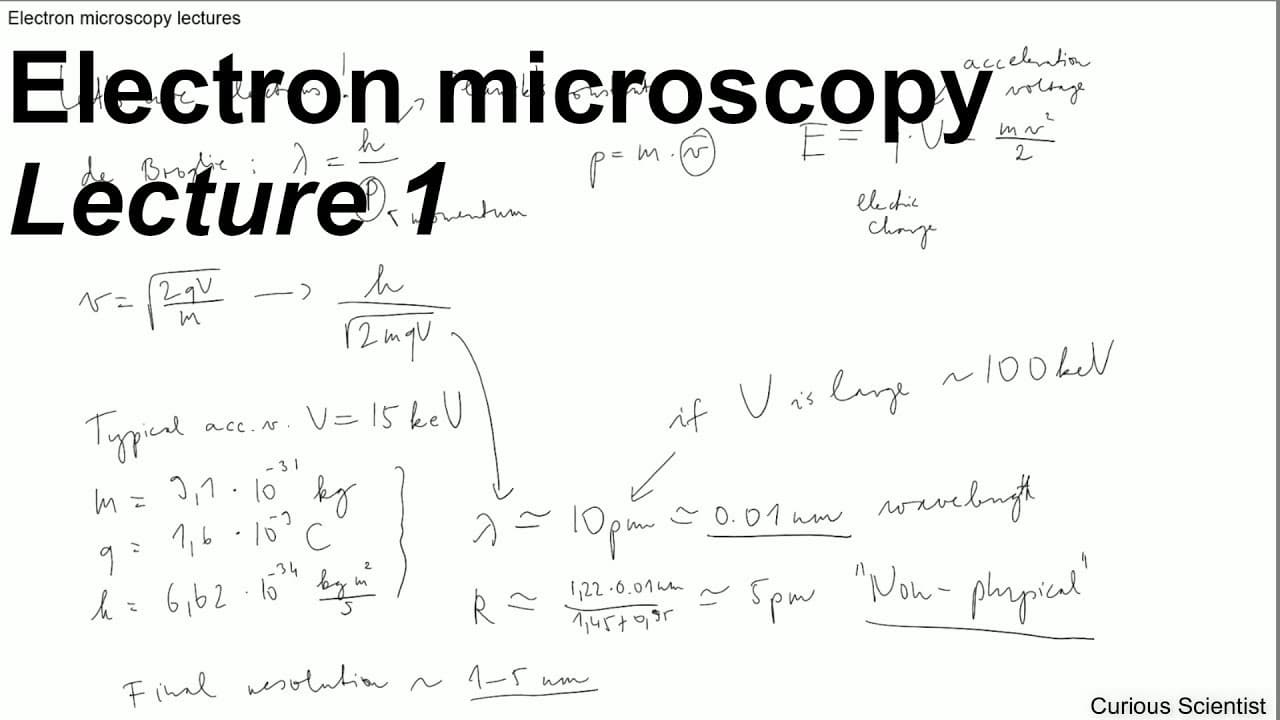
Scanning electron microscopy (SEM) offers higher resolution than light optical microscopes, enabling the analysis of features as small as a few nanometers. By using electron beams instead of visible light, SEM overcomes the diffraction limits of traditional microscopy, making it essential for characterizing nanoscale structures in materials science and life sciences.
Transcript
welcome to another video in this video I'm going to start a series of lectures about electron microscopy to be more precise I will talk about scanning electron microscopes and the basic principles behind each characterization technique and I decided to do this series of lectures because I work a lot with scanning electron microscopes and I do a lot... Read More
Key Insights
- 🛩️ Scanning Electron Microscopes (SEMs) provide significantly higher resolution compared to light optical microscopes, enabling analysis of features as small as a few nanometers.
- 🙂 The limitations of optical microscopes are primarily due to the diffraction of visible light, restricting resolution to about 200 nanometers.
- 🏑 The techniques of electron microscopy are vital for advanced material characterization and are applicable in various fields including biology, pharmaceuticals, and materials science.
- 🙂 Using electrons instead of light enhances resolution largely because of the shorter wavelength of electrons, which can resolve structures at the atomic and molecular levels.
- 📼 The video serves as an introduction, setting the stage for a series of lectures aimed at disseminating knowledge on SEM and its applications in research and industry.
- 💦 Understanding the principles of diffraction and resolution is crucial when working with microscopy to accurately interpret the data obtained from samples.
- 👻 SEM not only captures images but also allows the extraction of compositional and structural data from materials, increasing its utility in scientific research.
Install to Summarize YouTube Videos and Get Transcripts
Explore YouTube Video Summarizer or Get YouTube Transcript Extractor
Questions & Answers
Q: Why are scanning electron microscopes (SEM) necessary when optical microscopes exist?
SEMs are necessary because they offer greater resolution compared to light optical microscopes (LOMs). The resolution limit of LOMs is approximately 200 nanometers due to the wavelength of visible light. SEMs, utilizing electron beams, can resolve structures significantly smaller than this limit, making them essential for examining nanoscale materials and biological specimens.
Q: What is the basic principle of resolution in microscopy as discussed in the video?
The video explains resolution in microscopy as the ability to distinguish between two points. It is influenced by diffraction patterns; if two points are too close, their diffraction patterns overlap, making it impossible to resolve them as separate entities. The Rayleigh criterion provides a formula to calculate the minimum distance two features must be apart to be distinguishable under a microscope.
Q: How does the wavelength of electrons compare to photons in terms of microscopy resolution?
Electrons have much shorter wavelengths than photons, which enhances the resolution of electron microscopes. The video notes that while photons have wavelengths around 400 nanometers, electrons can have wavelengths on the order of picometers, allowing for the resolution of much smaller structures and materials.
Q: What future topics will the lecturer cover in subsequent videos on SEM?
Future lectures will focus on the structure of the electron microscope, detailing its main components and how each part functions. The lecturer will also discuss the types of information those components can provide through different detectors, sensors, and measurement techniques, broadening the understanding of SEM applications.
Summary & Key Takeaways
-
The video introduces a lecture series focused on scanning electron microscopy (SEM), highlighting its advantages over light optical microscopes in terms of resolution and capability to analyze nanoscale structures.
-
It discusses the principles of light diffraction, limitations of optical microscopes, and the significance of using electron beams in SEM to achieve better resolution for examining smaller details in materials.
-
Future lectures will delve deeper into the functionality and components of electron microscopes, as well as provide practical examples of applications and measurements in various fields including life sciences and materials engineering.
Read in Other Languages (beta)
Share This Summary 📚
Summarize YouTube Videos and Get Video Transcripts with 1-Click
Try YouTube Summary with ChatGPT & Claude or YouTube Transcript Generator
Explore More Summaries from Curious Scientist 📚





Summarize YouTube Videos and Get Video Transcripts with 1-Click
Try YouTube Summary with ChatGPT & Claude or YouTube Transcript Generator