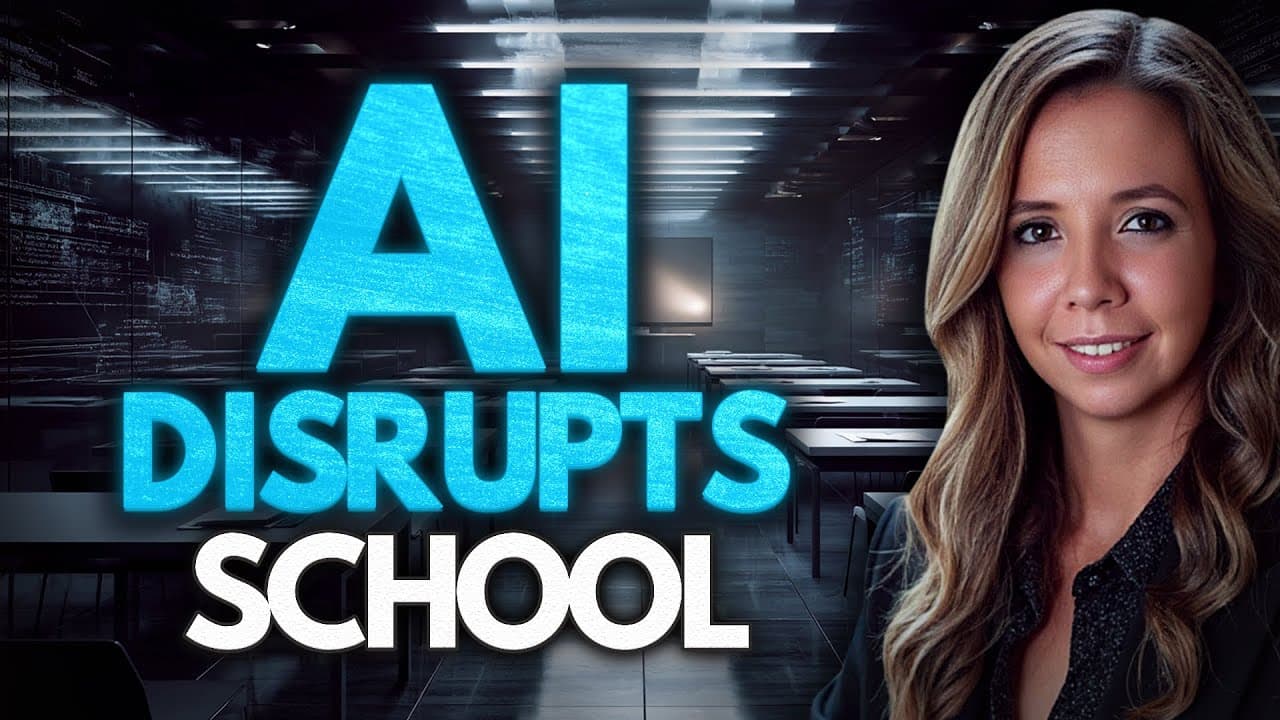
Are Factory Schools Dying? How AI Is Creating an Education Revolution
TL;DR
AI is transforming traditional education by giving students adaptive tutoring and immediate feedback while reducing teachers’ administrative workload. Teachers typically spend 5 to 20 hours per week on tasks such as lesson planning and grading, but participating school districts report AI savings of 5 to 10 hours weekly. Read on to see how Primer Micro School, personalized learning, and two-hour academics could reshape education.
Transcript
Picture this. While your kid sits in a cramped classroom, memorizing outdated facts from a textbook written in 2003, somewhere across town, another child just finished their entire academic day in 2 hours. They're now building a sailboat, learning to code with an AI tutor, or working on a real business problem. Which kid do you think will thrive in... Read More
Key Insights
- Personal AI tutoring is presented as a way to give every student continuous, individualized support. The tutor can adjust to a learner’s pace, provide help without frustration or judgment, identify misconceptions quickly, and guide the student toward understanding instead of merely supplying uniform instruction.
- Teacher assistance is one of AI’s immediate educational uses. Teachers reportedly spend 5 to 20 hours per week on lesson plans, grading, progress reports, and related administration, while participating school districts report that AI tools are already saving teachers 5 to 10 hours weekly.
- Effective educational technology is driven by a defined learning need. Sal Khan argues that laptops and tablets have sometimes improved outcomes but have also sat unused, so schools should identify the use case first and then select an appropriate tool, whether that tool is a pencil or artificial intelligence.
- AI-supported classroom learning includes tutoring, progress reports, writing coaching, and simulated conversations. Students can interact with literary or historical characters, receive support while working, and use AI that can see their writing, while teachers can monitor progress and address attempts to misuse the technology.
- Microschools are presented as alternatives to overcrowded, standardized classrooms. At Primer Micro School, students reportedly work at their own pace, use AI to solve problems, build things with their hands, and pursue personal interests without being uniformly held back or left behind.
- The Alpha school model reportedly compresses academic instruction into two hours. The remaining time is devoted to practical experiences involving farms, sailboats, workshops, and other real-world activities, with the goal of developing thinking and applicable skills instead of emphasizing the repetition of memorized information.
- Adaptive learning paths are designed to respond to individual needs in real time. The described system can vary instruction for students who benefit from visual material, hands-on experiences, or different pacing, replacing a single standardized sequence with support tailored to each learner’s progress.
- Project-based learning prioritizes critical thinking, problem-solving, creativity, and collaboration. Instead of limiting education to tests and factual recall, the proposed model asks students to build businesses, create art, conduct research, explore simulations, and apply knowledge to realistic problems and personal interests.
Install to Summarize YouTube Videos and Get Transcripts
Explore YouTube Video Summarizer or Get YouTube Transcript Extractor
Questions & Answers
Q: How is AI transforming traditional education?
AI can provide each student with personalized tutoring, immediate feedback, writing guidance, and instruction adjusted to their pace. It can also help teachers prepare lesson plans, grade papers, write progress reports, and monitor student progress. The proposed model redirects more school time toward mentorship, creativity, projects, and practical problem-solving.
Q: How can AI personalize education for each student?
AI can adapt a learning path to a student’s pace, progress, and needs instead of giving everyone the same instruction. It can identify misconceptions, change its explanations, and support visual or hands-on learning. This allows students to advance without being held back or left behind by the pace of an entire class.
Q: How can AI reduce teachers’ administrative workload?
AI can assist with lesson plans, grading papers, progress reports, and other routine tasks. Teachers are described as spending 5 to 20 hours per week on administration, while participating school districts report savings of 5 to 10 hours weekly from AI tools. That recovered time can support more direct teaching and mentorship.
Q: What role do teachers have in AI-powered education?
AI is presented as a teaching assistant rather than a replacement for teachers. It can handle repetitive work and provide progress information, leaving teachers more time to mentor, inspire, interpret student needs, and guide creative problem-solving. Teachers still provide the human relationships and judgment central to the proposed model.
Q: Why is adding technology to classrooms not enough?
Sal Khan says schools should begin with a clear educational use case instead of putting technology first. Some laptop and tablet programs accelerated outcomes, while other devices simply collected dust. The appropriate tool could be a pencil or artificial intelligence, depending on the learning need.
Q: How do AI tutors give students immediate feedback?
An AI tutor can respond while a student is working, identify misunderstandings, and adjust its guidance to the learner’s pace. It can also see a student’s writing and act as a writing coach. Teachers can receive information about the student’s progress instead of waiting only for completed assignments.
Q: What does learning at Primer Micro School look like?
Primer Micro School in Arizona and Florida is presented as an alternative to standardized classroom learning. Students work at their own pace, use AI to solve problems, build things with their hands, and pursue personal interests. The approach combines personalized academics with projects and practical activities.
Q: How does the Alpha school model combine AI and project-based learning?
The Alpha model reportedly compresses academic instruction into two hours. Students can then spend the remaining time on practical experiences involving farms, sailboats, workshops, coding, art, research, or business problems. These activities emphasize critical thinking, creativity, collaboration, and applying knowledge rather than memorizing facts for tests.
Summary & Key Takeaways
-
Traditional schooling is presented as an industrial model built around fixed schedules, standardized instruction, memorization, and testing. The argument is that this approach neglects individual learning differences and consumes teachers’ time with lesson plans, grading, and progress reports, while failing to cultivate adaptability, creativity, curiosity, and continuous learning.
-
AI-supported education gives each student access to adaptive tutoring, immediate feedback, simulations, writing guidance, and personalized learning paths. It can also assist teachers with administrative work and provide reports about student progress. Technology is valuable only when connected to a clear educational use case, rather than introduced without an implementation plan.
-
Microschools such as Primer and the Alpha model are offered as alternatives that combine AI-powered academics with projects and practical activities. Students may complete conventional coursework more quickly, then spend time building, researching, creating art, solving business problems, or developing skills through farms, sailboats, workshops, and other hands-on experiences.
Read in Other Languages (beta)
Share This Summary 📚
Summarize YouTube Videos and Get Video Transcripts with 1-Click
Try YouTube Summary with ChatGPT & Claude or YouTube Transcript Generator
Explore More Summaries from Julia McCoy 📚




Summarize YouTube Videos and Get Video Transcripts with 1-Click
Try YouTube Summary with ChatGPT & Claude or YouTube Transcript Generator