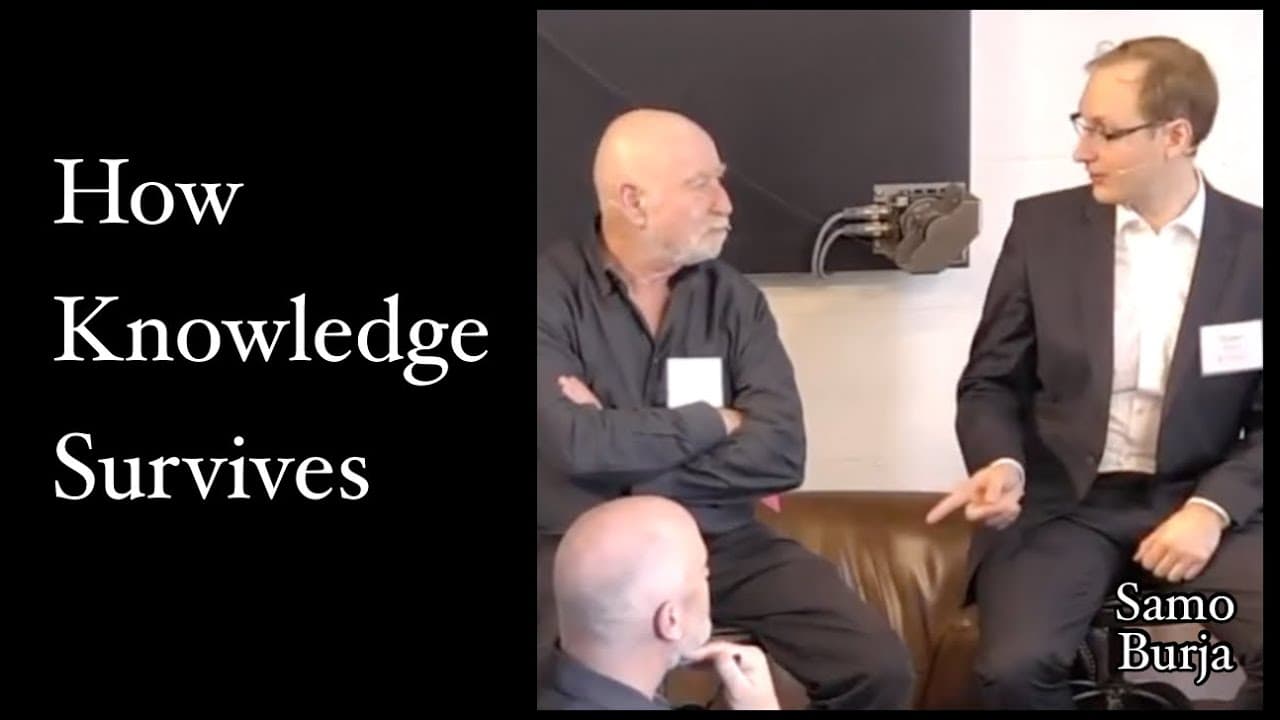
How Does Knowledge Survive Civilizational Collapse?
TL;DR
Knowledge survives civilizational collapse when it is distributed across people, places, and self-sustaining practices rather than concentrated in one institution or fragile supply chain. Over the last 10,000 years, localized agriculture and metallurgy have preserved useful capabilities, while Bronze Age production faltered when access to distant tin supplies broke down. Read on to see why modern chip fabs, centralized servers, and fragmented regional internets complicate that durable model.
Transcript
one of the rules of long-term civilizations is distributed knowledge I not all concentrated in one big library as it were and the capacity therefore to recreate infinitely the Bronze Age example all those people had bronze technology well they had the technology to use bronze but the supply chains that allowed him to use that knowledge to allowed h... Read More
Key Insights
- 🍉 Distributed knowledge is essential to the long-term sustainability of civilizations, preserving advancements even during collapses.
- 👍 Advancements in localized agriculture and metallurgy have proven resilient throughout history.
- ❓ The centralization of technology in Silicon Valley has contradicted the notion of decentralization in societies.
- 💁 Information has become a tool of political control due to the centralized physical infrastructure in which it resides.
- 👻 The fragmentation of the internet may increase its robustness and allow for unique strengths to develop in different regions.
- 👋 While centralized chip fabs may be good for certain civilizations, it creates economic disincentives for others.
- 💆 The Industrial Age brought mass production but maintained centralized means of production.
Install to Summarize YouTube Videos and Get Transcripts
Explore YouTube Video Summarizer or Get YouTube Transcript Extractor
Questions & Answers
Q: How does knowledge survive civilizational collapse?
Knowledge survives when it is distributed among many people and can be practiced with locally available resources. Local agriculture and blacksmithing can persist in many niches even after governments, institutions, or long-distance supply chains break down.
Q: Why did Bronze Age technology become difficult to sustain?
People retained the knowledge needed to use bronze, but the supply chains supporting bronze production broke down. Tin had to be transported from distant places, so losing access to it removed the practical reason and ability to produce bronze.
Q: What kinds of knowledge are most resilient during a collapse?
The most resilient knowledge does not depend heavily on centralized infrastructure or distant supply chains. The transcript identifies localized agricultural improvements and metallurgy that a blacksmith can perform as capabilities that can endure civilizational disruption.
Q: Why are potatoes an example of durable distributed knowledge?
Once potatoes were imported from the New World, they could continue reproducing through their own DNA even if the surrounding civilization declined. Their propagation therefore did not depend on preserving one library, institution, or complex industrial system.
Q: How can a blacksmith preserve technical knowledge after political collapse?
A blacksmith carries a practical packet of knowledge that can serve many different customers and social arrangements. Someone who once made weapons for legionaries might later work for a warlord or produce jewelry for support.
Q: Why are chip fabs difficult to decentralize?
Chip fabs require huge economies of scale, which encourages production to remain concentrated. This exposes the Industrial Age contradiction: products can be distributed massively even though the means of producing them are not distributed in the same way.
Q: Has Silicon Valley decentralized society?
The speaker argues that Silicon Valley has centralized societies on net, despite the importance of personal computers. Information is increasingly processed on large computers and servers located within government jurisdictions, allowing centralized physical infrastructure to support political control.
Q: Could fragmentation of the internet make knowledge more resilient?
The transcript suggests that separate Chinese, European, and American internets may increase robustness rather than simply represent a setback. Multiple regional systems could preserve capabilities in different places, although centralized infrastructure and economic incentives would still constrain technologies such as chip fabrication.
Summary & Key Takeaways
-
Long-term civilizations require distributed knowledge and technology to withstand collapses and preserve advancements.
-
Improvements in localized agriculture and metallurgy have proven resilient throughout civilizational collapses.
-
The contradiction arises in the Industrial Age where mass production is decentralized, but the means of production remain centralized.
Read in Other Languages (beta)
Share This Summary 📚
Summarize YouTube Videos and Get Video Transcripts with 1-Click
Try YouTube Summary with ChatGPT & Claude or YouTube Transcript Generator
Explore More Summaries from Samo Burja 📚





Summarize YouTube Videos and Get Video Transcripts with 1-Click
Try YouTube Summary with ChatGPT & Claude or YouTube Transcript Generator