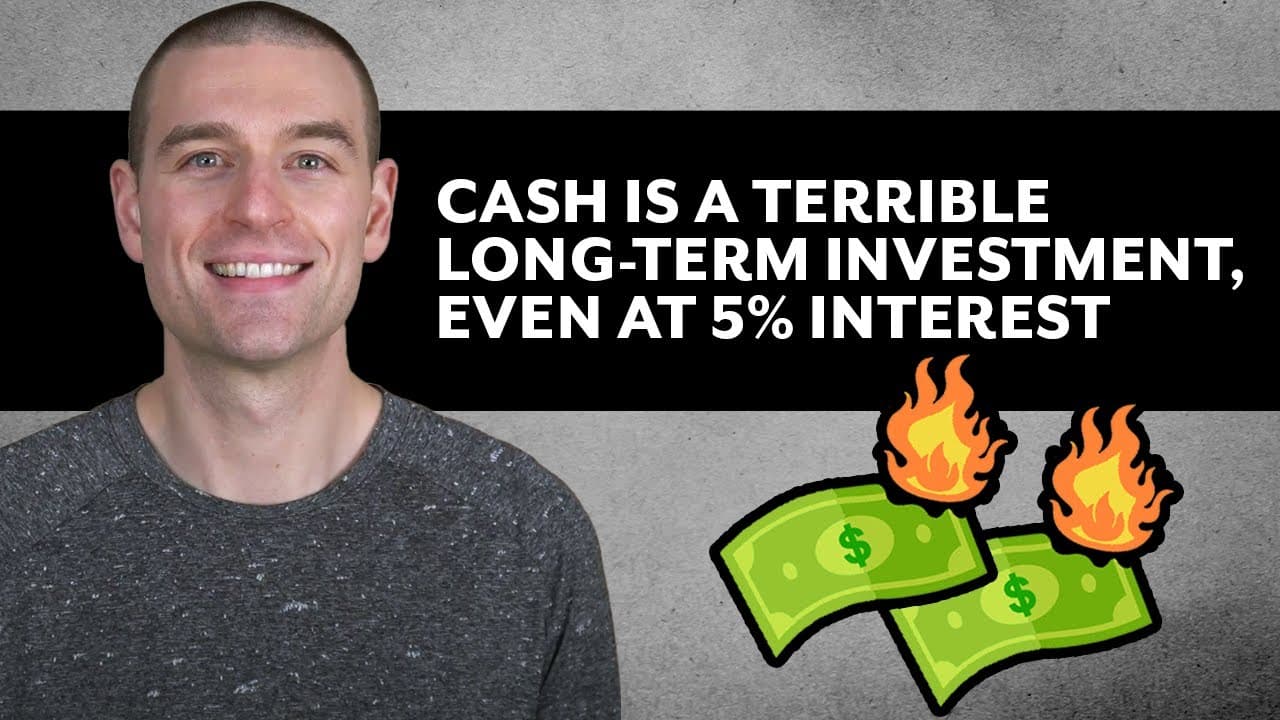
Why Is Cash a Bad Long-Term Investment Despite 5% Interest?
TL;DR
Cash is a poor long-term investment because it has unpredictable expected returns and is more likely to lose purchasing power over time compared to stocks and bonds. While it may feel stable, long-term investors should prioritize stocks and bonds for better financial growth and hedging against falling returns.
Transcript
with a five percent yield on cash why would anyone want to invest in stocks and bonds I know that cash feels good because its nominal value is stable it feels safe but it's counter-intuitively extremely risky for long-term investors cash is a poor hedge against falling expected returns it is historically much more likely to lose purchasing power th... Read More
Key Insights
- 🍉 Cash is stable in value but unpredictable in terms of its expected return, making it a poor long-term investment.
- ↩️ Long-term investors should consider stocks and bonds for higher expected returns and protection against falling expected returns.
- ☠️ Cash has lower expected returns than stocks and bonds in all interest rate environments.
- 🪘 Holding cash exposes long-term investors to the risk of losing purchasing power in the long run.
- 🍉 Stocks and long-term bonds are less risky for long-term investors than their short-term price fluctuations suggest.
- 🍉 The risk-free asset for long-term investors is a long-term inflation index bond.
- 🍉 Cash may be appealing in volatile market conditions, but it hinders long-term financial goals.
Install to Summarize YouTube Videos and Get Transcripts
Explore YouTube Video Summarizer or Get YouTube Transcript Extractor
Questions & Answers
Q: Why is cash considered a poor long-term investment?
Cash is unpredictable in terms of its expected return and has historically been more likely to lose purchasing power compared to stocks and bonds. It offers lower expected returns and does not provide a hedge against falling expected returns.
Q: What is the risk-free asset for a long-term investor?
While many investors consider cash as the risk-free asset, for long-term investors, a long-term inflation index bond is a better option. The stable coupon payments of the bond can offset short-term price fluctuations.
Q: Why do stocks and bonds have higher expected returns than cash?
Stocks and bonds command a risk premium above the return on cash to compensate investors for taking on risk. They are expected to generate higher returns in most environments.
Q: Is it recommended to hold onto cash until a market drop and then invest in stocks?
Buying the dip strategy, holding onto cash until a market drop, generally trails investing a lump sum in stocks. Stocks and bonds have historically shown higher expected returns than cash, making it more beneficial to stay invested.
Summary & Key Takeaways
-
Cash, while stable in value, is unpredictable in terms of its expected return, making it a poor long-term investment.
-
Short-term investors may find cash appealing due to its stability, but long-term investors should consider stocks and bonds for higher expected returns.
-
Holding cash exposes long-term investors to the risk of falling expected returns and can make it more challenging to meet financial goals.
-
(Content reviewed on 2026-08-27.)
Read in Other Languages (beta)
Share This Summary 📚
Summarize YouTube Videos and Get Video Transcripts with 1-Click
Try YouTube Summary with ChatGPT & Claude or YouTube Transcript Generator
Explore More Summaries from Ben Felix 📚




Summarize YouTube Videos and Get Video Transcripts with 1-Click
Try YouTube Summary with ChatGPT & Claude or YouTube Transcript Generator