Why Was the Great Pyramid of Giza Built?
TL;DR
The Great Pyramid may have been conceived as Ancient Egypt’s Manhattan Project, a collective effort to investigate the universe and channel divine power toward eternal peace. The lecture challenges the conventional tomb theory, reviews an internal-ramp construction proposal and an unsupported energy theory, then argues that the monument reflected Egyptian creation mythology, engineering ambition, and underestimated intellectual capacity.
Transcript
so um this will be a fun class today we are doing the Great Pyramid okay so um the Great Pyramid was built about 2500 BC that's 4,500 Years Ago by a pharaoh named uh curfew and um it was one of the seven uh great wonders of the um ancient world it's the only one that's still standing um from 2500 until 14400 uh CE which is about 4,000 years it was ... Read More
Key Insights
- The Great Pyramid was built around 2500 BC for Pharaoh Khufu and took about 26 years to complete, according to the lecture. It was the ancient world’s only surviving great wonder and remained the tallest human-made building for roughly 4,000 years.
- The pyramid’s architecture is aligned toward north and includes the King’s Chamber, a sarcophagus, the Grand Gallery, sloping passages, and a pyramidal superstructure. Its directional alignment is precise enough that the lecture describes the monument as usable like a compass.
- The Benben was central to Egyptian creation mythology because Atum, also identified in the lecture with the sun god Ra, emerged upon this primordial mound. The pyramid’s summit therefore connected its physical shape to cultural ideas about creation, divine presence, and cosmic beginnings.
- Jean-Pierre Houdin’s theory proposes that builders established the base with an external ramp, raised stones using counterweights, and continued construction through an internal spiral ramp. Under this explanation, the pyramid grew from the inside outward before receiving a reflective limestone covering.
- The pyramid’s construction may have been planned through a smaller model built beside the main structure. The lecture presents this possibility as evidence that ancient Egyptians possessed greater imagination and intellectual capacity than later scholars have sometimes been willing to recognize.
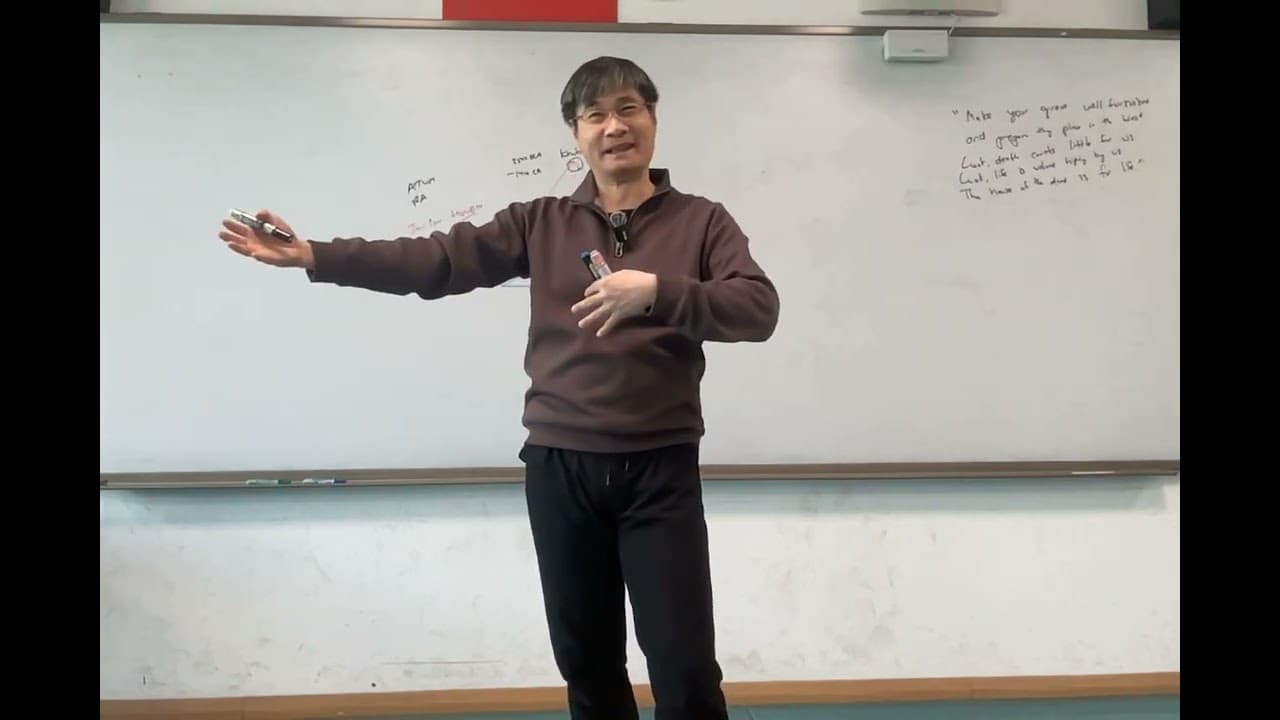
- The tomb theory interprets the pyramid as a resurrection mechanism that helped the pharaoh ascend into the sky, become a star or sun, and attain immortality. Egyptian writings cited in the lecture describe a well-prepared grave and the House of the Dead as being intended for life.
- The tomb theory faces three objections in the lecture: no body has been found inside a pyramid sarcophagus, a divine benefactor should not prioritize a selfish tomb, and a pharaoh could not know whether he would survive the roughly 26-year construction period.
- The Manhattan Project interpretation treats the Great Pyramid as a collective attempt to uncover the universe’s secrets and channel divine power toward eternal peace. The comparison emphasizes concentrated labor and intellectual ambition rather than claiming that the monument literally produced nuclear weapons or electricity.
Install to Summarize YouTube Videos and Get Transcripts
Explore YouTube Video Summarizer or Get YouTube Transcript Extractor
Questions & Answers
Q: How was the Great Pyramid of Giza built?
The lecture favors Jean-Pierre Houdin’s proposal that builders first used an external ramp to create the pyramid’s base. They then constructed counterweight systems that worked like pulleys and used an internal spiral ramp to carry stones upward. The structure was therefore built from the inside outward. After completing it, workers covered the exterior with limestone that reflected sunlight.
Q: Why does the lecture compare the Great Pyramid to the Manhattan Project?
The comparison presents the pyramid as a concentrated national effort to investigate the universe and channel divine power, rather than merely as a royal grave. The lecture describes the Manhattan Project as involving about 130,000 people over five to six years and uses it as an analogy for collective intellectual ambition. The proposed Egyptian goal was ultimately eternal peace on Earth.
Q: Why does the lecture question the Great Pyramid tomb theory?
The lecture identifies three logical difficulties. No mummy or body has been found inside a sarcophagus in any of the roughly 100 or more Egyptian pyramids mentioned. A divine pharaoh acting as humanity’s benefactor would appear selfish if his main priority were his own tomb. Finally, a pharaoh could die before the approximately 26-year construction project was completed.
Q: What evidence supports interpreting the Great Pyramid as a tomb?
The tomb interpretation fits Egyptian beliefs about an afterlife in which the pharaoh ascended to the heavens, became a star or sun, and later reincarnated within the pyramid. The lecture also cites a royal text instructing a son to furnish his grave and prepare his place in the west. That text calls the House of the Dead a place intended for life and immortality.
Q: What did the Benben symbolize in the Great Pyramid?
The Benben represented the primordial mound associated with creation in Egyptian mythology. In one account described by the lecture, a mound emerged from a vast dark ocean and became the place where the creator god Atum, also called Ra, first appeared. Another account has the Benben descending from dark space with Atum resting upon it. The pyramid’s summit echoed this sacred form.
Q: Was the Great Pyramid designed to generate or store energy?
The lecture discusses a theory attributed to Nikola Tesla that treats the pyramid as a battery for free, clean energy. Its proposed evidence includes the King’s Chamber’s sound frequency, the structure’s northward alignment, and the combination of granite inside with limestone outside. However, the lecture rejects the theory because it does not work scientifically and provides no clear use for the alleged energy.
Q: How did ancient Egyptians plan the Great Pyramid without modern blueprints?
The lecture proposes that the Egyptians built a model beside the pyramid, allowing them to solve construction problems before or while building the larger monument. This explanation is presented as a response to doubts about planning such a structure without modern writing or engineering methods. It also supports the broader argument that later scholars may underestimate ancient Egyptian imagination and intellectual capacity.
Q: Why was the Great Pyramid culturally and religiously important?
The Great Pyramid joined political authority, immortality, creation mythology, and monumental architecture in one structure. Its pyramid form and Benben-like summit recalled the emergence of Atum or Ra at creation. Its chambers and afterlife associations addressed the pharaoh’s transformation beyond death. Its northward alignment, enormous quantity of stone, reflective limestone surface, and endurance also expressed extraordinary collective capability.
Summary & Key Takeaways
-
Built around 2500 BC for Pharaoh Khufu, the Great Pyramid remained the tallest human-made building for about 4,000 years. Its northward alignment, internal chambers, grand gallery, pyramid shape, and Benben-like summit combined monumental engineering with Egyptian creation beliefs concerning Atum, Ra, the primordial mound, immortality, and divine order.
-
The lecture presents Jean-Pierre Houdin’s construction theory: workers first used an external ramp to establish the base, then employed counterweights and an internal spiral ramp to move stones upward. The pyramid was built from the inside outward and covered with reflective limestone, while a nearby model may have supported planning without modern blueprints.
-
The conventional tomb explanation fits Egyptian beliefs about death, resurrection, and immortality, but the lecture raises objections, including the absence of discovered bodies in pyramid sarcophagi. After rejecting a proposed energy-storage function as scientifically unworkable, it interprets the monument as a Manhattan Project focused on cosmic knowledge, divine power, and peace.
Read in Other Languages (beta)
Share This Summary 📚
Summarize YouTube Videos and Get Video Transcripts with 1-Click
Try YouTube Summary with ChatGPT & Claude or YouTube Transcript Generator
Explore More Summaries from Predictive History 📚



Summarize YouTube Videos and Get Video Transcripts with 1-Click
Try YouTube Summary with ChatGPT & Claude or YouTube Transcript Generator