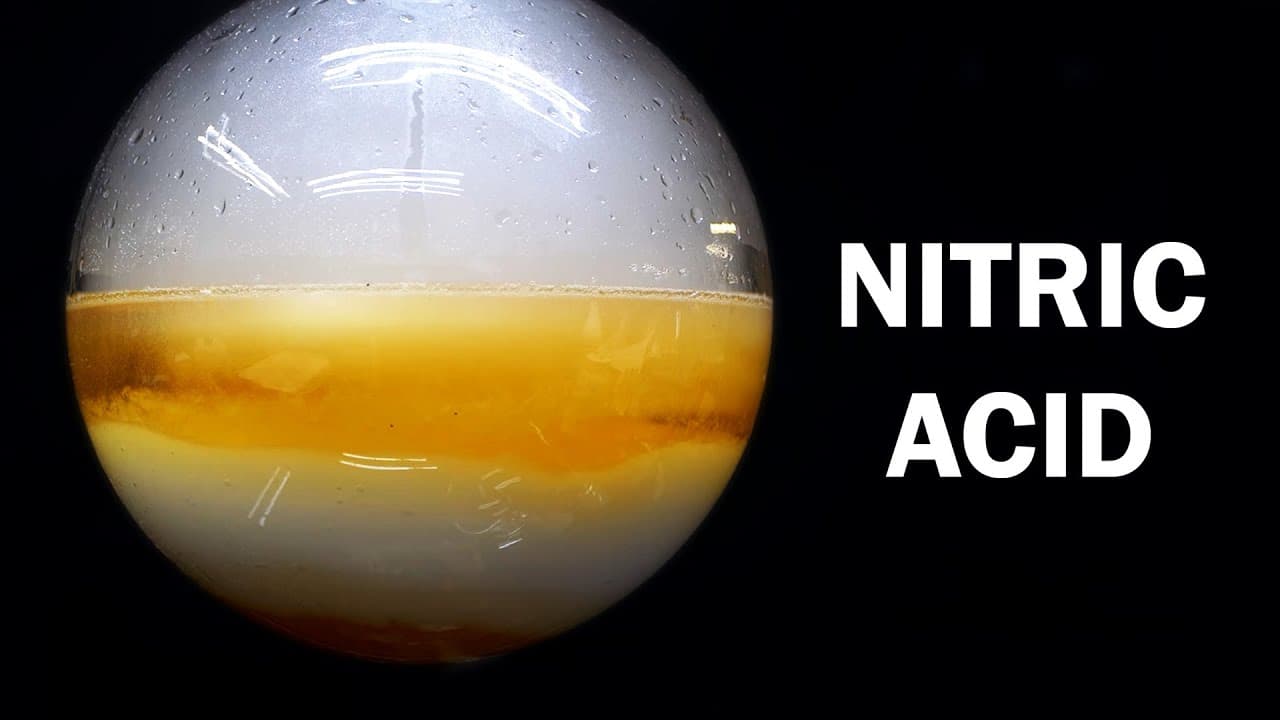
How to Make Azeotropic Nitric Acid at Home
TL;DR
To make azeotropic nitric acid, mix potassium nitrate with sulfuric acid, then distill the mixture to separate the nitric acid. Follow up with fractional distillation to achieve a pure concentration of about 68%. This nitric acid is essential for various chemical reactions, including nitration and explosive production.
Transcript
today we're going to be making a little bit of azeotropic nitric acid the nitric acid that you find in a lab is generally just the azeotropic type and this just means that it can't be purified or made stronger by distillation in the lab the azeotropic nitric acid is very useful for a lot of things in general but it's mostly used for reactions like ... Read More
Key Insights
- ❓ Azeotropic nitric acid is commonly used in nitration reactions and the production of explosives.
- 💄 The process of making azeotropic nitric acid involves reacting sulfuric acid drain cleaner with potassium nitrate.
- 💦 Distillation is used to separate the nitric acid from other components, and fractional distillation helps remove excess water.
- 🫢 The color change in the nitric acid during distillation is due to nitrogen dioxide gas impurity and can be expelled with dry air.
Install to Summarize YouTube Videos and Get Transcripts
Explore YouTube Video Summarizer or Get YouTube Transcript Extractor
Questions & Answers
Q: What is azeotropic nitric acid and why is it used in chemical reactions?
Azeotropic nitric acid is a type of nitric acid that cannot be purified or made stronger by distillation. It is commonly used in reactions like nitration, where an NO2 group is added to organic compounds, and in the production of explosives due to its highly nitrated nature.
Q: Can I use ammonium nitrate instead of potassium nitrate in the process?
Yes, ammonium nitrate can be used as a substitute for potassium nitrate. If you can easily find ammonium nitrate, such as in instant cold packs, it can be used in place of potassium nitrate.
Q: What is the purpose of using a fractional distillation column?
The fractional distillation column is used to selectively remove excess water from the nitric acid. As the vapors pass through the column, the more volatile fraction (water) condenses and falls back, while the less volatile fraction (azeotropic nitric acid) rises to the top and is collected.
Q: How can I test the concentration of the nitric acid I have made?
The concentration of the nitric acid can be determined by measuring its density. Measure a known volume of the acid, weigh it, and calculate the density in grams per milliliter. In this case, the density was found to be around 1.41 grams per milliliter, corresponding to a concentration between 68-69%.
Summary & Key Takeaways
-
Azeotropic nitric acid is commonly used in chemical reactions, particularly in nitration processes and the production of explosives.
-
The video provides a step-by-step guide on how to make azeotropic nitric acid using sulfuric acid drain cleaner and potassium nitrate.
-
The process involves distillation to separate the nitric acid from other components, followed by fractional distillation to remove excess water and achieve the desired concentration.
Read in Other Languages (beta)
Share This Summary 📚
Summarize YouTube Videos and Get Video Transcripts with 1-Click
Try YouTube Summary with ChatGPT & Claude or YouTube Transcript Generator
Explore More Summaries from NileRed 📚

Summarize YouTube Videos and Get Video Transcripts with 1-Click
Try YouTube Summary with ChatGPT & Claude or YouTube Transcript Generator