Why Is China Winning the Open-Weight AI Race?
TL;DR
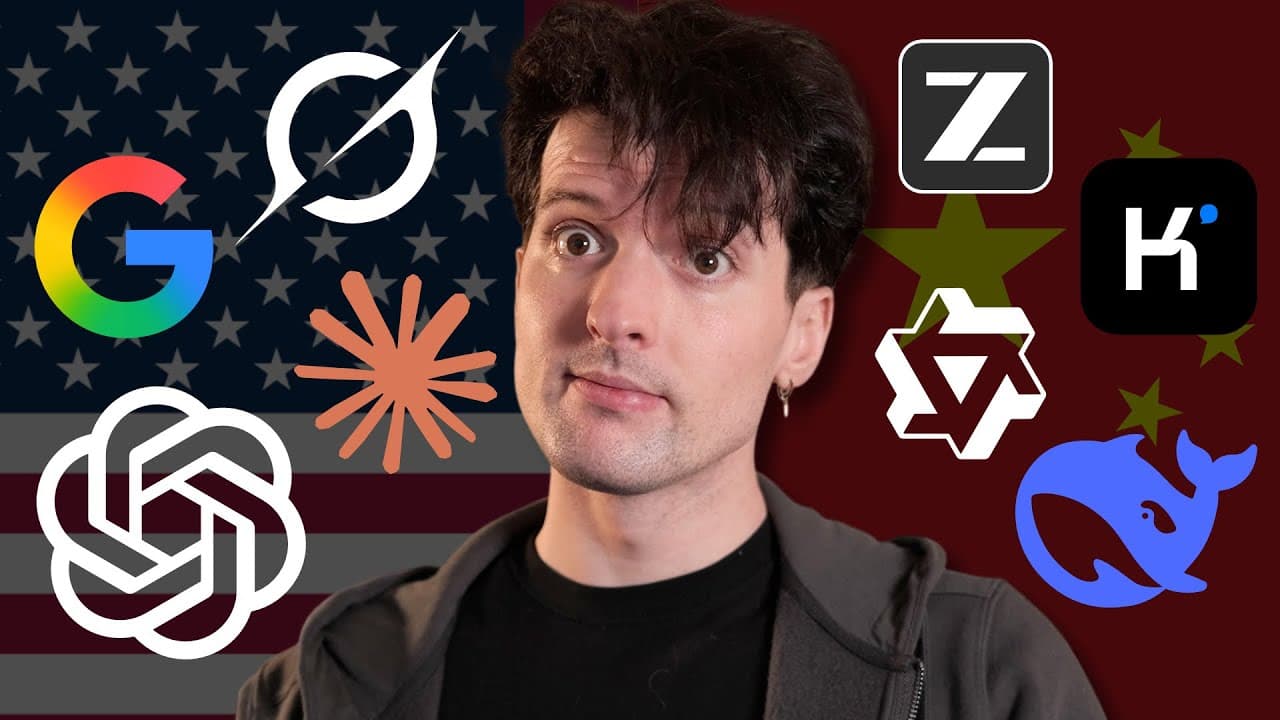
While the top closed models come from US labs (OpenAI, Google, Anthropic), the leading open-weight models are Chinese: Kimi K2, DeepSeek, and MiniMax M2. The best US open-weight entry, GPT-OSS-120B, ranks fourth and reportedly calls tools far less reliably than the Chinese models, so America nearly vanishes when only downloadable weights are counted.
Transcript
If you look at the current top models, they're all from America, Google, Anthropic, and OpenAI. We are clearly winning the AI race until you zoom out a little bit. Then you see a lot of these blue bars appearing in the chart. Those blue bars are for openweight models. And if we look at the top three, Kimmy, Deepseek, and Mini Maxm2, you realize tha... Read More
Key Insights
- China leads the open-weight model race, with Kimi (Kimmy), DeepSeek, and MiniMax M2 taking the top three spots, while the first US open-weight model, GPT-OSS-120B, only appears in fourth place on the chart.
- GPT-OSS-120B may score well on intelligence charts, but the speaker says its ability to reliably call tools and fit into real workflows is 'nothing in comparison' to Kimi, MiniMax, and DeepSeek V3.2.
- Open weight differs from open source: open source exposes the code that compiles into a usable binary, while open weights expose the parameters needed to run the model but not the training data that produced them.
- The speaker argues training data is analogous to the developer, not the source code, because data creates the weights that generate tokens, so calling models 'open source' by the strict code definition is impossible.
- The Allen Institute, funded by Microsoft's Paul Allen, is the only US lab that releases both weights and training data, but its models rank near Llama and are not competitive.
- Closed models keep weights on the creator's own infrastructure: Gemini 3 Pro runs only on Google Vertex and AI Studio, and GPT-5.1 is limited to OpenAI and Azure, because those companies sell the API, not the model.
- Open weights enable many independent providers: DeepSeek 3.2 EXP and Kimi K2 are hosted across Deep Infra, Novita, Silicon Flow, Fireworks, Groq, and others, creating competition on infrastructure, price, and speed.
- European open models trail badly, with Mistral Large 3 barely appearing on the chart and beaten by a 20-billion-parameter OpenAI model and several 15-billion-parameter models; Meta's Llama 4 sits at the very bottom.
Install to Summarize YouTube Videos and Get Transcripts
Explore YouTube Video Summarizer or Get YouTube Transcript Extractor
Questions & Answers
Q: Which country is winning the open-weight AI race?
China is winning the open-weight race and by quite a bit, according to the video. When you filter to models whose weights are downloadable and usable, the top three are all Chinese: Kimi (Kimmy), DeepSeek, and MiniMax M2. America nearly gets wiped off the chart because its strongest models are closed weight, and the first US open-weight model to appear, GPT-OSS-120B, only reaches fourth place.
Q: What is the difference between open-weight and open-source AI models?
Open source exposes the actual code used to create the thing people experience, and that code compiles deterministically into a binary anyone can reproduce cheaply on their own computer. Open weight instead exposes the trained parameters (weights) needed to run the model and generate tokens, but not the training data. The speaker argues turning data into weights is not even deterministic, so weights are not equivalent to a compiled binary.
Q: Why is GPT-OSS-120B considered weaker than the Chinese open-weight models?
The speaker, who has used GPT-OSS-120B quite a bit, calls it 'rough.' While it might score well on intelligence charts, its ability to reliably call tools and be used inside real workflows is described as 'nothing in comparison' to what he experienced with Kimi, MiniMax, and DeepSeek V3.2. He says there is a huge gap between those Chinese models and the US open-weight entry, despite benchmark scores.
Q: Why do open-weight models allow more provider choice than closed models?
Because the weights are downloadable, many independent companies can host and serve the same model, creating competition across infrastructure. DeepSeek 3.2 EXP is offered by Deep Infra, Novita, Silicon Flow, Atlas Cloud, and others, and Kimi K2 has more than a dozen providers including Fireworks, Groq, and the creator Moonshot itself. Closed models like Gemini 3 Pro and GPT-5.1 run on only one or two official platforms.
Q: Why don't closed AI labs like Google and OpenAI share their model weights?
They keep weights on their own infrastructure because they want to sell you the API, not the model. Gemini 3 Pro's weights have never left Google's campus, so it runs only on Google Vertex and AI Studio. GPT-5.1 is limited to OpenAI and, through the Microsoft partnership, Azure. The video notes Google reportedly only shares weights privately in rare cases, such as a rumored billion-dollar-plus Apple deal for Siri.
Q: Should AI models be called open source at all?
The speaker argues no. Under the strict open-source definition that exists for code, there will never be a model that qualifies, because you cannot reproduce the exact weights even with the data since training is not deterministic. He believes 'open source' should not be used to describe models, but stresses that open weight is still a very cool and useful thing worth celebrating rather than dismissing.
Q: Which lab actually releases its training data, and is it competitive?
The only lab the speaker knows of that releases the data is the Allen Institute, funded by Paul Allen from Microsoft as an attempt to do truly open AI research in the US. Its models expose both weights and data, so you could hypothetically retrain them yourself, though not deterministically. However, on the charts they sit right next to Llama and are not competitive.
Q: How do European and Meta open models compare in the open-weight race?
They perform poorly. Mistral Large 3, which just dropped and inspired the video, is barely even on the chart, and the speaker says a 20-billion-parameter model from OpenAI beats Mistral, along with several 15-billion-parameter models. Meta's Llama 4 sits all the way at the end; only Scout and Maverick shipped, and the larger promised version was never released because they performed so poorly.
Summary & Key Takeaways
-
Ranking the top AI models by raw intelligence shows US labs winning, but zooming out to open-weight models flips the picture: Kimi, DeepSeek, and MiniMax M2 dominate the top three, and the first American entry, GPT-OSS-120B, lands only fourth and performs poorly on tool calling.
-
Open weight is not open source. Open source exposes code that compiles deterministically into a binary anyone can reproduce, while open weights only expose parameters. The speaker argues training data resembles the developer rather than the source code, so a strict open-source model will likely never exist.
-
Closed labs like Google and OpenAI keep weights on their own infrastructure to sell APIs, limiting Gemini and GPT to one or two providers. Open-weight Chinese models spread across many hosts, enabling real competition on speed, latency, and price across infrastructure providers.
Read in Other Languages (beta)
Share This Summary 📚
Summarize YouTube Videos and Get Video Transcripts with 1-Click
Try YouTube Summary with ChatGPT & Claude or YouTube Transcript Generator
Explore More Summaries from Theo - t3․gg 📚






Summarize YouTube Videos and Get Video Transcripts with 1-Click
Try YouTube Summary with ChatGPT & Claude or YouTube Transcript Generator