Building a coil winder [Part 2] - Assembling the electronics
TL;DR
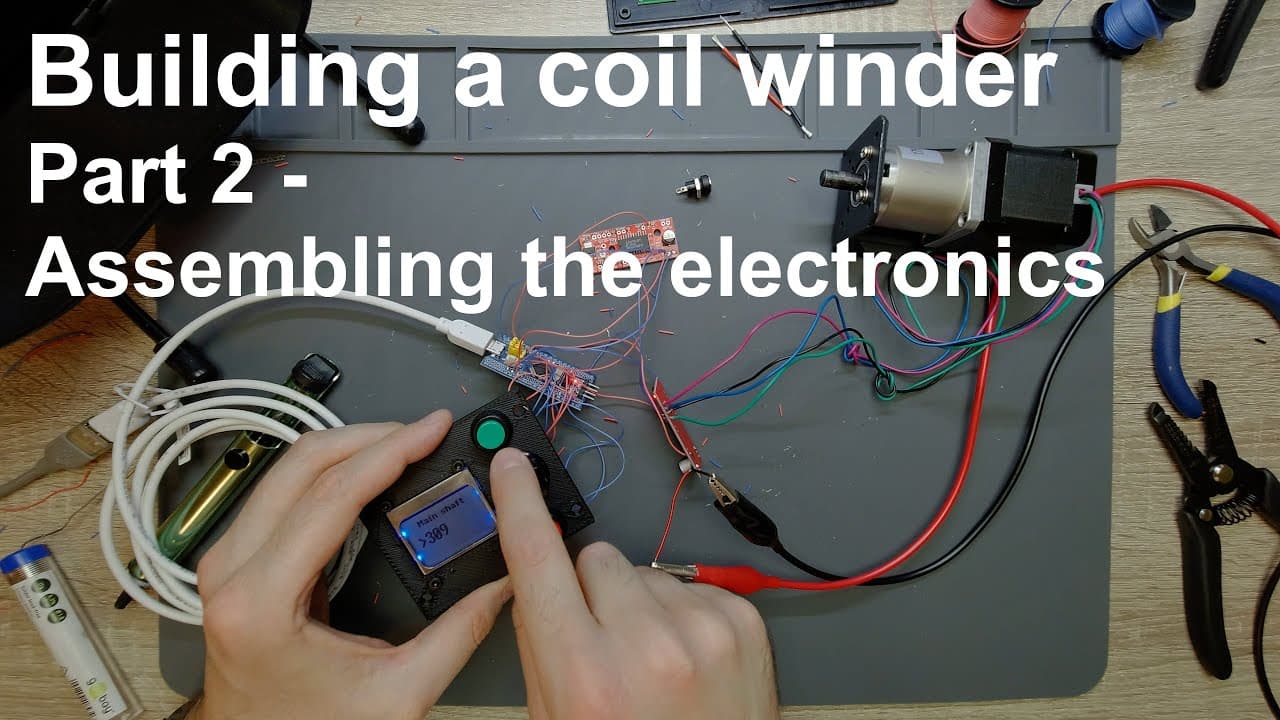
Assembly of electronics to control two stepper motors using a microcontroller and LCD display.
Transcript
welcome everyone in this video i'm going to show you how i assemble the electronics for another project so i did not want to include this part in that video because it would be too long and people are not watching the whole video anyway so it might be worth to split it up into several parts so that other project consists of two stepper motors which... Read More
Key Insights
- 👻 The STM32 bluepill microcontroller enhances project capabilities, allowing for more powerful control over stepper motors compared to simpler boards.
- 😒 The use of a rotary encoder provides direct feedback to the microcontroller, improving accuracy in position control and operational responses.
- 👻 Microstepping functionality allows for fine-tuned motor movements, ideal for applications requiring precision in operation.
- 😒 Designing a custom PCB plate for the stepper motor drivers ensures organized and efficient use of space, contributing to a cleaner assembly process.
- 👤 Employing a Nokia 5110 LCD offers a straightforward method for displaying real-time values and settings, enhancing user interaction.
- 🫵 The assembly process is broken into manageable sections to facilitate easier understanding and to keep viewers engaged by concentrating on specific elements at a time.
- ❓ Flexible wiring solutions are prioritized to avoid rigid connections that restrict movement within the housing during assembly modifications.
Install to Summarize YouTube Videos and Get Transcripts
Explore YouTube Video Summarizer or Get YouTube Transcript Extractor
Questions & Answers
Q: What is the main purpose of this electronics assembly?
The main purpose is to assemble the electronics necessary to control two stepper motors through an STM32 microcontroller, allowing for precise command inputs via an LCD interface and rotary encoder. This assembly aims to enhance user control and functionality during operation.
Q: What components are essential for controlling the stepper motors in this project?
Essential components include two stepper motor drivers, a Nokia 5110 LCD for display purposes, buttons for user inputs, a rotary encoder for position control, and an STM32 microcontroller. These elements work together to provide real-time feedback and motor control.
Q: How does the rotary encoder function in this project?
The rotary encoder provides input to the microcontroller, registering the rotational position and translating it into digital signals. This enables the system to detect rotations accurately, allowing adjustments to the stepper motors based on user inputs and predefined parameters.
Q: What is microstepping and why is it important in controlling stepper motors?
Microstepping is a technique that divides each full step of a stepper motor into smaller incremental movements. It allows for smoother and more precise control, reduces vibration, and improves the overall performance of the motor, making it particularly beneficial in applications requiring fine adjustments.
Q: Why is the choice of a plastic housing significant for the project?
Using a plastic housing is significant because it helps protect the electronics, provides a clean aesthetic by covering rough cuts, and organizes the components more effectively. It minimizes wire clutter, promoting a more professional and functional design.
Q: How is the microcontroller programmed for this project?
The microcontroller is programmed using the Arduino IDE, which allows for easier management of the wiring and code compared to using the STM32 Cube IDE. This enables the user to upload code more efficiently while leveraging the capabilities of the STM32 microcontroller.
Q: What challenges might arise during the assembly process?
Challenges during assembly can include ensuring precise connections between components, troubleshooting any short circuits or signal interference, managing the physical arrangement of wires to avoid congestion in the housing, and calibrating the rotary encoder and buttons for accurate function.
Q: What future improvements does the creator plan for this project?
Future improvements may include enhancing the control mechanism with feedback systems for closed-loop motor control, integrating additional sensors, refining the wiring for a cleaner appearance, and updating the code to optimize performance based on practical testing results.
Summary & Key Takeaways
-
The video demonstrates the assembly of electronics for a project involving two stepper motors, controlled via an LCD panel and a microcontroller, specifically the STM32 bluepill.
-
Key components include a Nokia 5110 LCD, rotary encoder, buttons for motor control, and stepper motor drivers that facilitate precise motor movements through microstepping.
-
The final objective is to create a dual motor control system that integrates seamless commands and feedback mechanisms for enhanced functionality in a compact design.
Read in Other Languages (beta)
Share This Summary 📚
Summarize YouTube Videos and Get Video Transcripts with 1-Click
Try YouTube Summary with ChatGPT & Claude or YouTube Transcript Generator
Explore More Summaries from Curious Scientist 📚
![Building a Peltier cooler-based cooling box - First iteration, improvements [Part 2/6] thumbnail](/_next/image?url=https%3A%2F%2Fi.ytimg.com%2Fvi%2F0YlNw0EGnzI%2Fhqdefault.jpg&w=750&q=75)
Summarize YouTube Videos and Get Video Transcripts with 1-Click
Try YouTube Summary with ChatGPT & Claude or YouTube Transcript Generator