Why Could China's AI Price War Correct Markets?
TL;DR
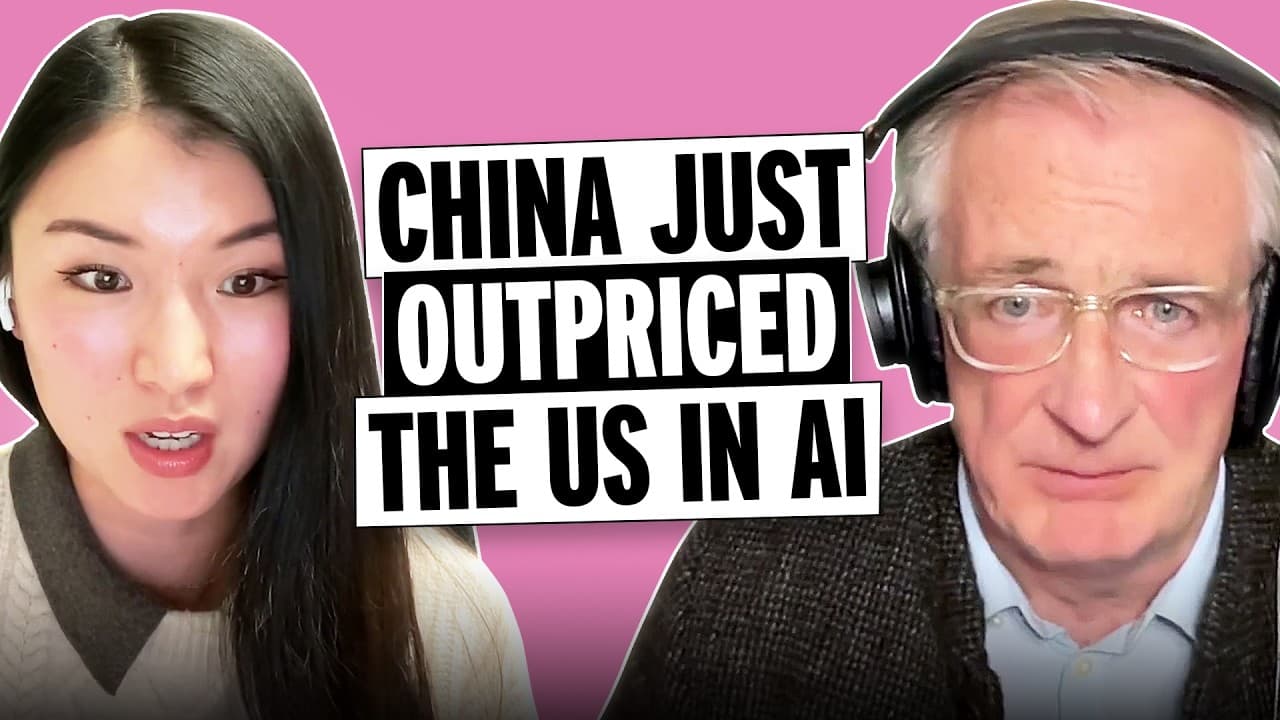
Chinese AI models are becoming competitive by cutting training and inference costs, releasing open weights, and prioritizing efficient deployment. Their adoption by American companies could weaken the economics behind expensive US models and data centers, although security concerns, political backlash, and the US advantage in frontier research make the long-term outcome uncertain.
Transcript
The latest Chinese AI sensation which is called Kimmy K2 cost just a fraction of what it would cost to train an AI model in America. It it cost about $4.6 million US. That is just a tiny fraction of what OpenAI has been investing in its uh large language models over in the US. Welcome to China Decode. I'm Alice Han and I'm James King. Well, in toda... Read More
Key Insights
- China's AI strategy is centered on cheaper, lighter, and increasingly competitive models that can be deployed at substantially lower training and inference costs. This approach contrasts with the American emphasis on increasingly large frontier models, hyperscalers, and expensive data-center expansion.
- Kimi K2 reportedly cost about $4.6 million to train, which the hosts present as a small fraction of comparable American investment. Alice Han also characterizes that amount as 1,500 times less than OpenAI's research and development spending for the year.
- American companies are adopting Chinese models because price and speed can outweigh brand or national origin. Airbnb reportedly replaced ChatGPT with Alibaba's Qwen, while venture firms are switching to Moonshot's Kimi and developer data indicate strong US usage of Chinese models.
- The AI market correction risk comes from a mismatch between costly American infrastructure and rapidly declining model prices. If lower-cost Chinese systems deliver sufficiently comparable performance, investors may question whether billions committed to US models and data centers can generate the expected returns.
- Open-weight models are not necessarily fully open-source systems. Many models described as open source release their trained parameters while withholding underlying code and datasets, so the episode cautions against treating every accessible Chinese or American model as completely open.
- The US still appears better positioned in the race toward artificial general intelligence or superintelligence because it has invested heavily in frontier laboratories, leading-edge models, datasets, and data centers. Lower Chinese costs therefore do not establish a definitive winner in the long-term competition.
- Security and political concerns could restrict Chinese AI adoption in Western markets. James Kynge notes allegations involving Alibaba and the Chinese military, alongside Alibaba's forceful denial, while both hosts expect Chinese language models to become politicized as their usage and competitiveness increase.
- China's hyper-competitive business environment produces price wars across both technology and consumer markets. The episode connects AI involution with the coffee battle involving Starbucks, Luckin, and Cotti, showing how aggressive local rivals can force established Western companies to reconsider ownership and strategy.
Install to Summarize YouTube Videos and Get Transcripts
Explore YouTube Video Summarizer or Get YouTube Transcript Extractor
Questions & Answers
Q: How could China's AI price war cause a market correction?
China's AI price war could cause a correction by undermining the revenue and valuation assumptions behind expensive American models and data centers. Chinese developers are lowering training and inference costs while producing systems described as competitive with US alternatives. If customers migrate toward cheaper models, investors may reconsider whether massive American capital expenditures can earn sufficient returns.
Q: Why are American companies adopting Chinese AI models?
American companies are adopting Chinese AI models because they can be fast, inexpensive, and sufficiently capable for practical applications. Airbnb reportedly moved from ChatGPT to Alibaba's Qwen, and venture firms are using Moonshot's Kimi. Their decisions indicate that commercial users may choose lower operating costs when perceived performance differences are limited.
Q: How much did it cost to train Kimi K2?
Kimi K2 reportedly cost about $4.6 million to train. The hosts describe this as only a fraction of the cost associated with training American frontier models, and Alice Han says it is 1,500 times less than OpenAI's research and development spending for the year. The comparison illustrates China's emphasis on efficient model development.
Q: Are Chinese AI models truly open source?
Chinese AI models are not uniformly open source, just as American models are not uniformly closed. Many systems called open source are more accurately described as open weight because their trained parameters are available while the underlying code and datasets remain unavailable. DeepSeek and Qwen are cited alongside American open offerings from Meta, Microsoft, and Google.
Q: Does cheaper Chinese AI mean China has won the AI race?
Cheaper Chinese AI does not establish a final winner because the US-China competition is expected to unfold over a long period with many reversals. The United States has committed billions to data centers, hyperscalers, frontier laboratories, and leading-edge models, which may leave it further ahead in the pursuit of artificial general intelligence or superintelligence.
Q: Why might developing countries choose Chinese AI models?
Developing countries may choose Chinese AI models because limited budgets make free or inexpensive systems more practical than premium Western alternatives. Former Google CEO Eric Schmidt is cited as warning that most countries could standardize on Chinese models, not necessarily because those models are better, but because they are available at little or no cost.
Q: What security concerns surround Chinese language models?
Security concerns include possible links between Chinese technology providers and state or military activity, as well as politically shaped model responses. James Kynge cites a Financial Times report alleging that Alibaba supported the Chinese military against US targets, but he emphasizes that the claims were not independently verified and that Alibaba strongly rejected them as nonsense.
Q: What does China's coffee war reveal about its consumer market?
China's coffee war shows how aggressive local competition can pressure established Western brands on price, relevance, and control. Starbucks has lost ground to Luckin and Cotti and is selling majority control of its China business. The episode presents this as another example of China's hyper-competitive environment forcing foreign companies to reconsider their market strategies.
Summary & Key Takeaways
-
China's AI industry is pursuing cheaper training, lower inference prices, and widely accessible model weights while American firms invest billions in frontier models and data centers. The hosts argue that competitive Chinese systems could pressure US pricing, challenge expensive infrastructure assumptions, and contribute to concerns about an American AI market bubble.
-
Kimi K2 reportedly cost about $4.6 million to train, while its performance is described as approaching US standards. American companies are already testing or adopting Chinese models because they are fast and inexpensive. This adoption suggests that practical buyers may prioritize acceptable performance and low costs over model origin or prestige.
-
The episode connects Chinese AI competition with broader regional and consumer struggles. China and Japan are clashing over Taiwan and the Asia-Pacific balance of power, while Starbucks is surrendering majority control of its China business after losing ground to Luckin and Cotti in an intensely competitive coffee market.
Read in Other Languages (beta)
Share This Summary 📚
Summarize YouTube Videos and Get Video Transcripts with 1-Click
Try YouTube Summary with ChatGPT & Claude or YouTube Transcript Generator
Explore More Summaries from The Prof G Pod – Scott Galloway 📚



Summarize YouTube Videos and Get Video Transcripts with 1-Click
Try YouTube Summary with ChatGPT & Claude or YouTube Transcript Generator