How to Build Wealth by Driving an Older Car
TL;DR
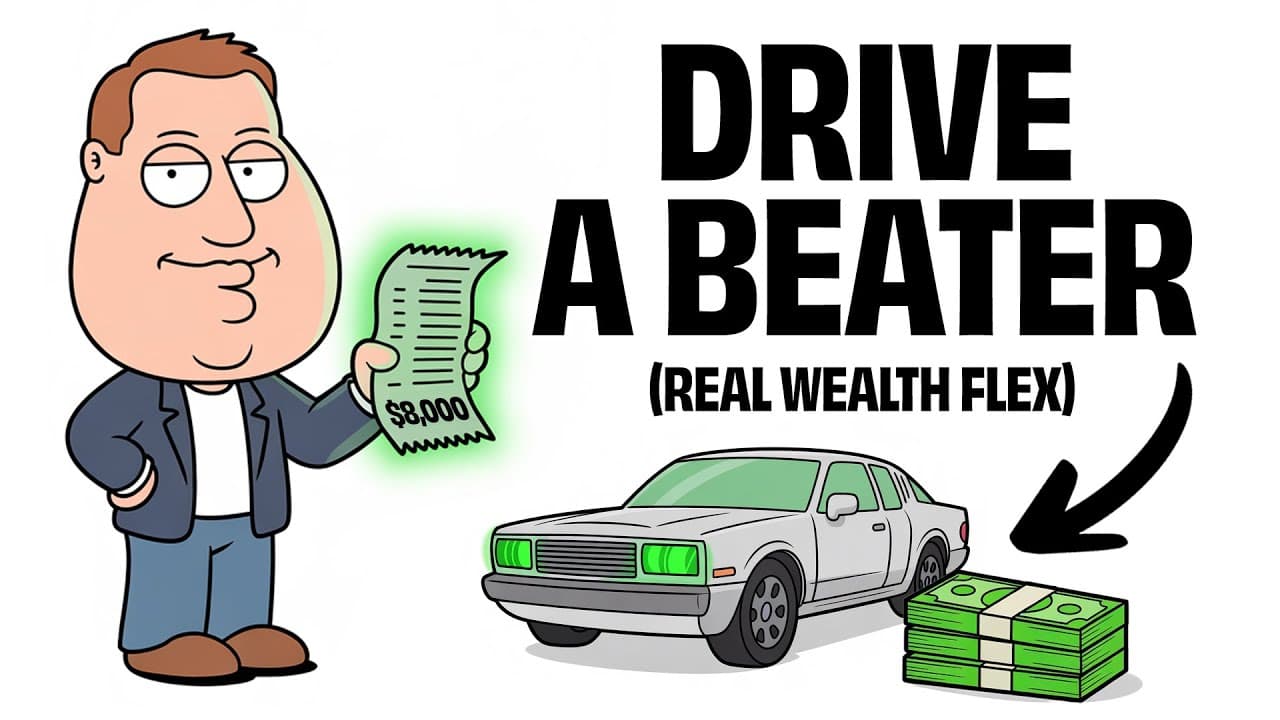
Choose a mechanically reliable older car with cosmetic wear instead of financing a newer vehicle for status. Paying cash can eliminate monthly payments, reduce insurance costs, and free money for investing or an emergency fund, while careful inspection of the engine, transmission, brakes, fluids, maintenance history, and other major systems helps control repair risk.
Transcript
What if I told you that the fastest way to stay broke is to drive around in a shiny new car that makes you feel important while everyone else is signing their financial future away for heated seats and that new car smell. There's a group of people quietly building serious wealth by driving vehicles that look like they've survived multiple apocalyps... Read More
Key Insights
- A smart beater is a mechanically reliable and safe vehicle that happens to have faded paint, minor dents, interior wear, or an unattractive exterior. It is not a dangerous car that frequently breaks down or leaves its owner stranded.
- Transportation value is the ability to travel reliably from point A to point B at the lowest total ownership cost. Status value comes from appearance, features, identity, and the impression a vehicle may create for other people.
- A $450 monthly payment totals $32,400 across six years before considering additional interest. Financing can also require comprehensive insurance, while buying an $8,000 older car with cash eliminates the loan payment and may permit liability-only coverage.
- Investing $450 each month for six years in a diversified portfolio earning an assumed 7% annually could accumulate roughly $42,000. The example illustrates how avoiding a car payment can redirect money toward assets instead of vehicle depreciation.
- Older vehicles usually require more maintenance, but even a $1,500 major repair costs less than four $450 car payments. The strategy depends on evaluating likely repair needs and comparing them with the continuing payment and insurance costs of a newer vehicle.
- Mechanical condition is more important than cosmetic condition when evaluating an inexpensive older car. Buyers should inspect fluids and leaks, listen to the engine, test the brakes, transmission, air conditioning, and electrical systems, and ask for maintenance records.
- Some older vehicles are simpler to diagnose and repair because they have fewer complex computer systems and electronic components. When problems occur, the transcript argues that they may be easier to identify without specialized diagnostic equipment or expensive proprietary parts.
- Driving an unimpressive but functional car can separate self-worth from possessions and reduce anxiety about dents, scratches, detailing, and social judgment. That mindset can encourage a wider focus on actual savings and long-term wealth rather than the appearance of wealth.
Install to Summarize YouTube Videos and Get Transcripts
Explore YouTube Video Summarizer or Get YouTube Transcript Extractor
Questions & Answers
Q: What qualifies as a smart beater car?
A smart beater is an older, inexpensive vehicle that runs reliably and remains safe despite cosmetic flaws. It may have faded paint, minor dents, a worn interior, or an unattractive exterior. It is not a death trap or a car that breaks down constantly. Its value comes from dependable transportation and low total ownership cost, not appearance or status.
Q: How can driving an older car help build wealth?
Driving an older car can eliminate or reduce monthly loan payments, lower insurance expenses, and free cash for an emergency fund or investments. In the example, avoiding a $450 monthly payment allows that same amount to be invested. At an assumed 7% annual return, those monthly investments could grow to roughly $42,000 over six years.
Q: How does an $8,000 cash car compare with a financed newer car?
The comparison uses an older car costing $8,000 in cash and a newer sedan costing $450 monthly for six years. The monthly payments total $32,400 before additional interest, and financing also brings higher insurance costs because comprehensive coverage is needed. The cash car removes the payment and leaves $450 available each month for other priorities.
Q: Do repair costs cancel the savings from an older car?
Older cars typically require more maintenance, but the transcript argues that their annual maintenance rarely exceeds the monthly payments on a newer vehicle. A $1,500 major repair can feel expensive because it arrives at once, yet it still costs less than four payments of $450. Buyers should compare repairs with avoided loan and insurance expenses rather than viewing repairs alone.
Q: How should you inspect an older car before buying it?
Focus on the systems that determine reliability and safety. Check engine oil and other fluids, listen to the engine while it idles and revs, and look beneath the vehicle for leaks. Test the brakes, transmission, air conditioning, and electrical systems. Ask for maintenance records and confirm whether major scheduled services, such as timing belt replacement, were completed.
Q: Why might some older cars be easier to repair?
Some older cars use simpler technology and contain fewer complex computer systems and electronic components than newer vehicles. The transcript argues that this simplicity can make faults more straightforward to identify and repair. Owners may be less dependent on specialized diagnostic equipment or expensive proprietary parts, although the vehicle still requires careful mechanical evaluation before purchase.
Q: How can owning an older car reduce insurance costs?
Owning a vehicle outright gives the driver the option to carry only liability insurance rather than the comprehensive coverage required for a financed car. Depending on location and driving record, the transcript says this choice could save hundreds of dollars annually. Owners may also decide whether minor cosmetic repairs are worthwhile instead of repairing damage to satisfy loan requirements.
Q: What psychological benefits can come from driving a beater?
A cosmetically worn car can reduce concern about door dings, scratches, crowded parking lots, frequent washing, and detailing. It can also weaken the connection between possessions and personal worth. By accepting a functional vehicle that does not project status, a driver may redirect mental energy toward saving, investing, and building actual wealth rather than maintaining its appearance.
Summary & Key Takeaways
-
A smart beater is a reliable vehicle with cosmetic flaws, not an unsafe car that constantly breaks down. The buying decision should prioritize transportation value, mechanical condition, safety, maintenance history, and total ownership cost instead of attractive paint, luxury features, social status, or an affordable-looking monthly payment.
-
The comparison presented contrasts an $8,000 cash purchase with a newer sedan requiring $450 monthly for six years. Investing that monthly amount at an assumed 7% annual return could produce roughly $42,000, while the financed vehicle may be worth about $15,000 after six years of depreciation.
-
Driving an older car can provide benefits beyond its purchase price. Owners may reduce insurance expenses, worry less about cosmetic damage, and redirect attention from maintaining an image toward savings and investment goals. The broader lesson is to separate functional value and personal self-worth from the appearance of material success.
Read in Other Languages (beta)
Share This Summary 📚
Summarize YouTube Videos and Get Video Transcripts with 1-Click
Try YouTube Summary with ChatGPT & Claude or YouTube Transcript Generator
Explore More Summaries from Nick Invests 📚




Summarize YouTube Videos and Get Video Transcripts with 1-Click
Try YouTube Summary with ChatGPT & Claude or YouTube Transcript Generator