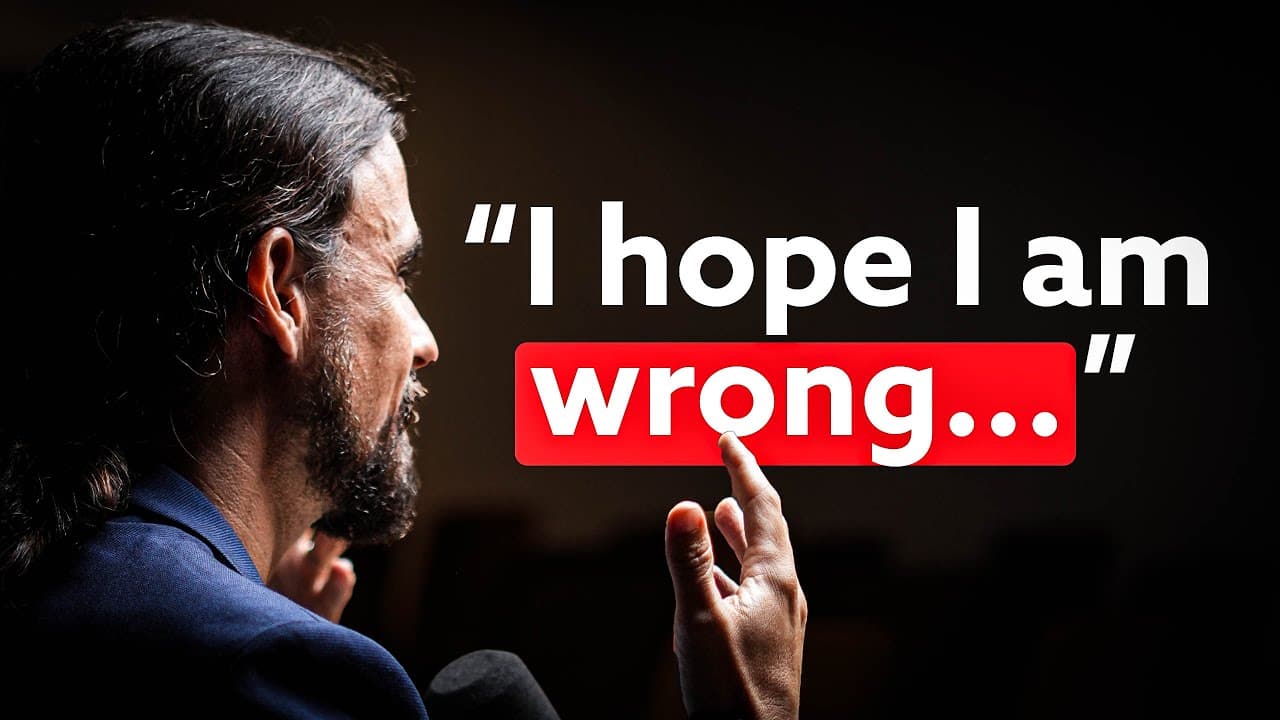
Why Does Neuroscientist Alex Gómez-Marín Say Materialism Struggles With Consciousness?
TL;DR
Materialism struggles with consciousness because, according to neuroscientist Alex Gómez-Marín, physical descriptions do not explain subjective experience. He describes a field with more than 200 classified positions, criticizes the expectation that more brain research will eventually close the explanatory gap, and warns against equating intelligent behavior with consciousness in AI. Read on to understand the scientific, institutional, and technological stakes of this debate.
Transcript
I don't see that education is going on in schools. I don't see a lot of healing happening in hospitals and I don't see a lot of food being sold in supermarkets. Can a wrong theory about consciousness negatively impact our lives? I was on my way to Barcelona to talk to a physicist and neuroscientist who is convinced we are more than our brains and b... Read More
Key Insights
- Consciousness research is no longer academically taboo, but its expansion has produced both useful inquiry and substantial theoretical noise. Gómez-Marín says the field now contains more than 200 classified positions, with many researchers promoting proposals that he believes do not qualify as complete scientific theories.
- Theories of consciousness are compared to toothbrushes because researchers tend to develop their own and resist using alternatives. The metaphor highlights how intellectual ownership, professional investment, and personal ego can make scientists reluctant to abandon a favored framework when conflicting evidence or arguments appear.
- Scientific disagreement is shaped by human institutions as well as evidence. Gómez-Marín argues that ego, greed, frustration, ideological commitments, and conference cultures affect which questions are treated as legitimate, showing why scientific practice cannot be understood as a purely impersonal process.
- The hard problem of consciousness is presented as a fundamental challenge to materialism, not merely a technically difficult puzzle. Gómez-Marín argues that materialism excludes what subjective experience contributes and therefore cannot explain how consciousness emerges from physical descriptions without appealing to an unexplained miracle.
- Promissory materialism is the expectation that additional brain research will eventually explain consciousness within a materialist framework. Gómez-Marín criticizes this expectation because it postpones the central explanatory gap while allowing materialism to remain dominant instead of competing openly with other metaphysical positions.
- Competing consciousness frameworks receive unequal treatment within scientific debate. Gómez-Marín says non-materialist approaches, including panpsychism, are sometimes dismissed through oversimplified examples, while difficult concepts in integrated information theory can be misunderstood because their language appears to conflate different meanings of information.
- Consciousness is not identical to intelligence, despite common public discussions of conscious AI. The conversation notes that people often use these concepts interchangeably, which makes claims about machine consciousness difficult to assess and forces researchers to clarify basic definitions before addressing technological conclusions.
- AI and transhumanism make consciousness theory practically consequential because assumptions about minds can influence how humans and machines are engineered. Gómez-Marín warns that behavioral resemblance alone cannot establish consciousness and calls for understanding when and why a physical system is conscious before powerful institutions embed contrary assumptions in public thinking.
Install to Summarize YouTube Videos and Get Transcripts
Explore YouTube Video Summarizer or Get YouTube Transcript Extractor
Questions & Answers
Q: Why does neuroscientist Alex Gómez-Marín say materialism struggles with consciousness?
Gómez-Marín argues that materialism cannot derive subjective experience from physical descriptions because those descriptions omit what consciousness contributes. He says treating this incompatibility as a difficult problem awaiting more research gives materialism additional time without resolving its central explanatory gap.
Q: What is the hard problem of consciousness?
The hard problem asks how physical processes could produce subjective experience. Gómez-Marín treats it as a fundamental incompatibility for materialism rather than an ordinary scientific puzzle that additional neuroscience will necessarily solve.
Q: What does “promissory materialism” mean in this discussion?
Promissory materialism is the expectation that further research on the brain will eventually explain consciousness within a materialist framework. Gómez-Marín criticizes this promise because it postpones the explanatory problem while materialism remains dominant over competing metaphysical positions.
Q: What does the toothbrush metaphor mean in consciousness research?
The metaphor says theories of consciousness are like toothbrushes: everyone has one, but nobody wants to use someone else’s. Gómez-Marín connects this tendency to a field containing more than 200 classified positions and to researchers’ reluctance to abandon theories they have developed for decades.
Q: What is the hidden war on consciousness?
Gómez-Marín describes several overlapping conflicts over which consciousness theories and phenomena receive serious scientific consideration. These range from disagreements about conference openness and rigor to an ideological struggle in which approaches that appear non-materialist face resistance; he identifies AI and transhumanism as the more consequential front.
Q: How do the two main consciousness conference cultures differ?
Gómez-Marín describes the Barcelona conference as more open but potentially less rigorous, allowing discussion of life after death, quantum consciousness, neural correlates, and some psychedelic research. He characterizes the other major conference as potentially more rigorous but less open, illustrating the difficulty of balancing inclusion with evidential standards.
Q: Why should consciousness not be equated with intelligence?
The discussion treats consciousness and intelligence as distinct concepts, although public conversations about AI often blend them. A system can display behavior associated with intelligence without that behavior proving subjective experience, so sophisticated performance alone cannot establish consciousness.
Q: How could consciousness theories affect AI and transhumanism?
Gómez-Marín argues that assumptions about consciousness can shape claims about conscious machines and the engineering of human beings. He warns that resemblance to conscious behavior is insufficient and says researchers must understand why and when a physical system can be conscious before corporations or governments normalize stronger claims.
Summary & Key Takeaways
-
Alex Gómez-Marín describes consciousness research as a fragmented field containing more than 200 classified positions. He contrasts one conference culture that is more open to subjects such as life after death and quantum consciousness with another that may be more rigorous but less open, illustrating tensions between openness, evidence, and scientific acceptance.
-
Gómez-Marín argues that the hard problem does not create an ordinary research puzzle for materialism. In his view, it exposes materialism's inability to derive subjective experience from physical descriptions. He says reframing this incompatibility as a difficult future problem effectively granted materialism additional time instead of encouraging genuine competition among metaphysical frameworks.
-
The discussion connects theories of consciousness with practical questions about AI and transhumanism. Gómez-Marín warns against assuming that a system is conscious merely because its behavior resembles conscious behavior. He contends that researchers must understand why and when physical systems can be conscious before corporations or governments normalize strong claims about conscious machines or human engineering.
Read in Other Languages (beta)
Share This Summary 📚
Summarize YouTube Videos and Get Video Transcripts with 1-Click
Try YouTube Summary with ChatGPT & Claude or YouTube Transcript Generator
Explore More Summaries from Essentia Foundation 📚
Summarize YouTube Videos and Get Video Transcripts with 1-Click
Try YouTube Summary with ChatGPT & Claude or YouTube Transcript Generator