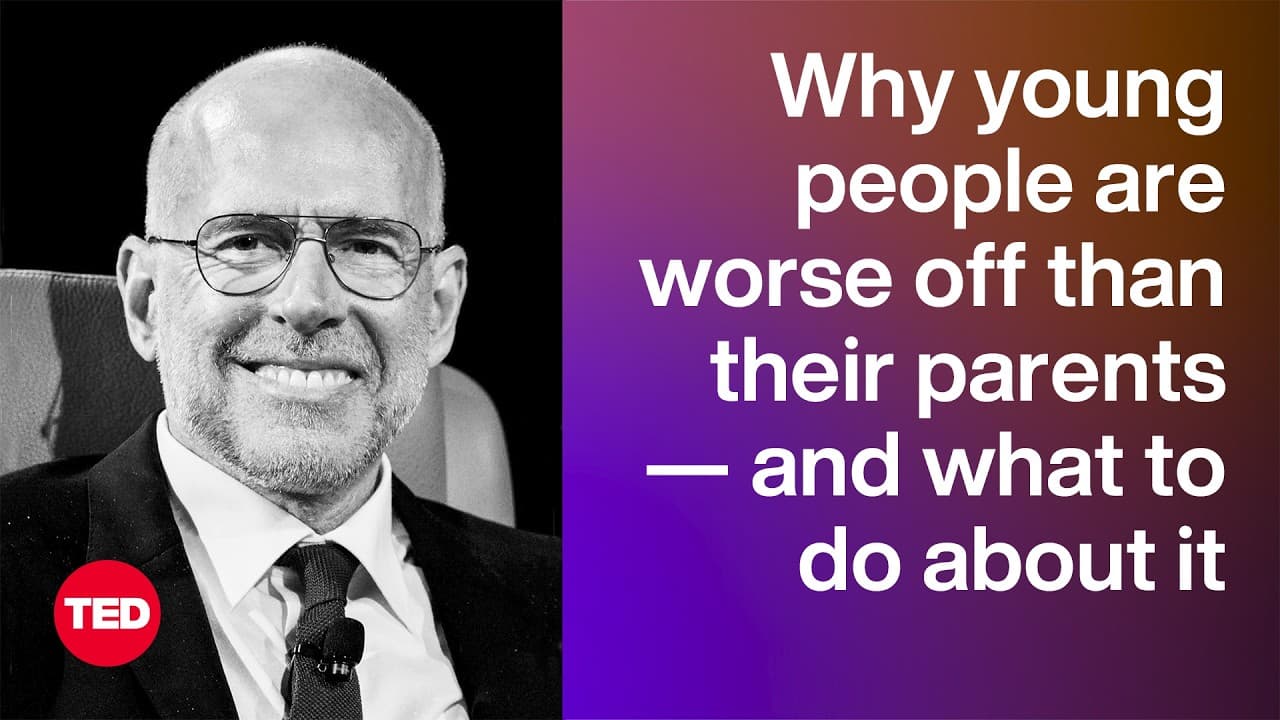
Why Are Young People Struggling More Than Their Parents?
TL;DR
Younger generations are facing significant struggles due to rising living costs, stagnant wages, and a broken social contract that limits opportunities. Scott Galloway advocates for reforms like means-testing Social Security, investing in education, increasing minimum wage, and acknowledging wealth disparities to help restore balance and prosperity for the youth.
Transcript
hello and welcome Ted members it's very very very very good to see you I'm the head of Ted Chris Anderson I'm a Ted head apparently and uh really excited to be here with you we're actually doing something we haven't done before we are going to watch together a Smash Hit Ted Talk in the presence of the man who gave that talk Scott Galloway I'm going... Read More
Key Insights
- 🧑🤝🧑 The broken social contract between younger and older generations has resulted in increasing financial challenges for young people.
- 🥺 Social media can have negative effects on the well-being of young individuals, leading to increased rates of depression, self-harm, and obesity.
- 🚕 Solutions to generational inequality require political action, investment in education and vocational programs, and progressive tax reform to ensure a more equitable distribution of resources.
- 🎙️ More videos with Scott Galloway:
Install to Summarize YouTube Videos and Get Transcripts
Explore YouTube Video Summarizer or Get YouTube Transcript Extractor
Questions & Answers
Q: Why does Scott Galloway propose banning social media for individuals under 16?
Galloway argues that social media has negative impacts on the mental and emotional well-being of young people, leading to increased rates of depression, self-harm, and obesity. He believes that alternative programs and resources can help young people find peer connections outside of social media.
Q: How does Galloway propose addressing the financial challenges faced by younger generations?
Galloway suggests implementing policies like increasing the minimum wage to $25 per hour, expanding college enrollments while reducing tuition fees, and reforming tax structures to be more progressive. He also calls for greater investment in vocational programs and non-traditional degrees.
Q: What are some key steps Galloway recommends to address generational inequality?
Galloway emphasizes the need for political action, engaging with elected representatives who are willing to address issues such as the deficit, intergenerational wealth transfers, and social programs. He also urges people to get involved in local schools and charities, and push for the elimination of disparities in education and access to resources.
Q: What are some potential downsides or challenges to Galloway's proposed solutions?
Galloway acknowledges that there will always be winners and losers when implementing large-scale changes, and some industries or individuals may resist certain reforms. Additionally, finding alternative communities or programs to replace social media for young people may require new strategies and resources.
Summary & Key Takeaways
-
Scott Galloway highlights the increasing financial challenges faced by younger generations, including rising costs of education, homeownership, and decreasing wages.
-
He argues that the social contract, which traditionally promised younger generations greater prosperity than their parents, is now broken, leading to feelings of rage and shame among young people.
-
Galloway identifies social security as a major problem, suggesting that it should be means-tested and age-adjusted to better allocate resources. He calls for taxing the wealthy and investing in education and vocational programs.
Read in Other Languages (beta)
Share This Summary 📚
Summarize YouTube Videos and Get Video Transcripts with 1-Click
Try YouTube Summary with ChatGPT & Claude or YouTube Transcript Generator
Explore More Summaries from TED 📚





Summarize YouTube Videos and Get Video Transcripts with 1-Click
Try YouTube Summary with ChatGPT & Claude or YouTube Transcript Generator