What Is OpenAI PRISM and How Does It Help Scientists?
TL;DR
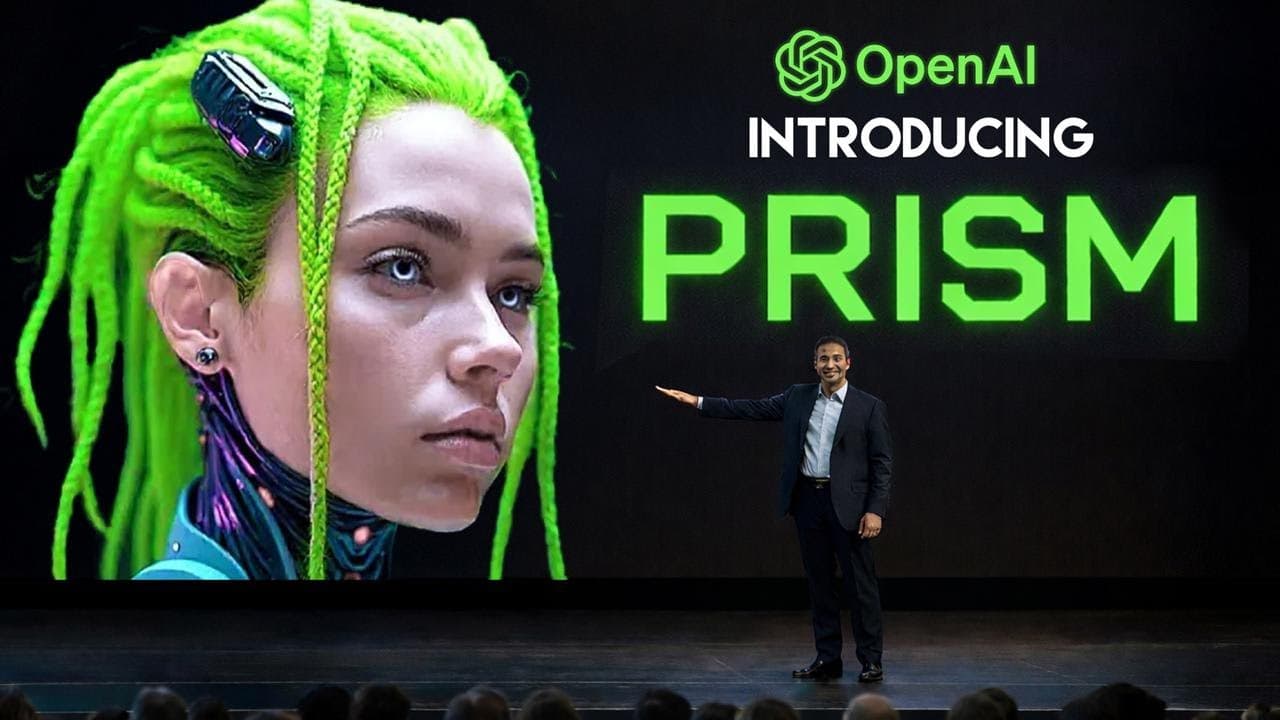
OpenAI's PRISM is a free, cloud-based LaTeX workspace that embeds GPT-5.2 directly inside scientific papers, letting the model see a manuscript's full structure to revise prose, refactor equations, update citations, and pull related work. Alongside it, Microsoft unveiled its Maya 200 inference chip, the UAE released the transparent K2 Think model, and Yahoo launched its Claude-powered Scout search engine.
Transcript
Open AAI just launched a free AI workspace called Prism that plugs GPT 5.2 directly into scientific papers. Microsoft just revealed a custom AI chip called Maya 200 that it says beats rival cloud processors on inference efficiency. The UAE released a fully transparent open model named K2 Think to compete with US and Chinese systems and Yahoo rolled... Read More
Key Insights
- PRISM is a free AI-native workspace for scientists, available to anyone with a regular ChatGPT account, that runs on GPT-5.2, which OpenAI positions as its most advanced model for mathematical and scientific reasoning.
- The core advantage of PRISM is context access, because GPT-5.2 sits inside the project and can see surrounding sections, equations, references, and overall manuscript structure instead of relying on pasted chunks in a chat window.
- PRISM consolidates a fragmented research workflow, replacing the constant switching between text editors, LaTeX compilers, PDFs, citation managers, and chat tools with one integrated cloud environment where drafting, revising, and collaboration live together.
- GPT-5.2's visual capabilities let researchers turn whiteboard equations or rough diagrams into LaTeX, and the AI can refactor equations, update citations across the paper, and make in-place edits directly in the document.
- Microsoft's Maya 200 is an in-house AI chip built specifically for inference, which Microsoft claims delivers three times the performance of Amazon's third-generation Tranium chip and about 30% better performance per dollar than similarly priced alternatives.
- NVIDIA still dominates with an estimated 92% share of the data center GPU market, so while Maya 200 may improve Microsoft's margins and give Azure a cost advantage, it is unlikely to seriously dent NVIDIA's lead soon.
- K2 Think is a reasoning-focused open model from the UAE's MBZUAI that was trained using fewer than 2,000 NVIDIA H200 chips and published full disclosures of its data, algorithms, and code, positioning it as a sovereign alternative to US and Chinese systems.
- Yahoo Scout is an AI answer engine powered primarily by Anthropic's Claude combined with Microsoft's Bing grounding API, delivering direct synthesized answers while drawing on Yahoo's roughly 500 million user profiles and a knowledge graph of over 1 billion entities.
Install to Summarize YouTube Videos and Get Transcripts
Explore YouTube Video Summarizer or Get YouTube Transcript Extractor
Questions & Answers
Q: What is OpenAI PRISM and who is it for?
PRISM is a free AI-native workspace designed specifically for scientists, available to anyone with a regular ChatGPT account. It runs on GPT-5.2, which OpenAI positions as its most advanced model for mathematical and scientific reasoning. PRISM is a cloud-based, LaTeX-native environment where drafting, revising, equations, citations, figures, and collaboration all live in one place, with the model embedded directly inside the project rather than sitting in a separate tab.
Q: How does GPT-5.2 access scientific papers inside PRISM?
Instead of pasting chunks of text into a chat window, GPT-5.2 sits directly inside the project with access to the full structure of the paper. It can see surrounding sections, equations, references, and the overall structure of the manuscript. That context lets it help revise prose, assess claims, explore hypotheses, reason through complex arguments, and even search for prior research such as pulling in relevant work, all while staying grounded in the current document.
Q: What practical problems does PRISM solve for researchers?
PRISM removes friction from a fragmented workflow where scientists jump between text editors, LaTeX compilers, PDFs, citation managers, and chat tools, losing context at each switch. Researchers can turn whiteboard equations or rough diagrams into LaTeX using GPT-5.2's visual capabilities, refactor equations, update citations across the paper, and make in-place edits directly in the document. It also supports unlimited collaborators, real-time edits and comments, and optional voice-based editing.
Q: Why does OpenAI say 2026 is the year for AI and science?
OpenAI's VP for science compared PRISM to coding tools like Cursor and Windsurf, arguing that 2025 was for AI and software engineering while 2026 is shaping up to be for AI and science. He noted the magic is not just the model but deep workflow integration. OpenAI says ChatGPT already receives about 8.4 million messages per week on advanced hard science topics spanning physics, math, and biology, showing where usage is heading.
Q: What is Microsoft's Maya 200 chip and how does it perform?
Maya 200 is Microsoft's new in-house AI chip built specifically for inference, meaning running trained models to generate outputs like tokens, responses, and predictions at scale. It is packed with high-bandwidth memory and a redesigned memory system. Microsoft claims it delivers three times the performance of Amazon's third-generation Tranium chip, surpasses Alphabet's 7th-generation Ironwood TPU in certain inference metrics, and provides about 30% better performance per dollar than similarly priced alternatives.
Q: Can Maya 200 challenge NVIDIA's dominance?
NVIDIA remains dominant, with estimates putting it at about 92% share of the data center GPU market, and its GPUs are still considered the most flexible and powerful for both training and inference. While Maya 200 may improve Microsoft's margins, reduce its dependence on NVIDIA GPUs, and give Azure a cost advantage in some scenarios, it is unlikely to seriously dent NVIDIA's overall lead anytime soon. Microsoft is also releasing a software development kit for developers.
Q: What makes the UAE's K2 Think model transparent?
K2 Think is a reasoning-focused model from Mohamed bin Zayed University of Artificial Intelligence that stands out for its transparency, publishing not just the model but full disclosures of the data, algorithms, and code used to build it. Its base model was built fully in-house rather than relying on an off-the-shelf openweight model, and it includes decontamination checks to avoid benchmark leakage. It was trained using fewer than 2,000 NVIDIA H200 chips for a fraction of the cost of leading models.
Q: How does Yahoo Scout work and what powers it?
Yahoo Scout is an AI-powered answer engine that delivers direct synthesized answers instead of a list of links, competing with Google's AI mode, Perplexity, and ChatGPT's real-time search. It is powered primarily by Anthropic's Claude model combined with Microsoft's Bing grounding API to back answers with authoritative sources. Scout also draws on Yahoo's ecosystem, including around 500 million user profiles and a knowledge graph with over 1 billion entities, and integrates tightly with Yahoo Finance.
Summary & Key Takeaways
-
OpenAI launched PRISM, a free cloud-based LaTeX-native workspace running GPT-5.2 that embeds AI directly inside scientific papers. The model accesses a manuscript's full structure to revise prose, assess claims, explore hypotheses, refactor equations, update citations, and pull relevant prior work, all while making in-place edits and staying grounded in the current document.
-
PRISM builds on Cricset, a mature cloud LaTeX platform OpenAI acquired, and supports unlimited collaborators, real-time edits, and optional voice-based editing. OpenAI's VP for science framed 2026 as the year for AI and science, noting ChatGPT already receives about 8.4 million messages per week on advanced hard science topics like physics, math, and biology.
-
Microsoft revealed its Maya 200 inference chip, the UAE released the fully transparent K2 Think reasoning model trained on fewer than 2,000 H200 chips, and Yahoo launched Scout, a Claude and Bing-powered AI search engine. Together they show AI moving beyond chat into science labs, cloud hardware, national strategies, and search.
Read in Other Languages (beta)
Share This Summary 📚
Summarize YouTube Videos and Get Video Transcripts with 1-Click
Try YouTube Summary with ChatGPT & Claude or YouTube Transcript Generator
Explore More Summaries from AI Revolution 📚



Summarize YouTube Videos and Get Video Transcripts with 1-Click
Try YouTube Summary with ChatGPT & Claude or YouTube Transcript Generator