How CIA Operations Shape India and Global Power
TL;DR
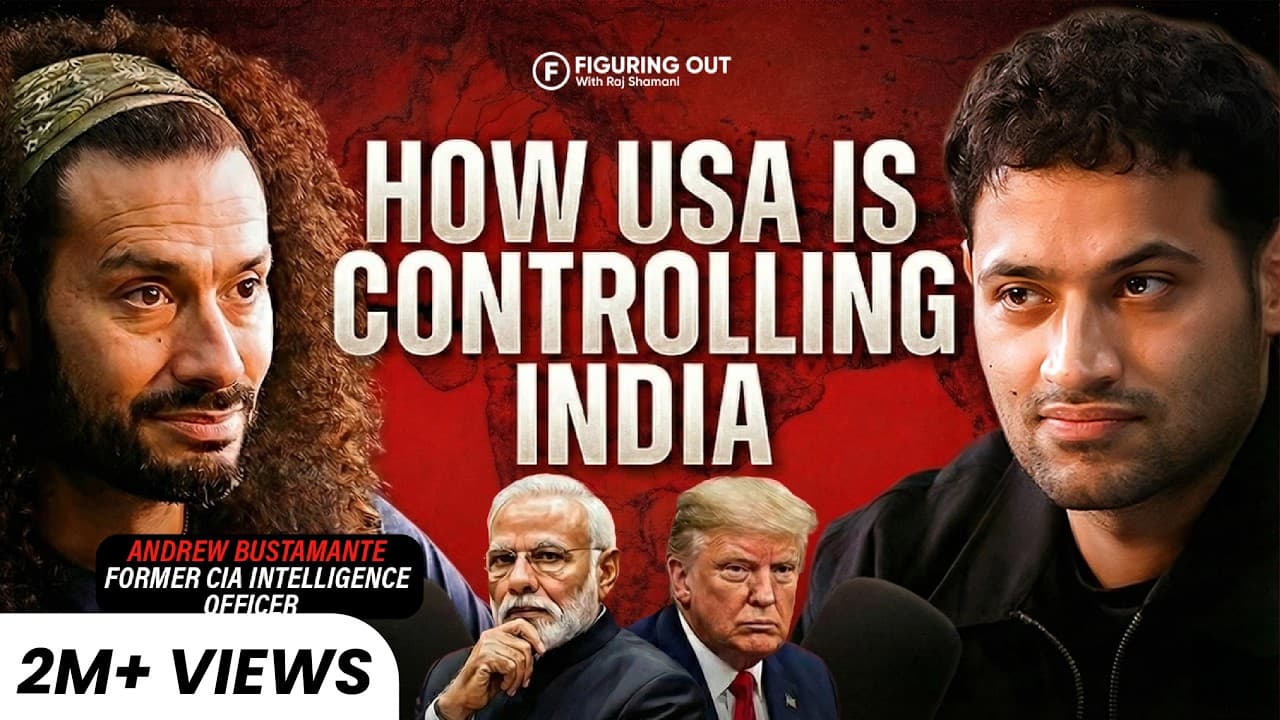
Intelligence agencies collect information, conduct covert action, and train officers gradually to manage operational stress without making them ineffective. Former CIA officer Andrew Bustamante argues that India has strong intelligence capabilities, vital engineering talent, and valuable ties with Russia, while the United States uses regional relationships to obtain information and preserve its global influence.
Transcript
And you said India has one of the top two agencies in the world. There's RAW and there's the intelligence bureau which is IB. Why did you say so? Indian intelligence is so good. They are very effective at being able to identify terrorist activities, threats to the homeland. And Pakistan's ISI uses terrorist tactics in India. They're blowing things ... Read More
Key Insights
- Intelligence training is designed to avoid disabling trauma, according to Bustamante. He says realistic preparation remains controlled and less dramatic than movie portrayals because an officer who becomes psychologically damaged during training may no longer be capable of operating effectively in the field.
- Non-intimate killing occurs when the operator is absent from the target’s death, according to the guest. His examples include drone strikes, explosives, sabotage, and poison, while intimate killing involves direct physical participation and requires more training, experience, and psychological preparation.
- Desensitization is presented as a gradual process that changes how an operator perceives violence. Bustamante says exposure to suffering, followed by categorizing people as harmful or protective, helped prepare him for offensive operations involving military equipment and attacks against terrorist organizations.
- Cold exposure was Bustamante’s most difficult training experience because his body and concentration deteriorated quickly. He says the exercise was combined with medical triage practice, requiring participants to recognize when someone needed fluids, covering, or removal from the exercise.
- Indian intelligence is highly effective at detecting terrorist activity and threats to the homeland, according to Bustamante. He identifies RAW and the Intelligence Bureau as important services and places India among the strongest intelligence environments discussed during the interview.
- American intelligence seeks independent information about India because India will not disclose everything, according to the guest. He argues that intelligence collection helps officials judge whether another government is being truthful and claims Pakistan offers useful access for recruiting sources connected to India.
- Regional conflict restricts national growth by directing resources toward rivalry, according to Bustamante. He argues that outside powers benefit when India and Pakistan remain focused on each other, while the host frames this as a possible method for preserving American power.
- India’s education system and engineering talent give the country leverage over the United States, according to the guest. He argues that the American technology industry depends heavily on Indian talent, limiting the practical force of political threats concerning visas.
Install to Summarize YouTube Videos and Get Transcripts
Explore YouTube Video Summarizer or Get YouTube Transcript Extractor
Questions & Answers
Q: How does CIA training prepare officers for violent operations?
CIA training prepares officers gradually and attempts to prevent psychological trauma, according to Bustamante. He says trainees may first encounter indirect forms of violence, disturbing footage, medical scenes, or battlefield realities before facing more demanding operational responsibilities. The purpose is to build tolerance and preserve performance because a person traumatized during training may become ineffective in actual field operations.
Q: What is the difference between intimate and non-intimate killing?
Non-intimate killing means the operator is not physically present when the targeted person dies. Bustamante gives examples such as drone attacks, planted explosives, vehicle sabotage, and poisoned pills. Intimate killing involves direct participation, including stabbing, shooting, hanging, or cutting someone’s throat. He says direct violence requires greater experience, training, and psychological preparation than remote action.
Q: How did Andrew Bustamante describe becoming desensitized to violence?
Bustamante says desensitization began through travel and repeated exposure to suffering, illness, death, and violence outside the average American experience. He describes gradually viewing human beings as biological creatures and then separating harmful actors from those seeking peace. That mental framework, in his account, helped him move from intelligence collection into covert action and operations against terrorist organizations.
Q: What was Andrew Bustamante’s hardest intelligence training exercise?
Cold exposure was Bustamante’s hardest training exercise because he became cold quickly, started shivering, struggled to control his hands, and found it difficult to think. He explains that cold exposure was paired with first-responder or field-medic practice. Participants had to assess when someone needed fluids, covering, or removal, making the exercise both physically demanding and medically instructive.
Q: Why does the United States collect intelligence about India?
The United States needs independent intelligence because India will not voluntarily reveal everything, according to Bustamante. He says spies help American officials determine when India may be truthful or misleading. He also claims Pakistan can provide valuable access to people and information connected with India, which gives American intelligence a strategic reason to maintain relations with Pakistan.
Q: How does India’s engineering talent affect its relationship with the United States?
India’s engineering talent gives it leverage because the American technology industry depends heavily on skilled Indian workers, according to Bustamante. He argues that political leaders can threaten visa restrictions, but the United States still needs the talent India produces. In his assessment, Indian officials understand this dependency and can account for it when responding to American pressure or public rhetoric.
Q: Why did India’s relationship with Russia matter during Western sanctions?
Bustamante describes India’s continued support for Russia during Western sanctions as a strategically intelligent decision. He presents the policy as an example of India weighing its own interests, choosing its own position, and resisting pressure to follow another bloc automatically. He also argues that alignment among India, Russia, and China already creates difficulties for the United States.
Q: How did CIA activity differ under Barack Obama and Donald Trump?
Bustamante says Barack Obama used the CIA extensively for worldwide covert action, the war on terror, and the hunt for Osama bin Laden. He contrasts that period with Donald Trump’s first term, when he says missions, funding, and agency use declined. In Bustamante’s assessment, those decisions damaged careers inside the CIA and left the organization weaker than it had been under Obama.
Summary & Key Takeaways
-
Andrew Bustamante describes intelligence work as a combination of information collection, covert action, threat assessment, and carefully controlled training. He distinguishes remote operations from direct violence, arguing that officers must be introduced gradually to disturbing situations because trauma during training can leave them unable to function effectively in the field.
-
The guest praises India’s intelligence services for identifying terrorist activity and threats to the homeland. He claims that American intelligence still seeks information about India because allied or friendly governments do not disclose everything, and he presents Pakistan’s access to India as strategically useful for gathering otherwise unavailable information.
-
The discussion connects intelligence operations with wider geopolitical competition. Bustamante argues that continued India-Pakistan conflict consumes resources that could support growth, while India strengthens its position through education, engineering talent, and relations with Russia. He also claims that reduced missions and funding under Donald Trump weakened CIA capabilities and damaged careers.
Read in Other Languages (beta)
Share This Summary 📚
Summarize YouTube Videos and Get Video Transcripts with 1-Click
Try YouTube Summary with ChatGPT & Claude or YouTube Transcript Generator
Explore More Summaries from Raj Shamani 📚

Summarize YouTube Videos and Get Video Transcripts with 1-Click
Try YouTube Summary with ChatGPT & Claude or YouTube Transcript Generator