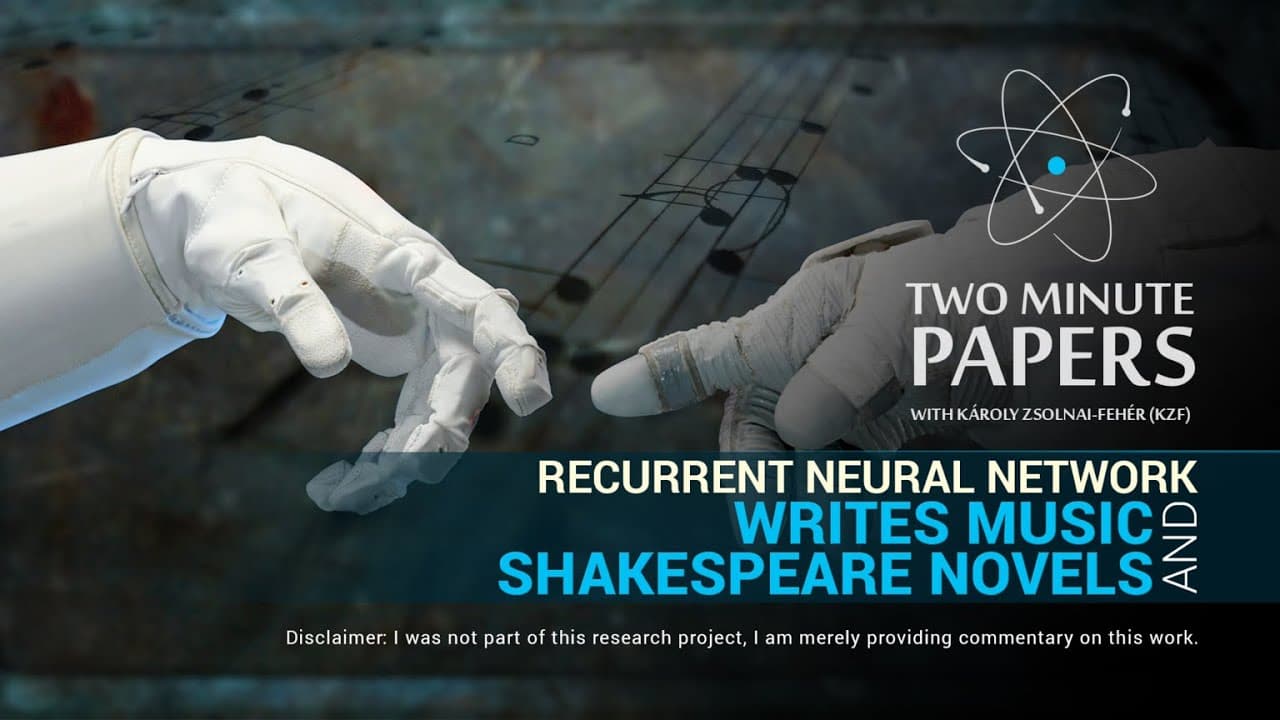
How Can a Recurrent Neural Network Write Music and Shakespeare-Style Text? | Two Minute Papers #19
TL;DR
Recurrent neural networks can generate music, Shakespeare-style text, math papers, and Linux-like source code by learning patterns in sequences. Unlike one-to-one artificial neural networks, RNNs support one-to-many, many-to-one, and many-to-many relationships for tasks such as image captioning, sentiment analysis, and machine translation. Read on to see how letter-by-letter training progresses from gibberish to convincing text.
Transcript
Artificial neural networks are very useful tools that are able to learn and recognize objects on images, or learn the style of Van Gogh and paint new pictures in his style. Today, we're going to talk about recurrent neural networks. So, what does the recurrent part mean? With an artificial neural network, we usually have a one-to-one relation betwe... Read More
Key Insights
- 🧡 Recurrent neural networks enable a wide range of applications, from image captioning to sentiment analysis and machine translation.
- 👻 RNNs can learn and recognize patterns in sequences of data, allowing for understanding structures, vocabulary, and style.
- 👨💻 The algorithm's ability to generate text in the style of famous authors or even source code showcases the potential of RNNs in creative tasks.
- 🚱 Despite the impressive results, it is essential to approach RNN-generated content with caution, as it can deceive non-expert readers.
Install to Summarize YouTube Videos and Get Transcripts
Explore YouTube Video Summarizer or Get YouTube Transcript Extractor
Questions & Answers
Q: How can a recurrent neural network write music and Shakespeare-style text?
A recurrent neural network learns patterns from existing sequential works and then generates a new sequence based on those patterns. After reading all of Shakespeare's works, the algorithm produced text with plausible names, while training on other people's music enabled it to write its own grooves.
Q: What does “recurrent” mean in a recurrent neural network?
The transcript explains recurrence through relationships in which an input or output can be a sequence rather than a single item. RNNs can support one-to-many, many-to-one, and many-to-many relationships between inputs and outputs.
Q: How are recurrent neural networks different from typical artificial neural networks?
A typical artificial neural network has a one-to-one relationship: one image enters and one classification, such as a human face or train, comes out. A recurrent neural network can instead produce or process sequences through one-to-many, many-to-one, and many-to-many relationships.
Q: How can an RNN describe an image?
Image description is a one-to-many task. One image is provided as input, and the RNN outputs a sequence of words forming a sentence about what appears in the image.
Q: How do recurrent neural networks perform sentiment analysis?
Sentiment analysis is a many-to-one task in which a sequence, such as a sentence, is classified as negative or positive. For movie reviews, this can indicate whether a user liked or hated the movie without requiring someone to read pages of discussion.
Q: How are recurrent neural networks used for machine translation?
Machine translation is a many-to-many task because both the input and output are sequences. The RNN takes a sentence in one language and translates it into an output sentence in another language.
Q: How does an RNN learn to generate novel-like text letter by letter?
The algorithm generates the new text one letter at a time and is not allowed to memorize words. Training begins with gibberish, then reveals patterns such as spaces, paired quotation marks, periods followed by uppercase letters, common short words, longer words, and eventually sentence fragments that make sense.
Q: What other content can recurrent neural networks generate?
The examples include math papers, new source code learned from the Linux operating system, and a continuation of “Let It Go” from Disney's Frozen. The transcript warns that convincing generated writing can deceive a non-expert reader.
Summary & Key Takeaways
-
Recurrent neural networks (RNNs) allow for one-to-many relationships, where the input is an image and the output is a sequence of words describing the image.
-
RNNs can also handle many-to-one relationships, such as sentiment analysis on sequences of sentences to determine whether they are positive or negative.
-
Additionally, RNNs can manage many-to-many relationships, such as machine translation or generating text in a specific style, like that of Tolstoy or Shakespeare.
Read in Other Languages (beta)
Share This Summary 📚
Summarize YouTube Videos and Get Video Transcripts with 1-Click
Try YouTube Summary with ChatGPT & Claude or YouTube Transcript Generator
Explore More Summaries from Two Minute Papers 📚



Summarize YouTube Videos and Get Video Transcripts with 1-Click
Try YouTube Summary with ChatGPT & Claude or YouTube Transcript Generator