How to Create Classes and Objects in Python
TL;DR
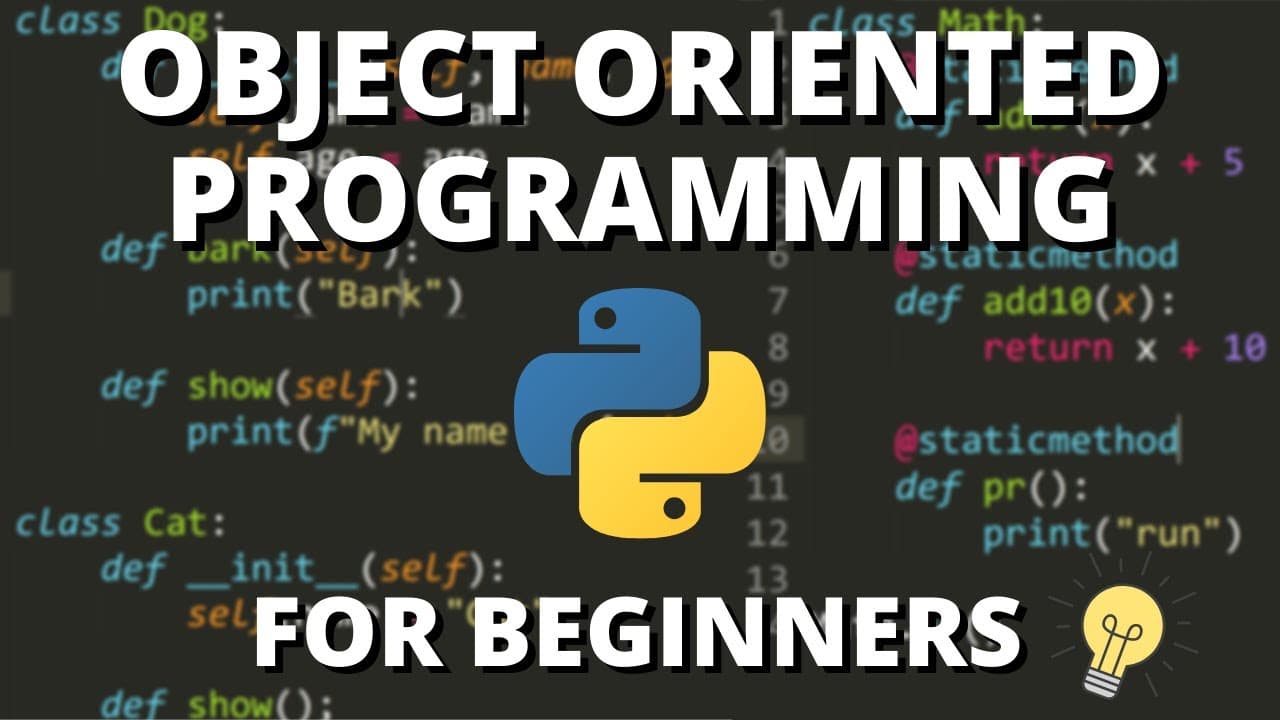
Python values, functions, and custom instances are objects whose classes define the operations and methods available to them. Create a custom type with the class keyword, instantiate it by calling the class name with parentheses, and define methods inside the class using self as the first parameter. Those methods can print, return values, and accept additional arguments.
Transcript
hello everybody and welcome back so in this video you're gonna learn about object-oriented programming in Python and how you can create your own custom objects by making different classes in Python now this video is geared towards beginner so people that have some knowledge of Python have written Python code before but I've not yet stepped up into ... Read More
Key Insights
- Nearly everything used in Python is an object belonging to a class, including strings, integers, and functions. The type() function reveals this relationship by returning results such as class str, class int, or class function for the supplied value or function name.
- An object is an instance of a specific class, and that class defines how the object can interact with other parts of a program. Assigning x = 1 creates a variable referring to an integer object whose value is 1.
- A Python type determines which operations are valid for an object. Adding two integers works because addition is defined for integer objects, while adding an integer and a string raises a TypeError for unsupported operand types.
- A method is a function associated with a class and called on an object through dot notation. The expression string.upper() invokes the upper method on a string object and produces an uppercase version of that string.
- Method availability depends on an object's class. A string supports upper(), but an integer does not, so attempting to call upper() on an integer produces an error stating that the integer object has no such attribute.
- A custom class is a blueprint for objects of a programmer-defined type. Writing a Dog class makes it possible to define the operations that Dog instances support, including a bark method that prints a value when called.
- Instantiation creates a new instance of a class by calling the class name with parentheses. Assigning d = Dog() creates an object of type Dog, and type(d) identifies both the module where the class is defined and the Dog class name.
- Methods can accept arguments and return values in addition to printing output. A method defined with self and another parameter can operate on the supplied argument, as shown by an add_one method that receives 5 and returns 6.
Install to Summarize YouTube Videos and Get Transcripts
Explore YouTube Video Summarizer or Get YouTube Transcript Extractor
Questions & Answers
Q: What is an object in Python?
An object in Python is an instance of a specific class. Common values that may appear to be simple data types are objects: a string is an object of class str, and an integer is an object of class int. Functions are objects as well. The object's class defines how it can interact with other values and which operations and methods are available to it.
Q: How can you check an object's class in Python?
Use the type() function with the value, variable, or function you want to inspect. Applying type() to a string reports class str, while applying it to an integer reports class int. To inspect a function itself, pass its name without calling it with parentheses. The result reports class function, showing that a function is also an object belonging to a class.
Q: Why can Python add two integers but not an integer and a string?
The class of each object determines which operations are defined for it. Addition is defined between integer objects, so adding two integers works without an error. Adding an integer object to a string object raises a TypeError because Python does not have the addition operation defined for that combination of operand types. The error identifies int and str as the unsupported types.
Q: What is a method in Python object-oriented programming?
A method is essentially a function defined inside a class. It represents an operation that objects of that class can perform and is commonly called with dot notation, a method name, and parentheses. For example, upper() can act on a string object. In a custom Dog class, bark() can be defined as a method and then called on a Dog instance.
Q: Why does upper() work on strings but not integers?
The upper method is available to string objects because it is associated with the string class. An integer belongs to a different class, which does not define an upper attribute. Calling upper() on an integer therefore produces an error stating that the int object has no attribute upper. This demonstrates that an object's class controls the methods and operations available to it.
Q: How do you create a custom class in Python?
Create a custom class with the class keyword followed by the class name, then define its methods inside the indented class body. The example uses a Dog class and places a bark method inside it. The method begins with a self parameter and prints a value. Class names conventionally begin with an uppercase letter, with camel case used when a name contains multiple words.
Q: How do you create and use an instance of a Python class?
Create an instance by calling the class name with parentheses and assigning the result to a variable. For example, d = Dog() instantiates the Dog class and stores the new Dog object in d. Because bark is defined for Dog objects, d can call it with d.bark(). Passing d to type() reports that it belongs to the Dog class.
Q: How can a Python class method accept arguments and return values?
Define the method inside the class with self as its first parameter and add another parameter for the value supplied by the caller. The method can perform an operation with that value and return the result. In the example, an add_one method accepts x, returns x + 1, and produces 6 when it is called with 5 on a Dog instance.
Summary & Key Takeaways
-
Python programming already involves objects, even before a programmer defines a custom class. Calling type() on a string, integer, or function reports its class. A variable such as x assigned to 1 therefore refers to an integer object, and its class determines how that object can interact with other values.
-
A class determines which operations and methods its objects support. Adding an integer to a string raises a TypeError because addition is not defined for that combination. Similarly, upper() works on a string object but not on an integer object, which has no upper attribute. Object behavior therefore depends on its class.
-
A custom class acts as a blueprint for its instances. A Dog class can contain methods such as bark(), and calling Dog() creates an instance that can use those methods. Methods are functions defined inside classes, begin with self in the examples, and may accept additional parameters, print output, or return calculated values.
Read in Other Languages (beta)
Share This Summary 📚
Summarize YouTube Videos and Get Video Transcripts with 1-Click
Try YouTube Summary with ChatGPT & Claude or YouTube Transcript Generator
Explore More Summaries from Tech With Tim 📚






Summarize YouTube Videos and Get Video Transcripts with 1-Click
Try YouTube Summary with ChatGPT & Claude or YouTube Transcript Generator