How Does Sleep Work and How Do You Improve It?
TL;DR
Sleep is probably the single most effective thing you can do to reset brain and body health, and it runs in roughly 90-minute cycles alternating non-REM and REM sleep. Deep non-REM dominates the first half of the night and acts almost like natural blood pressure medication, while REM sleep, when testosterone peaks, dominates the second half. Both quantity and quality matter.
Transcript
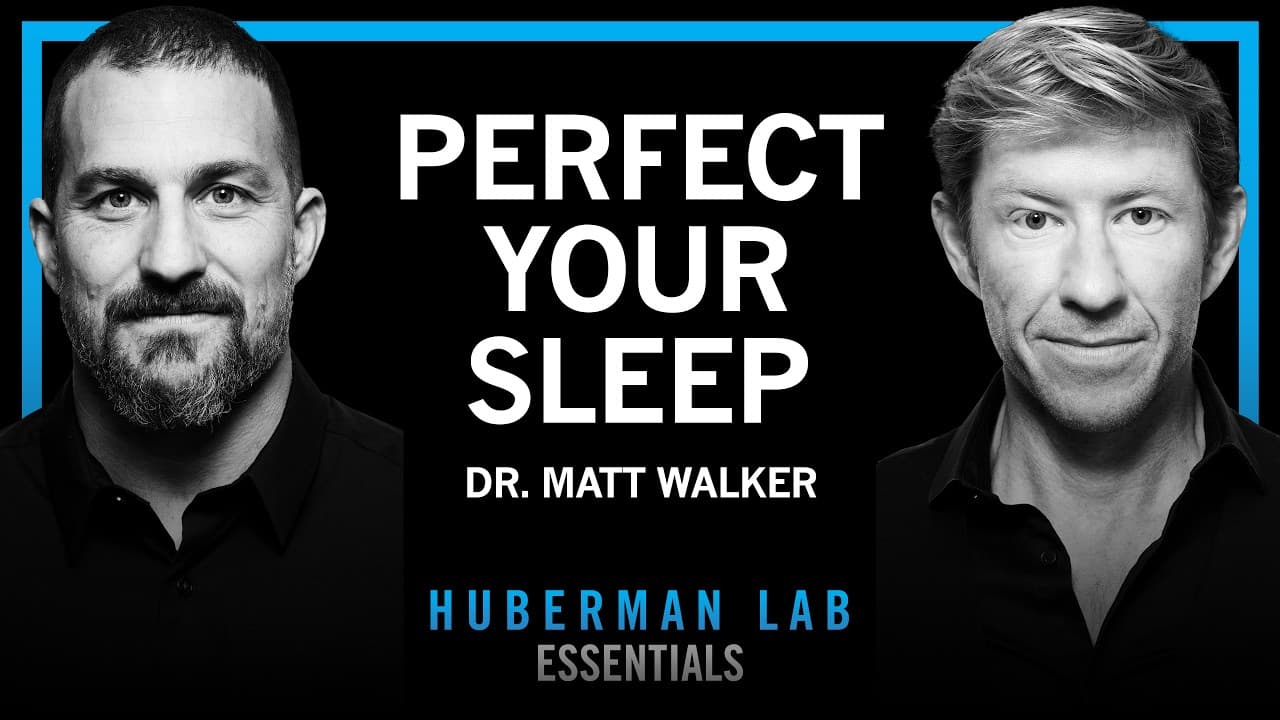
welcome to Huberman Lab Essentials where we revisit past episodes for the most potent and actionable science-based tools for mental health physical health and performance and now my discussion with Dr matt Walker let's start off very basic what is sleep sleep is probably the single most effective thing you can do to reset your brain and body health... Read More
Key Insights
- Sleep is probably the single most effective thing you can do to reset your brain and body health, and as a process it is an incredibly complex physiological ballet rather than a single uniform state. It divides into two main types, non-rapid eye movement sleep and rapid eye movement sleep.
- REM sleep involves complete paralysis of the voluntary muscles, described as being locked into a physical incarceration of your own body. The brain paralyzes the body so the mind can dream safely, because anyone acting out a dream of flying would quickly have been removed from the gene pool.
- Only two voluntary muscle groups are spared from REM paralysis: the extra-ocular muscles, without which rapid eye movements would be impossible, and the inner ear muscle, which was discovered later. One argument is that inactive eyeballs would develop oxygen problems in the aqueous or vitreous humor.
- The sleep cycle repeats roughly every 90 minutes on average for most adults. Falling asleep takes you through light non-REM stages one and two, down into stages three and four after about 20 minutes, then back up to a short REM period at around 80 minutes.
- Brain wave activity slows measurably as sleep deepens. Waking activity runs at roughly 20, 30, 40, or 50 cycles per second, slows to about 15 or 20 in light non-REM, then down to around eight or ten waves per second as deeper stages approach.
- Deep non-REM sleep features remarkable physiological coordination, where hundreds of thousands of cortical cells fire together and then fall silent together, a pattern not seen during any other brain state. Heart rate also drops substantially at this point.
- Deep non-REM sleep acts almost as a form of natural blood pressure medication and governs insulin regulation of metabolism. Removing it produces autonomic dysfunction, abnormalities in heart rate and blood pressure, and a disregulated, pre-diabetic blood sugar profile the next day.
- Growth hormone and testosterone are more REM sleep dependent, and peak testosterone levels occur during REM sleep in the second half of the night. This means losing early sleep and losing late sleep produce different profiles of mental and physical dysfunction rather than one being simply worse.
- Waking briefly at the end of a REM period is perfectly natural and normal, particularly with age, since the body makes a postural movement after being paralyzed. Concern is warranted when you cannot get back to sleep for 20 to 25 minutes, or wake consciously six, seven, or eight times a night.
- Caffeine has a half-life of somewhere between 5 to 6 hours for the average adult, and therefore a quarter-life of 10 to 12 hours. When it clears, you face the original adenosine plus everything that accumulated while caffeine was in your system, described as a tsunami wave.
Install to Summarize YouTube Videos and Get Transcripts
Explore YouTube Video Summarizer or Get YouTube Transcript Extractor
Questions & Answers
Q: What is sleep and why does it matter?
Sleep is probably the single most effective thing you can do to reset your brain and body health. As a physiological process it is far from simple, described in the episode as an incredibly complex physiological ballet. It is broadly separated into two main types: non-rapid eye movement sleep and rapid eye movement sleep. From a face-value evolutionary perspective sleep looks profoundly detrimental, since while asleep you are not finding a mate, not reproducing, not foraging for food, not caring for your young, and worst of all you are vulnerable to predation. Sleep should arguably have been selected against, but it survived every step along the evolutionary path, which suggests every sleep stage is non-negotiable.
Q: Why does the body become paralyzed during REM sleep?
During REM sleep you are completely paralyzed, locked into what is described as a physical incarceration of your own body. The brain paralyzes the body so that the mind can dream safely. The reasoning is protective: if you dreamt you were one of the best skydivers who could simply fly, got up on your apartment window and leapt out, that would be the end of you, and anyone doing that would quickly have been popped out of the gene pool. Involuntary muscles are thankfully not paralyzed, so breathing continues and the heart keeps beating, though the body goes through what are called autonomic storms.
Q: Which muscles are not paralyzed during REM sleep?
Only two voluntary muscle groups are spared from REM paralysis. The first is the extra-ocular muscles, which control the eyes. If those were paralyzed you would not be able to have rapid eye movements at all, which is what gives REM sleep its name. The second, discovered later, is the inner ear muscle. One argument for why the eyeballs are spared is that if eyeballs are left inactive for long periods you may develop oxygen issues in the aqueous or vitreous humor, since the drain systems of the anterior eye require movement. This connects to glaucoma, where people have deficits in drainage through the anterior chamber.
Q: How long is a sleep cycle and what happens during one?
A full sleep cycle averages about 90 minutes for most adults and repeats reliably through the night. You first enter light non-REM stages one and two, where heart rate drops slightly and brain wave activity slows from a waking 20 to 50 cycles per second down to about 15 or 20, then to around eight or ten waves per second. After roughly 20 minutes you descend into stages three and four of deep non-REM, where heart rate really drops and hundreds of thousands of cortical cells fire together then go silent together. You stay there another 20 or 30 minutes, rise back to stage two, and at about 80 minutes have a short REM period.
Q: Why is deep sleep concentrated early in the night and REM later?
The composition of the 90-minute cycles changes across the night in a seesaw balance. In the first half of the night, the majority of those cycles are comprised of lots of deep non-REM sleep, meaning stages three and four. Once you push through to the second half, the balance shifts and the majority of each cycle is made up of the lighter stage two non-REM sleep plus increasingly more rapid eye movement sleep. This structure means that cutting your night short at either end removes a different type of sleep, so the consequences differ depending on which portion you lose.
Q: What happens if you lose deep sleep versus losing REM sleep?
Which loss is worse depends on the outcome measure. Deep non-REM sleep acts almost as a form of natural blood pressure medication, so taking it away typically produces autonomic dysfunction the next day, with abnormalities in heart rate and blood pressure. Deep sleep also governs insulin regulation of metabolism, meaning the difference between a regulated blood sugar profile and a disregulated, pre-diabetic-looking one. Growth hormone, by contrast, appears more REM sleep dependent, and peak testosterone levels happen during REM sleep in the second half of the night. Walker's answer when asked which he would prefer to lose was neither, since it depends entirely on what you are trying to optimize for.
Q: Is waking up in the middle of the night bad for you?
Waking briefly during the night is perfectly natural and normal, particularly as we progress with age. At the end of a REM period within the 90-minute cycle, almost everybody wakes up and makes a postural movement, turning over because the body has been paralyzed for so long and wants to shift. Getting up, using the restroom, and falling back asleep within 10 or 15 minutes is something you can be relaxed about. Attention is warranted in two cases: if you spend long periods unable to get back to sleep, usually defined as 20 to 25 minutes, or if you are consciously waking six, seven, or eight times a night, which makes sleep fragmented.
Q: Does sleep quality matter more than sleep quantity?
Neither substitutes for the other. The great science of sleep in the past 5 or 10 years has been that yes, quantity is important, but quality is just as important, and you cannot have one without the other for a good next-day outcome. Specifically, you cannot get only 4 hours of sleep with brilliant quality and expect to be unimpaired, and equally you cannot get 8 hours of sleep with very poor quality and expect to be unimpaired the next day. Sleep efficiency is one quality measure discussed: batting an 80 percent average is a bit concerning, while adding 10 percent puts you among healthy sleepers.
Q: How much daylight should you get to sleep better?
The current recommendation given is to try to get at least 30 to 40 minutes of exposure to some kind of natural daylight, ideally sunlight but other forms of bright light also work, early in the day when you want to be awake and when your temperature is rising, then reduce light exposure later in the day as temperature falls. Occupational health research supports this: workers were moved from offices facing walls with no natural daylight to working in front of a window, and their measured total sleep time increased by well over 30 minutes while sleep efficiency improved by 5 to 10 percent. The eyes are described as the only portals conveying time of day to the rest of the brain and body.
Q: When should you stop drinking caffeine before bed?
The principle offered is that the dose and the timing make the poison. Caffeine has a half-life of somewhere between 5 to 6 hours for the average adult, and therefore a quarter-life of somewhere between 10 to 12 hours, though duration of action is variable between people. The problem with a late cup is what happens on the way out: if you drink coffee at 8 p.m. after 12 hours awake, you stop feeling tired temporarily, but once the caffeine clears you are hit with the adenosine you already had plus all the adenosine that built up while the caffeine was in your system. That arrives not as a trickle but as an avalanche, described as a tsunami wave, producing the caffeine crash.
Summary & Key Takeaways
-
Sleep is broadly split into non-rapid eye movement sleep and rapid eye movement sleep. During REM the brain paralyzes the body so the mind can dream safely, since acting out dreams would have removed people from the gene pool. Involuntary muscles keep working, and only the extra-ocular muscles and the inner ear muscle are spared from the paralysis.
-
A night moves through repeating cycles averaging about 90 minutes in adults. After falling into light stages one and two of non-REM, heart rate drops and brain wave activity slows from roughly 20 to 50 cycles per second while awake down to about eight or ten. Deep stages three and four follow, then a rise back up into a short REM period.
-
The balance shifts across the night. The first half is dominated by deep non-REM sleep, and the second half by lighter stage two non-REM and increasingly more REM. Losing either half produces a different profile of mental and physical dysfunction, so neither can be treated as expendable.
-
Light exposure and caffeine timing are the two levers discussed most concretely. Getting at least 30 to 40 minutes of natural daylight is the current recommendation, and caffeine has a half-life of roughly 5 to 6 hours with a quarter-life of 10 to 12 hours, which is why a late cup produces a crash when adenosine returns as a wave.
Read in Other Languages (beta)
Share This Summary 📚
Summarize YouTube Videos and Get Video Transcripts with 1-Click
Try YouTube Summary with ChatGPT & Claude or YouTube Transcript Generator
Explore More Summaries from Andrew Huberman 📚

Summarize YouTube Videos and Get Video Transcripts with 1-Click
Try YouTube Summary with ChatGPT & Claude or YouTube Transcript Generator