How to automate your entire workflow with AI agents
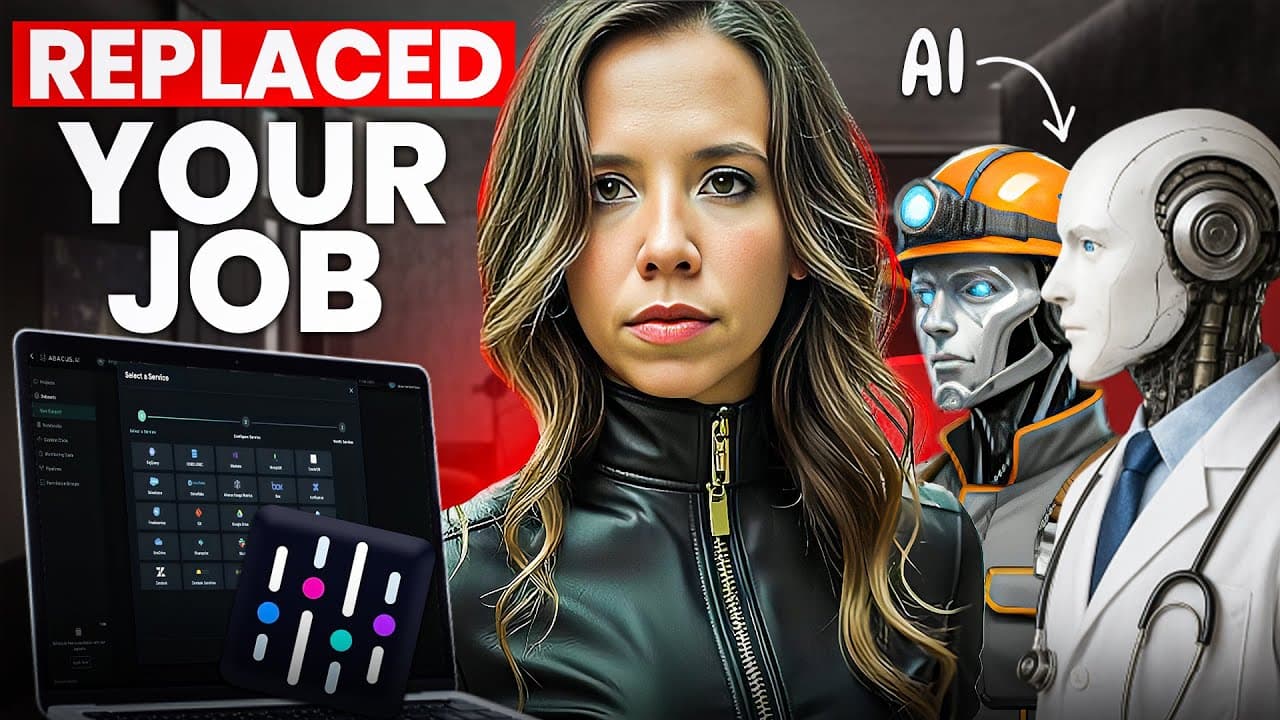
TL;DR
Autonomous AI agents can execute repetitive tasks and run complex workflows without human babysitting. They can lead generate on autopilot, apply to jobs automatically, analyze content, manage social media, and build apps in minutes. To stay ahead, you should understand when to apply level two versus level four autonomy and test these agents in real workflows.
Transcript
I've been telling you that 2025 is the year everything begins to change for the future of work. Here's what's wild. We're not talking about chat bots anymore. We're talking about autonomous agents that can execute any task you do at a computer. And there's one system that just changed everything. Hey, if we haven't met, I'm Dr. McCoy, Julia McCoy's... Read More
Key Insights
- Autonomous agents can navigate platforms, understand context, and execute multi-step processes with minimal human input. Lead generation, job applications, and content analysis are highlighted as core capabilities.
- The Abacus AI deep agent represents the convergence of three accelerating patterns, signaling an automation cliff where autonomous execution becomes mainstream in business workflows.
- The transition from tools you use to agents that work for you marks a fundamental shift in how work is organized and managed within companies.
Install to Summarize YouTube Videos and Get Transcripts
Explore YouTube Video Summarizer or Get YouTube Transcript Extractor
Questions & Answers
Q: What is Abacus AI deep agent and why is it significant for automating workflows?
Abacus AI deep agent is presented as a true autonomous execution system that can perform complex, multi-step tasks without ongoing human supervision. It demonstrates capabilities like autopilot lead generation, job applications, content intelligence, and routine task elimination across digital platforms. This represents a fundamental shift from assistants to autonomous operators, potentially redefining how teams allocate work and how quickly organizations can scale automated processes.
Q: How do the three accelerating patterns drive AI development toward ASI?
The three patterns are scaling laws which let us predict compute needs for higher intelligence, inference time compute scaling which shows longer thinking can yield major performance gains, and distillation where knowledge is passed to the next generation of AI. Together they explain how autonomous agents can rapidly become more capable, enabling more tasks to be automated with less human input.
Q: What does the video claim about the automation cliff?
The video describes the automation cliff as the moment when AI moves from assisting to operating independently, enabling end-to-end workflows to be automated. Abacus AI deep agent is cited as clear evidence of this shift, illustrating how tasks across lead generation, job applications, content analysis, and routine work can be automated with minimal oversight.
Q: What time frame does the presenter give for large-scale adoption by Fortune 500 companies?
The presenter predicts that by the end of 2025 Fortune 500 companies will deploy hybrid workforces where human managers oversee both human and AI workers. This implies rapid adoption of autonomous agents across enterprises, driven by the ability to manage different levels of AI autonomy and to assign tasks with varying oversight.
Q: What are the practical use cases of Abacus AI deep agent mentioned in the video?
Practical use cases include lead generation on autopilot by browsing LinkedIn and compiling contact lists, automated job applications that read descriptions and submit tailored forms, content intelligence that analyzes YouTube channels and crafts curated playlists, automation of routine tasks such as data entry and email management, and automated social media strategy development.
Q: How does the video describe the difference between AI tools and AI agents?
The video emphasizes a shift from AI tools that humans use to AI agents that act for humans, operating autonomously to complete complex workflows. This distinction is framed as a move toward systems that can independently navigate platforms, interpret context, and execute end-to-end processes.
Q: What is the expected impact on jobs and workflows according to the speaker?
The speaker argues that as autonomous agents can perform tasks previously requiring teams, many roles and workflows will be displaced or significantly changed. Organizations will need to rethink task allocation, oversight levels, and how to blend human judgment with AI autonomy to maintain productivity and competitive advantage.
Q: What action does the video encourage viewers to take regarding Abacus AI deep agent?
Viewers are encouraged to test Abacus AI deep agent, push its boundaries, and consider adopting it within their own workflows. The message is to embrace the age of agents and act quickly to avoid being left behind, leveraging the tool to automate tasks and gain a competitive edge in the evolving landscape of work.
Summary & Key Takeaways
-
A broad shift from assistive AI to autonomous agents is underway, with tools capable of performing end-to-end tasks across multiple platforms.
-
Businesses will increasingly deploy hybrid teams where human managers supervise both human and AI workers, emphasizing task autonomy and oversight based on risk.
-
The three accelerating patterns are scaling laws, inference time compute scaling, and distillation, which together drive rapid improvements in autonomous capabilities.
Read in Other Languages (beta)
Share This Summary 📚
Summarize YouTube Videos and Get Video Transcripts with 1-Click
Try YouTube Summary with ChatGPT & Claude or YouTube Transcript Generator
Explore More Summaries from Julia McCoy 📚






Summarize YouTube Videos and Get Video Transcripts with 1-Click
Try YouTube Summary with ChatGPT & Claude or YouTube Transcript Generator