DIY Miniature Tensile Testing Machine
TL;DR
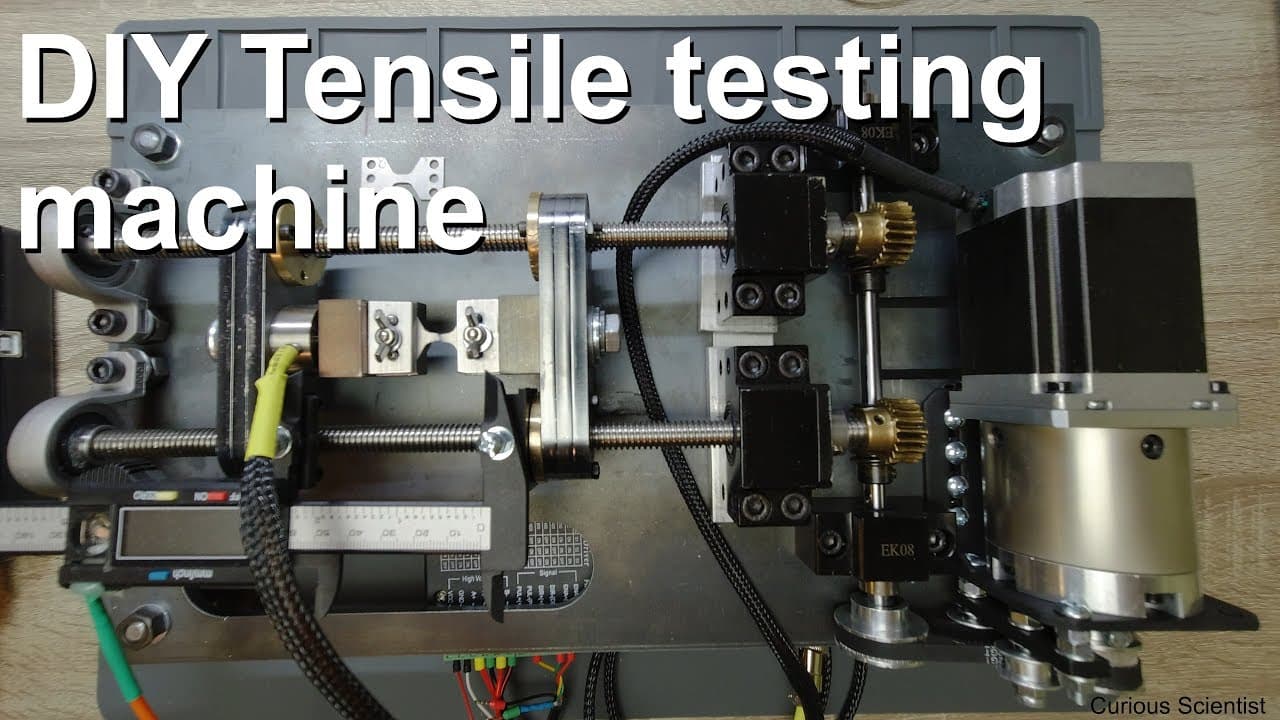
An overview of a custom-built miniature tensile testing machine and its components.
Transcript
welcome everyone in this video I'm going to talk about my miniature tensile testing machine a little bit so I will guide you to all the parts and all the electronics and everything not in too much details but still I will share as much as possible so I would like to talk about motivation behind this machine so I'm using different tensile testing ma... Read More
Key Insights
- 👷 The construction of the tensile testing machine aims to customize and enhance existing testing technologies for better performance.
- 😒 Mechanical design choices, such as the use of NEMA 23 motors and dual lead screw systems, are critical for achieving high torque and stability.
- 🧑🦼 The integration of electronic components, including multiple Arduinos, is essential for managing motor control, data acquisition, and testing processes seamlessly.
- 🎨 Noise interference remains a significant challenge, affecting data quality from sensitive sensors, illustrating the complexities of electronic design in testing devices.
- 🖐️ The design of support structures and bearings plays a crucial role in ensuring the stability and proper functioning of mechanical systems under load.
- 🛃 Digital image correlation methods and custom software facilitate improved measurement accuracy and data processing capabilities in testing applications.
- 📽️ Continuous iteration and refinement are vital in engineering projects, showcasing the importance of adaptability and incremental improvements.
Install to Summarize YouTube Videos and Get Transcripts
Explore YouTube Video Summarizer or Get YouTube Transcript Extractor
Questions & Answers
Q: What motivated the creator to build their own tensile testing machine?
The creator was motivated by dissatisfaction with existing tensile testing machines, especially regarding their software capabilities and performance. They desired a more efficient and reliable system tailored to their specific testing needs, which led to the conception of a custom-built prototype over a year and a half.
Q: What specific challenges did the creator face during assembly?
The creator faced multiple challenges, including breaking belts due to insufficient strength, noise interference affecting the data from the digital caliper, and alignment issues with mechanical parts. Additionally, managing the complexities of integrating the motor control with data acquisition presented hurdles during the assembly process.
Q: How does the motor system work in this tensile testing machine?
The machine utilizes a NEMA 23 motor paired with a planetary gear to achieve high torque and speed, vital for quickly moving the crossheads during tensile tests. The power from the motor is transmitted through pulleys to dual lead screws, which manage the load efficiently while maintaining stability and precision.
Q: What components were implemented in the electronics setup?
The electronics setup includes multiple Arduinos for effective data processing and control. A main Arduino manages communications with the computer and load cell, while a secondary Arduino controls the motor with precision, preventing interruptions that could disrupt testing operations and motor functionality.
Q: How did the creator address the challenges of measurement precision?
The creator resolved precision challenges by utilizing a digital caliper modified as a displacement sensor and implementing digital image correlation methods for better accuracy. Although measuring displacement directly may not be highly precise due to spatial constraints, alternative visual tools were considered to enhance data accuracy.
Q: What is the purpose of the special lead screw design used in the machine?
The special twin lead screw design allows for better confinement and restriction of forces experienced by the crossheads, reducing the burden on support bearings. By ensuring that loads are balanced and applied evenly, it enhances the machine’s stability and performance during testing.
Q: What future improvements are planned for the tensile testing machine?
Future improvements include resolving current noise interference issues with the digital caliper and redesigning the support structure for bearings to optimize alignment and efficiency. Additionally, the creator aims to make adjustments to streamline the overall design for a more compact setup while maintaining functionality.
Q: How does the software interface improve user experience during tests?
The software interface allows users to configure various test parameters effortlessly, such as specimen details, testing movement, and desired data output formats. Its functionality supports real-time data visualization and records critical metrics, enhancing the overall user experience and simplifying the testing process.
Summary & Key Takeaways
-
The speaker discusses the motivation behind creating a bespoke tensile testing machine due to dissatisfaction with existing models' software and capabilities.
-
Detailed descriptions of the mechanical components are provided, including the use of a NEMA 23 motor, dual lead screws for torque management, and various gear arrangements for motion control.
-
The electronics section encompasses Arduino integration for motor control, load sensing, and data acquisition, illustrating the complexities involved in building an efficient testing machine.
Read in Other Languages (beta)
Share This Summary 📚
Summarize YouTube Videos and Get Video Transcripts with 1-Click
Try YouTube Summary with ChatGPT & Claude or YouTube Transcript Generator
Explore More Summaries from Curious Scientist 📚
Summarize YouTube Videos and Get Video Transcripts with 1-Click
Try YouTube Summary with ChatGPT & Claude or YouTube Transcript Generator