What Traits Do World-Changing Shapers Share?
TL;DR
Successful shapers combine an original vision with the practical ability to build it, moving fluidly between enormous goals and precise details. They put the mission first, demand excellent performance, recognize multiple forms of talent, and remain open to expertise from people who think differently. Their confidence becomes more reliable when they stress-test ideas, acknowledge what they do not know, and keep learning.
Transcript
You mentioned shapers, Elon Musk, Bill Gates. What, who are the shapers that you find yourself thinking about when you're constructing these ideas, the ones that define the archetype of a shaper for you? Well, as I say, a shaper for me is somebody who comes up with a great visualization, um, usually a really unique visualization, and then, uh, actu... Read More
Key Insights
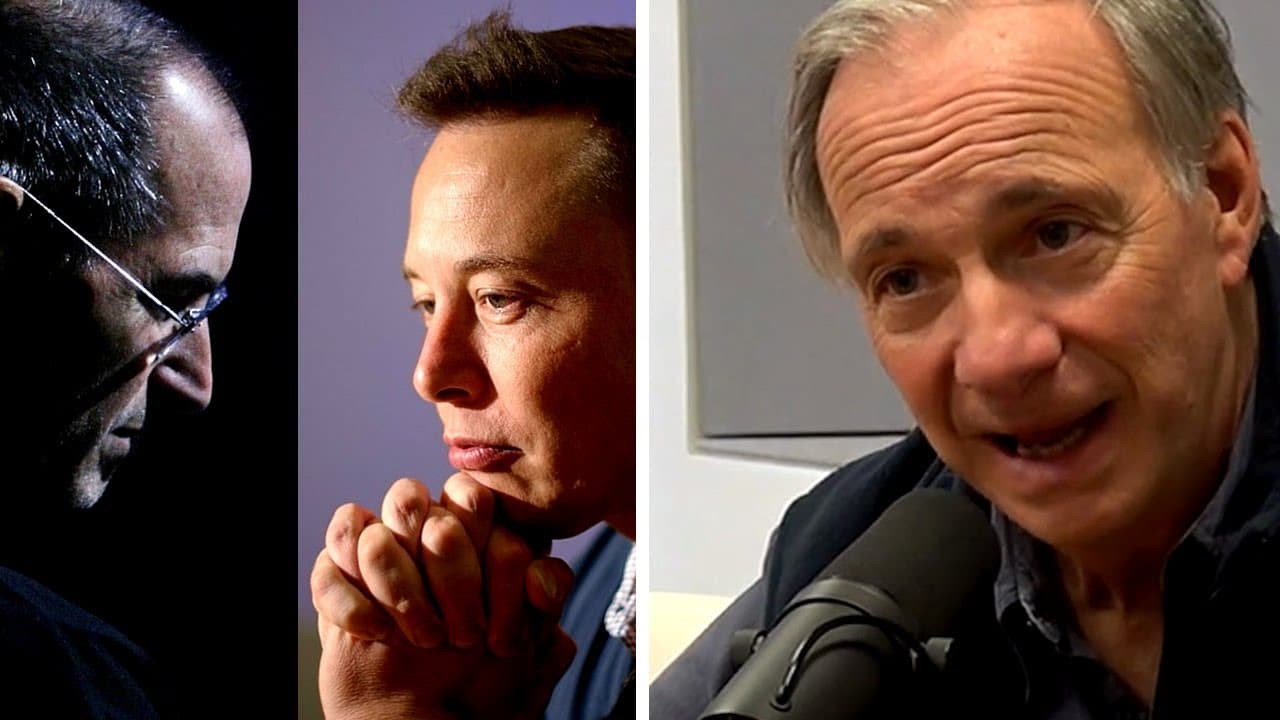
- A shaper is someone who develops a distinctive vision, builds it into reality, and changes the world through execution. Dalio identifies shapers across many domains, including Marc Benioff, Chris Anderson, Muhammad Yunus, Geoffrey Canada, Elon Musk, and Steve Jobs.
- The defining abilities of shapers are excitement about new possibilities, practical action, and a strong capacity to learn. A compelling idea alone is insufficient because the person must acquire knowledge, organize resources, and turn an unfamiliar ambition into something concrete.
- Full-range thinking is the ability to move between an enormous strategic vision and fine operational details. Dalio describes this movement as helicoptering, illustrated by Elon Musk discussing humanity's future beyond Earth while also explaining the specific controls of an early Tesla car.
- Mission-first leadership requires holding people to exceptionally high performance standards. Dalio says shapers can appear low in concern for others on personality assessments because related questions measure their willingness to confront conflict and remove performance barriers that threaten the mission.
- A-player teams require appreciation for different kinds of excellence. Dalio agrees that strong missions need excellent contributors, but rejects the assumption that every A player must possess the same strengths, temperament, perspective, or way of contributing to collective success.
- Excellent people management is compatible with rigorous performance expectations. Leaders should help individuals understand themselves, establish agreement about their circumstances and results, and support a valuable personal development experience while addressing whether their work meets the mission's needs.
- Open-minded confidence is stronger than certainty without testing. Dalio observes that confidence and accuracy can be negatively correlated, so capable leaders ask how they might be wrong, seek the best available thinking, and use competing perspectives to increase their probability of learning.
- An idea meritocracy is a decision-making process designed to identify the best available ideas through collaboration. It depends on independent thinking, candid stress testing, awareness of personal limitations, and access to people whose expertise and viewpoints complement one another.
- More videos with Ray Dalio / Steve Jobs:
Install to Summarize YouTube Videos and Get Transcripts
Explore YouTube Video Summarizer or Get YouTube Transcript Extractor
Questions & Answers
Q: What is a shaper according to Ray Dalio?
A shaper is someone who forms a powerful and usually distinctive vision, then possesses the practical ability to build it and change the world. Dalio says shapers exist across many domains. His examples include Marc Benioff with Salesforce, Chris Anderson with TED, Muhammad Yunus in social enterprise, Geoffrey Canada with Harlem Children's Zone, and Elon Musk with his ambitious technology ventures.
Q: What traits do successful shapers have in common?
Successful shapers are energized by new possibilities and a call to adventure, but they also possess practicality and a strong capacity to learn. They can move from a broad vision to specific details, hold people to demanding standards, confront obstacles to the mission, seek knowledge from others, and coordinate people with different expertise, strengths, and perspectives.
Q: How does Elon Musk illustrate full-range thinking?
Elon Musk illustrates full-range thinking by moving between questions about humanity's long-term future and the smallest practical details of a product. Dalio recounts Musk wondering why people were not pursuing Mars or outer space, investing part of his PayPal proceeds in that goal, learning about the field, and later explaining individual controls in an early Tesla car.
Q: Why can highly caring shapers score low on concern for others?
The assessment category called concern for others includes questions about willingness to enter conflict in pursuit of a mission. Muhammad Yunus and Geoffrey Canada devoted their work to helping others, yet could score low because they insist that individuals perform at the unusually high level their missions require. The score therefore may reflect demanding accountability rather than an absence of compassion.
Q: Should a mission-driven team employ only A players?
Dalio agrees that an ambitious mission requires excellent performers, but he stresses that there are different ways to be an A player. A great team should recognize and coordinate those varied forms of excellence. Leaders must also help people understand their strengths, circumstances, and performance honestly, allowing personal development to accompany the team's pursuit of exceptionally high standards.
Q: How should leaders balance confidence with open-mindedness?
Leaders should retain confidence in their ability to think independently while continually asking how they might be wrong. Dalio says confidence and accuracy are often negatively correlated because highly confident people can still be inaccurate. Stronger judgment comes from gathering the best available thinking, testing assumptions with others, evaluating the responses, and using that process to improve the probability of learning.
Q: Why is recognizing what you do not know important?
Recognizing gaps in knowledge allows a leader to find people who are strong where the leader is weak. Dalio argues that nobody holds enough knowledge in one mind to succeed across every necessary area. Effective shapers identify their limitations, recruit complementary expertise, absorb ideas like vacuum cleaners, and orchestrate different capabilities into a more complete approach to the mission.
Q: What is an idea meritocracy?
An idea meritocracy is a decision-making process that seeks the best ideas available and enables people to work together toward a shared objective. In Dalio's account, it requires independent thought, open exchange, and stress testing rather than relying only on one leader's knowledge. Different perspectives and specialized abilities are assessed for their contribution to better learning and decisions.
Summary & Key Takeaways
-
Ray Dalio defines a shaper as someone who creates a distinctive vision and then builds it into something that changes the world. Examples span technology, media, finance, philanthropy, and education. Their shared characteristics include excitement about new possibilities, practical execution, continuous learning, and the ability to connect ambitious goals with operational details.
-
Shapers place extraordinary importance on accomplishing the mission and expect people to perform at the required level. Dalio argues that excellent teams need A players, but emphasizes that people can qualify as A players in different ways. Effective leadership therefore combines demanding standards with honest feedback, mutual understanding, coordination, and meaningful personal development.
-
Exceptional leaders do not depend solely on their own knowledge. They recognize uncertainty, seek expertise, absorb perspectives that differ from theirs, and stress-test their ideas before deciding. Dalio describes this collaborative search for the best available thinking as idea-meritocratic decision-making, which allows independent thought, confidence, open-mindedness, and specialized talent to reinforce one another.
Read in Other Languages (beta)
Share This Summary 📚
Summarize YouTube Videos and Get Video Transcripts with 1-Click
Try YouTube Summary with ChatGPT & Claude or YouTube Transcript Generator
Explore More Summaries from Lex Fridman 📚
Summarize YouTube Videos and Get Video Transcripts with 1-Click
Try YouTube Summary with ChatGPT & Claude or YouTube Transcript Generator