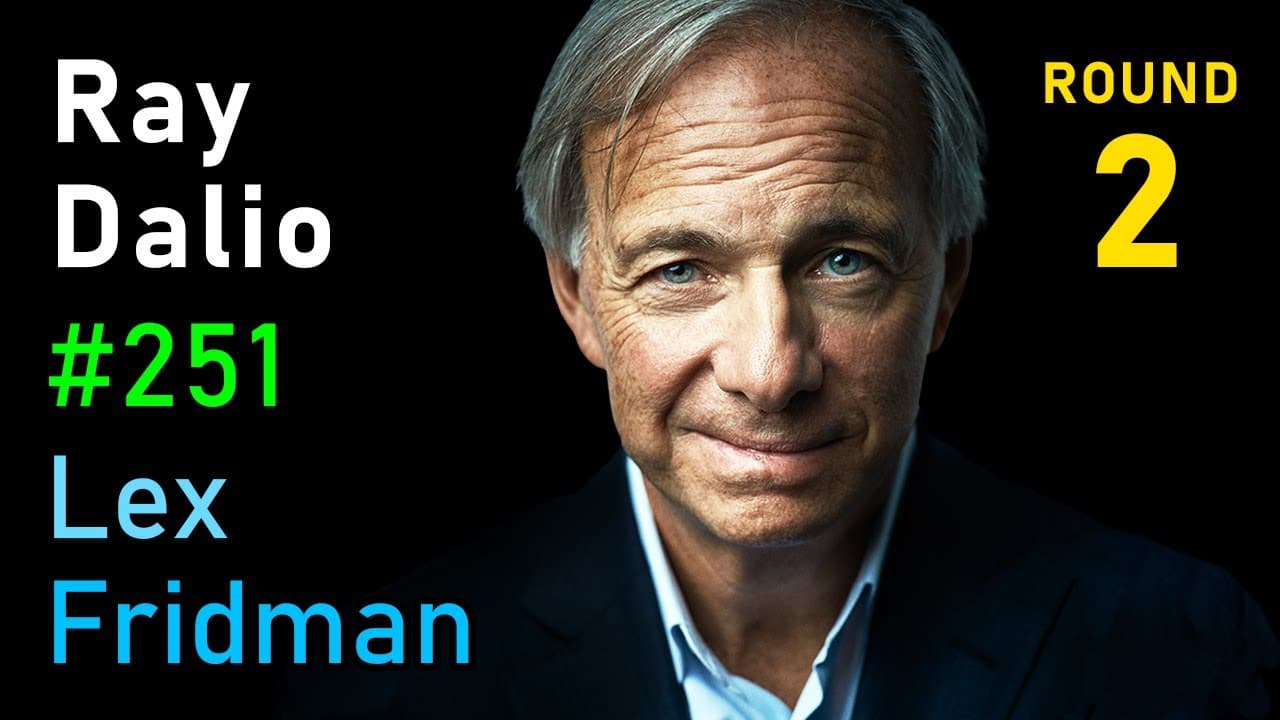
Ray Dalio: Money, Power, and the Collapse of Empires | Lex Fridman Podcast #251
TL;DR
Money and power have a deeply interconnected relationship that influences historical and current world orders. Ray Dalio emphasizes their role in the rise and fall of empires, highlighting the importance of education and innovation in fostering economic growth and stability.
Transcript
the following is a conversation with ray dalio his second time on the podcast he is a legendary investor founder of bridgewater associates author of a book i highly recommend called principles and also a new book called principles for dealing with a changing world order that looks at the geopolitics of today especially us and china to the lens of h... Read More
Key Insights
- 🤑 Money and power have a symbiotic relationship and influence each other throughout history.
- 🌍 The balance of power among nations shapes the world order, with the rise and fall of empires following predictable cycles.
- 🖐️ Education plays a vital role in driving economic growth and societal stability.
- 🌍 Understanding the perspectives and cultures of different nations is crucial for successful diplomacy and cooperation.
- 🪡 The vulnerabilities of different political systems depend on their ability to adapt to changing circumstances and address societal needs.
- 🤑 Bitcoin and other cryptocurrencies are alternative forms of money that challenge traditional financial systems, but gold remains a preferred store of wealth due to its universal recognition and time-tested value.
- 🎙️ More videos with Ray Dalio:
Install to Summarize YouTube Videos and Get Transcripts
Explore YouTube Video Summarizer or Get YouTube Transcript Extractor
Questions & Answers
Q: How do money and power intersect throughout history?
Money and power are symbiotic, with those who possess wealth having the ability to influence those in political power. This relationship can be observed in the historical dynamics between royal families, nobility, and the church.
Q: What are the key cycles that govern the rise and fall of empires?
The long-term debt and capital market cycle, the internal order and disorder cycle, and the external order and disorder cycle all influence the trajectory of empires.
Q: How has the world order evolved over time?
The development of nation-states and borders in the 17th century created a shift in power dynamics, with political power centered around nation-states. The major locus of power remains within nations, especially around productive assets.
Q: What are the vulnerabilities of different political systems?
Democracy can be vulnerable to internal conflicts that lead to disorder, while autocratic systems lack flexibility and may risk breaking under discontent. It is crucial to strike a balance between individual rights and the common good.
Key Insights:
- Money and power have a symbiotic relationship and influence each other throughout history.
- The balance of power among nations shapes the world order, with the rise and fall of empires following predictable cycles.
- Education plays a vital role in driving economic growth and societal stability.
- Understanding the perspectives and cultures of different nations is crucial for successful diplomacy and cooperation.
- The vulnerabilities of different political systems depend on their ability to adapt to changing circumstances and address societal needs.
- Bitcoin and other cryptocurrencies are alternative forms of money that challenge traditional financial systems, but gold remains a preferred store of wealth due to its universal recognition and time-tested value.
- Achieving mutual understanding and respecting cultural differences are essential for building a peaceful and prosperous world.
Summary
This conversation is with Ray Dalio about his new book, Principles for Dealing with a Changing World Order. They discuss the relationship between money and power throughout history, the cycles that govern rising and declining empires, and the current geopolitical dynamics between the US and China. The conversation also touches on the importance of education and innovation, the trajectory of the American empire, the potential for war with China, and the vulnerabilities of both democratic and autocratic systems.
Questions & Answers
Q: What is the relationship between money and power?
Money and power go hand in hand, supporting and competing with each other throughout history. Those with money have a certain type of power, as they can influence those in political power. This symbiotic relationship can be seen between royal families, nobility, and the church in the past. The dynamic between them has evolved over time, particularly with the rise of industrialization and capitalism. The major locus of power is typically centered around nation-states.
Q: How did nation states develop and what is their power structure?
Nation states as we know them today developed after the 30 Years War in 1668. They brought forth the concept of borders and self-governance within those borders. Power within nation states is hierarchical, with different levels such as central, provincial, and municipal. The coordination of these levels determines how the country is run.
Q: What are the three important cycles that influence empires and their currencies and markets?
The three cycles are the long-term debt and capital market cycle, the internal order and disorder cycle, and the external order and disorder cycle. These cycles govern the rising and declining empires. The long-term debt and capital market cycle relates to the financial situation of empires, while the internal and external order and disorder cycles deal with the stability and relationships of nations.
Q: Can you describe the big cycle of empires?
The big cycle consists of two orders: the internal order within a country and the world order between nations. The internal order is usually set out in a constitution or agreements, while the world order is determined by the winners of past wars. After major wars, a period of peace and prosperity follows, where nations work together. Power dynamics shift over time as countries become more successful or new powers emerge. This cycle has repeated over the last 500 years, shaping the world order.
Q: How are different nations doing today based on the 18 measures in your book?
The United States is facing financial challenges with increasing debt, while China has become a competitive trading nation but doesn't have the world's reserve currency. Education levels in the US have deteriorated compared to other developed countries, while China has made rapid progress in improving education and fostering entrepreneurship. The US still leads in certain areas of technology, but China is catching up. Each measure reflects the trajectory of a nation and helps monitor its progress.
Q: What are concerning indicators for the future of the American empire?
The United States' increasing debt and internal conflicts are concerning indicators. The education system has deteriorated, and it faces challenges in maintaining productivity and competitiveness. The vulnerability lies in not being able to overcome internal differences and work together for the benefit of the majority. Without addressing these challenges, the American empire could face collapse.
Q: What can great leaders do in this moment to address these challenges?
Great leaders need to rise above political differences and cooperate for the common good. Bipartisanship is crucial, with leaders drawing upon members of both parties to work towards a stronger, more prosperous nation. The focus should be on increasing the size of the pie and creating broad-based prosperity. If leaders fail to work together, it risks further internal disorder and challenges to the system.
Q: What are the potential trajectories that could lead to a war with China?
Wars can manifest in various forms such as trade wars, tech wars, geopolitical influence wars, capital wars, and military wars. Military war is a significant risk, particularly concerning the issue of Taiwan. The historical context of Taiwan as a sovereignty issue and the tension between China's view of reunification and the current situation could escalate into a military conflict. The other forms of war are competition and rivalry, which will continue to shape the relationship between the US and China.
Q: What are the defining characteristics of Xi Jinping as a leader?
Xi Jinping's background includes experiencing the cultural revolution and rising through the ranks of leadership. He is intelligent and initially focused on reform, particularly in opening up the economy and dealing with corruption. Under his leadership, China has made significant progress in areas like capital markets and addressing debt issues. The current focus is on controlling real estate speculation as part of a broader effort to maintain stability and address economic challenges.
Q: How does the Chinese system balance freedom and control?
The Chinese system balances freedom and control by focusing on the common good rather than individualism. There is more control and centralization compared to the US, but it is not entirely without flexibility. China recognizes the importance of incentives and productivity in a market economy, while also valuing social stability and managing potential risks. The balance between control and freedom allows for creativity and entrepreneurship in areas that are not politically sensitive.
Q: What are the vulnerabilities of democratic and autocratic systems?
The vulnerability of democracies lies in internal disorder and conflicts that can lead to chaos or the erosion of democratic values. Populism and the rejection of election results pose risks to the stability of democratic systems. Autocratic systems, on the other hand, lack flexibility and may struggle to adapt to changing circumstances. The lack of individual freedoms and centralized decision-making can lead to discontent and, in extreme cases, the collapse of the system.
Q: How can vulnerabilities be addressed in both systems?
In democracies, it is crucial to uphold respect for the rules and institutions that ensure fairness and resolve disagreements. Bipartisanship and a focus on the common good are essential for overcoming internal conflicts. In autocratic systems, greater flexibility and responsiveness to public discontent can help prevent the system from breaking down. Balancing control and freedom, as well as addressing issues like corruption and economic challenges, is crucial for the stability of any system.
Summary & Key Takeaways
-
Money and power have always been interconnected and have influenced each other throughout history, with those who have money holding a certain type of power that can impact those in political power.
-
The world order is shaped by both internal and external dynamics, including the balance of power among nations.
-
Dalio emphasizes the importance of education and inventiveness in driving economic growth and prosperity within a nation.
Read in Other Languages (beta)
Share This Summary 📚
Summarize YouTube Videos and Get Video Transcripts with 1-Click
Try YouTube Summary with ChatGPT & Claude or YouTube Transcript Generator
Explore More Summaries from Lex Fridman Podcast 📚


Summarize YouTube Videos and Get Video Transcripts with 1-Click
Try YouTube Summary with ChatGPT & Claude or YouTube Transcript Generator