How to Build and Sell High-Value n8n Workflows
TL;DR
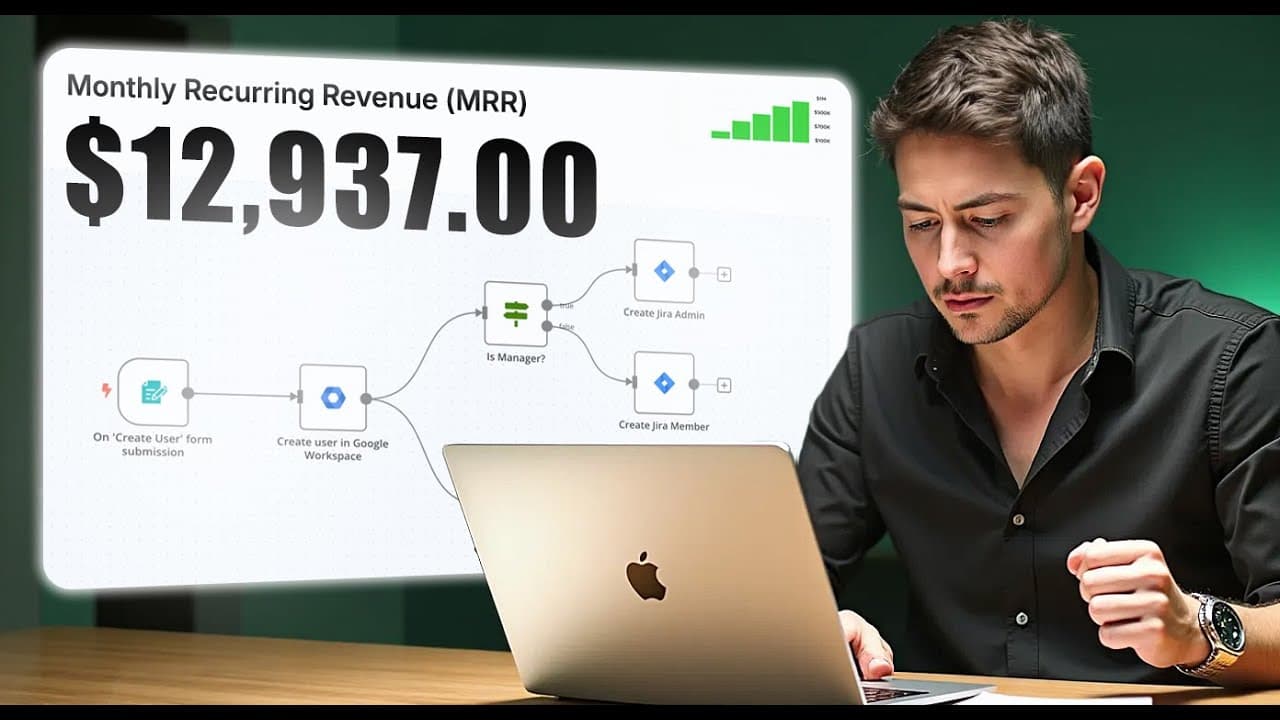
Build professional n8n automations by mastering core workflow logic, expression fields, field mapping, JSON, node connections, data processing, and AI prompting through practical projects. The course progresses from beginner foundations to eight business-focused systems, including personalized outreach, lead generation, proposal creation, content repurposing, journalist-response drafting, and website AI agents.
Transcript
hey welcome to the most comprehensive NAD building master class this is over eight hours of pure live automation builds and my goal is to take you from a pure beginner and turn you into somebody who can build professionalgrade AI workflows that a business is willing to pay thousands of dollars for this is your first time here i'm Nick i scaled my o... Read More
Key Insights
- n8n proficiency is developed through practical workflow construction, with foundational concepts introduced while assembling systems that could be implemented in a business or sold to clients. The live format also exposes the decisions, uncertainty, testing, and reasoning involved before a polished automation is complete.
- The course is structured to take a beginner from core n8n foundations to eight professional-grade AI workflows. The advanced systems are presented as implementations that can command $3,000 to $10,000, while the title frames the broader goal as selling workflows for more than $10,000.
- Expression fields are the instructor's preferred method for mapping changing information between workflow nodes. Understanding fixed fields, expression fields, and field inputs is treated as essential because business automations repeatedly transfer data from services such as Google Sheets into downstream processing and AI nodes.
- JSON is a necessary foundation for building n8n workflows because outputs contain structured values, objects, variables, and data types. The instructor favors JSON and schema views when examining node results, arguing that repeated exposure to JSON formatting helps builders understand the structure intuitively over time.
- The personalized email workflow starts with a manual trigger, retrieves lead rows from Google Sheets, and passes each record into artificial intelligence. It produces a subject line, icebreaker, elevator pitch, call to action, and postscript designed to make outreach appear informed by detailed research.
- The journalist-response workflow processes emails from Source of Sources, which was previously called Help a Reporter Out. It extracts opportunity titles, uses artificial intelligence for processing, and drafts an expert-style response that a user can review, edit, and send to a journalist.
- Google Sheets integration is simpler in the demonstrated cloud-hosted n8n environment because the user can select Sign in with Google and save a named credential. The instructor notes that other hosting arrangements require setup through Google Cloud Console before the connection can be used.
- The masterclass emphasizes reusable commercial projects rather than isolated demonstrations. The description identifies lead generation, proposal creation, content repurposing, personalized LinkedIn outreach, website AI agents, and personalized email generation as systems supported by templates or diagrams for continued building.
Install to Summarize YouTube Videos and Get Transcripts
Explore YouTube Video Summarizer or Get YouTube Transcript Extractor
Questions & Answers
Q: How do you start learning n8n for business automation?
Start with core workflow concepts such as triggers, nodes, fixed fields, expression fields, field mapping, variables, objects, data types, and JSON. The course teaches these foundations by building practical systems instead of separating them from implementation. Early projects retrieve business data, pass it between nodes, process it with artificial intelligence, and produce outputs that could support real outreach or publicity work.
Q: How does the personalized email workflow use Google Sheets?
The workflow begins with a manual trigger and uses a Google Sheets node to retrieve rows from a selected sheet. Each row contains information about a lead, and that information is passed into artificial intelligence. The system then generates an email subject line, personalized icebreaker, elevator pitch, call to action, and postscript intended to make the outreach appear carefully researched.
Q: What are fixed fields and expression fields in the course?
Fixed fields and expression fields are presented as two ways to provide node inputs. The instructor strongly favors expressions for ongoing workflow construction because expressions support mapping information from earlier node outputs into later fields. This becomes important when retrieving rows from Google Sheets and transferring each lead's information into an artificial intelligence step for customized email generation.
Q: Why is JSON important when building n8n workflows?
JSON is important because n8n node outputs expose structured information containing values, variables, objects, and data types. The course uses JSON and schema views to inspect this information, with a preference for JSON during most demonstrations. Repeatedly examining JSON helps builders recognize its formatting and understand how data from one node can be located, mapped, and processed by another node.
Q: How do you connect Google Sheets to cloud-hosted n8n?
In the demonstrated cloud-hosted environment, create a new Google Sheets connection, select Sign in with Google, authorize access to the relevant account, and save the credential with an organized name. Then choose the document and the specific sheet from the available lists. The instructor notes that a non-cloud-hosted setup involves additional work through Google Cloud Console before this connection can operate.
Q: How does the journalist-response automation work?
The journalist-response system begins with an email containing requests from Source of Sources, a service previously called Help a Reporter Out. The workflow feeds the listed titles into artificial intelligence, performs additional processing, and creates an email draft written as if it came from an expert in the relevant field. The user can review the draft, edit it, and send it to the journalist.
Q: What n8n workflows are covered in the masterclass?
The masterclass promises eight high-value n8n workflows and moves from foundational material to advanced AI automation systems. The transcript demonstrates personalized email outreach and journalist-response drafting. The description also identifies lead generation, deep multiline icebreakers, AI proposal generation, website AI agents, content repurposing, and personalized LinkedIn outreach, with templates or an Excalidraw diagram linked for several projects.
Q: How can n8n workflows be turned into paid client services?
The course focuses on automations tied to practical business outcomes, including personalized outreach, lead generation, proposals, content repurposing, website agents, and journalist responses. The instructor presents advanced implementations as systems that can command $3,000 to $10,000 and states that some demonstrated workflows have been sold multiple times. The commercial approach is to master the foundations, build complete systems, and adapt them for business use.
Summary & Key Takeaways
-
The course begins with n8n foundations, including triggers, nodes, fixed and expression fields, input mapping, variables, objects, data types, and JSON. Instead of treating these concepts only as academic material, the instructor introduces them through live builds that connect services, process business data, and send structured information into artificial intelligence.
-
A personalized outreach workflow retrieves multiple lead records from Google Sheets and sends each row to artificial intelligence. The system generates an email subject line, personalized icebreaker, elevator pitch, call to action, and postscript. Its purpose is to create outreach that appears carefully researched and can provide practical value in a business setting.
-
The broader masterclass covers eight business-focused n8n workflows, progressing from beginner material to advanced implementations presented as systems worth $3,000 to $10,000. Listed projects include lead generation, personalized outreach, AI proposal creation, content repurposing, journalist-response drafting, and website AI agents, with timestamps and supporting templates provided for reference.
Read in Other Languages (beta)
Share This Summary 📚
Summarize YouTube Videos and Get Video Transcripts with 1-Click
Try YouTube Summary with ChatGPT & Claude or YouTube Transcript Generator
Explore More Summaries from Nick Saraev 📚





Summarize YouTube Videos and Get Video Transcripts with 1-Click
Try YouTube Summary with ChatGPT & Claude or YouTube Transcript Generator