Why Did Senator Kennedy's Hearings Go Viral?
TL;DR
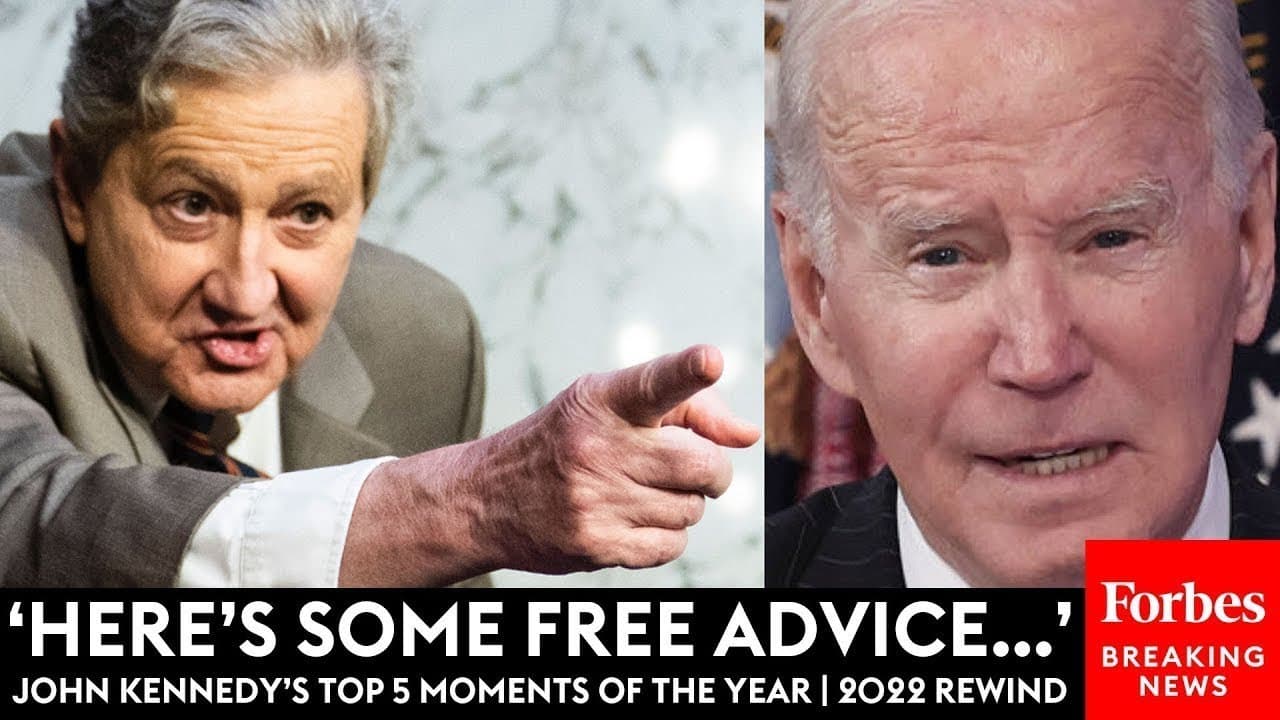
Senator John Kennedy’s most-watched hearing exchanges combine pointed policy questions, demands for direct answers, and memorable humor. He challenges nominees and officials about legal standards, securities law, inflation, energy policy, regulatory neutrality, flood insurance, bank concentration, national security, and government financial support connected to Russia.
Transcript
as many viewers on this channel know Louisiana Senator John Kennedy often is calls for viral moments and highly viewed videos the often humorous Republican who sits on the Senate Judiciary Committee has boasted multiple moments that have exceeded half a million views on this channel here are the top five most viewed John Kennedy moments on Forbes b... Read More
Key Insights
- Kennedy’s questioning style is built around short factual prompts, persistent follow-ups, and demands for direct answers. When witnesses respond generally or promise future research, he restates the question and highlights the specific knowledge he believes their proposed positions require.
- Appellate review standards are presented as foundational knowledge for a federal district court nominee. Kennedy asks separately about factual findings, legal conclusions, and mixed questions, while the nominee identifies possible standards but repeatedly says she would need additional research.
- Securities law becomes a test of professional readiness because Kennedy says the nominated district handles many securities cases. He asks about the SEC rule dealing with fraud and challenges the nominee after she provides only a basic description rather than a detailed explanation.
- Energy policy is framed as both an emissions issue and a national security issue. Kennedy argues that confronting Russia requires targeting its oil and gas position, while also recognizing that reducing carbon emissions remains an important public policy objective.
- Special drawing rights are criticized as financial support distributed unevenly across countries. Kennedy says the stated purpose involved helping poorer countries obtain vaccines, yet he argues that wealthier countries received most of the benefit and that Vladimir Putin received substantial support.
- Inflation is described as more complicated than a direct consequence of the pandemic. The Federal Reserve nominee cites supply-demand imbalances and supply-chain distortions, while Kennedy stresses that strong demand and too much money chasing too few goods must also be considered.
- Regulatory neutrality is presented as a limit on the Federal Reserve’s role. The nominee says the institution should not direct banks toward or away from particular sectors, including oil, gas, gun manufacturing, and gun dealing, but should focus on risk-management processes.
- Bank concentration is treated as a financial-stability concern requiring strong safeguards. The nominee says very large systemic institutions need substantial capital, liquidity, and risk-management protections because resolving them during a period of financial stress would be especially difficult.
Install to Summarize YouTube Videos and Get Transcripts
Explore YouTube Video Summarizer or Get YouTube Transcript Extractor
Questions & Answers
Q: How does John Kennedy question nominees during Senate hearings?
John Kennedy uses concise questions that seek specific legal, economic, or regulatory answers. When a nominee responds with general principles, professional background, or a promise to research the issue later, he repeats the core question and identifies why he considers it relevant to the proposed job. Humor and sharp comparisons make the exchanges memorable, but the questioning remains focused on readiness and accountability.
Q: What appellate review standards did Kennedy ask the judicial nominee about?
Kennedy asked how an appellate court reviews factual findings, alleged legal mistakes, and mixed questions of fact and law. He corrected the nominee’s initial response about factual questions and pressed her to distinguish among clear error, de novo review, and abuse of discretion. The nominee recognized those categories but repeatedly said she would need to research how they applied to the questions presented.
Q: Why did Kennedy ask a judicial nominee about the SEC fraud rule?
Kennedy connected the securities question to the nominee’s proposed service in the Southern District of New York, which he said handles many securities cases. He asked her to explain the SEC rule concerning fraud and described it as basic knowledge in that setting. She identified its general subject but said she had not litigated a securities matter and would consult precedent when confronting one.
Q: How did Kennedy connect energy policy with national security?
Kennedy argued that emissions reduction cannot be considered separately from geopolitical competition and national security. He said Russia and China take advantage of Western efforts that reduce support for oil and gas. In his view, isolating Vladimir Putin from the international community and marketplace requires action against Russian energy, while policy makers must also consider tensions involving Taiwan, surrounding seas, and Africa.
Q: What was Kennedy’s criticism of special drawing rights?
Kennedy said special drawing rights were presented as a way to help poorer countries purchase vaccines, but he argued that the distribution largely benefited wealthy countries while smaller countries received very little. He specifically criticized the support that reached Vladimir Putin and complained that neither the responsible officials nor the International Monetary Fund adequately explained or publicized the transfer.
Q: What causes of inflation were discussed in Kennedy’s questioning?
The Federal Reserve nominee attributed high inflation largely to pandemic-related supply-demand imbalances, continuing disruptions, supply-chain problems, and unexpectedly slow resolution of the public-health crisis. Kennedy accepted that supply chains mattered but rejected the idea that the pandemic alone explained inflation. He emphasized the demand side, particularly the effect of too much money competing for too few available goods.
Q: Should regulators discourage bank lending to selected industries?
The Federal Reserve nominee said it is not the institution’s job to tell private banks which economic sectors they may support. She said regulators should require sound risk management and strong internal processes rather than discourage lending solely because a borrower operates in oil, gas, gun manufacturing, or gun dealing. Kennedy agreed and pressed her to issue a clear statement reinforcing that position.
Q: Why are very large banks a financial-stability concern?
Kennedy asked whether economic power had become too concentrated among several dominant banks. The Federal Reserve nominee responded that very large systemic institutions create serious financial-stability concerns because they would be difficult to resolve during market stress. She said such institutions therefore require very large capital buffers, liquidity buffers, and effective risk-management systems to reduce the danger associated with their scale and interconnected importance.
Summary & Key Takeaways
-
Kennedy tests a federal judicial nominee on appellate review standards and securities law. After she repeatedly says unfamiliar questions would require research, he emphasizes that the Southern District of New York handles many securities cases and characterizes the relevant fraud rule as basic knowledge for the proposed position.
-
Kennedy argues that climate policy, energy production, and national security must be considered together. He says Russia and China exploit Western efforts to reduce carbon emissions, urges stronger action against Russian oil and gas, and criticizes the transfer of special drawing rights that benefited Vladimir Putin.
-
Kennedy questions a Federal Reserve nominee about inaccurate inflation forecasts, pandemic-related supply problems, and excessive demand. He also presses for regulatory neutrality toward oil, gas, and gun businesses, warns about flood insurance affordability, and asks whether economic power is excessively concentrated among the largest banks.
Read in Other Languages (beta)
Share This Summary 📚
Summarize YouTube Videos and Get Video Transcripts with 1-Click
Try YouTube Summary with ChatGPT & Claude or YouTube Transcript Generator
Explore More Summaries from Forbes Breaking News 📚
Summarize YouTube Videos and Get Video Transcripts with 1-Click
Try YouTube Summary with ChatGPT & Claude or YouTube Transcript Generator